The Best One Piece Cards to Invest In (2026): The Manga-Rare Class, Ranked in PSA 10
On this page
- 01The One Piece framework
- 02The One Piece ladder
- 03Gear 5 Luffy manga
- 04Zoro OP06 manga
- 05Ace OP02 manga
- 06Nami PRB01 manga
- 07Shanks OP09 manga
- 08Luffy OP11 manga
- 09Luffy OP01 Leader
- 10Zoro Dallas promo
- 11Nami OP01 alt
- 12The trophy tier
- 13The treatment hierarchy
- 14Match cards to your risk
- 15How to buy safely
- 16Investing on Graded
Four years after its English launch, the One Piece TCG has produced a real investment market: a grail that prints $16,600-$17,400, a manga-rare class that functions like Pokémon's Gold Stars, tournament trophy cards at $7,877, and liquid chase tiers on hundreds of graded comps. This is the pillar guide to all of it: the ten best cards in the game, ranked on real PSA 10 sold comps from CardboardSniper's pricing engine (eBay and Fanatics), with deep-dive guides on Luffy, Zoro, Nami, Shanks, and Ace behind every entry.
Nothing here is financial advice. Cards are a real but volatile asset class, and a four-year-old game is the volatile end of it. Here's what the data shows.
- The Gear 5 Luffy Manga Rare is the grail of the game: $14,500-$17,400 in PSA 10, never a lower cluster in two years.
- Manga rares are the asset class: the top five cards in this guide are all manga treatments, spanning $2,150 to $16,600, and every one repriced upward in 2026.
- Every card is quoted in PSA 10, where the treatment premium is the entire market: OP06-118 is $400 as a SEC and $5,200 as a manga.
- Zoro's manga is the liquid grail: 58 gem comps make it the premium position with a real exit market.
- The Ace OP02 manga is the vintage sleeper:$3,400-$4,000 from the game's second set, on 30 comps.
- Young-market risk is real: the game has never traded through a downturn. Size positions accordingly.
Every English set now has its own price guide — every chase variant tracked in PSA 10, English printings only: OP01 Romance Dawn · OP02 Paramount War · OP03 Pillars of Strength · OP04 Kingdoms of Intrigue · OP05 Awakening of the New Era · OP06 Wings of the Captain · OP07 500 Years in the Future · OP08 Two Legends · OP09 Emperors in the New World · OP10 Royal Blood · OP11 A Fist of Divine Speed · OP12 Legacy of the Master · OP13 Carrying On His Will · OP14 The Azure Sea's Seven · EB01 Memorial Collection · EB02 Anime 25th · EB03 Heroines Edition · The Best (reprints). Guides for OP15 and beyond land as their graded markets form.
The Framework: What Makes a One Piece Card an Investment
Every card below passes the same five-part filter as our Pokémon and sports guides, adapted for a young game: demand (the best-selling manga in history), scarcity (treatments and events, not print runs), gem-rate moats, liquidity, and era. One Piece's twist is that treatment is everything: the same card number spans 13-21× between its SEC and manga versions, so the variant hierarchy is the market.
- Manga rares = the Gold Star class:one comic-panel secret per set since OP05, brutal pulls, instant recognition, and 2026's strongest tape in the game.
- First-set scarcity compounds:OP01's underprinted English wave is the vintage tier, and its alt arts grind higher every quarter.
- Events out-scarce packs: championship stamps, winner promos, and one-day exclusives carry the thinnest floats.
- Character demand ranks the class: Luffy, then Zoro, then the art-premium characters (Nami), then the Emperors and brothers (Shanks, Ace).
The One Piece Ladder
The ten best cards in the game, on real PSA 10 sold comps:
Bars use a logarithmic scale so every rung is visible. Every value is a real 2025-2026 PSA 10 sold comp, not an asking price.
1. Gear 5 Luffy Manga Rare (OP05-119): The Grail
The engine has every PSA 10 sale:
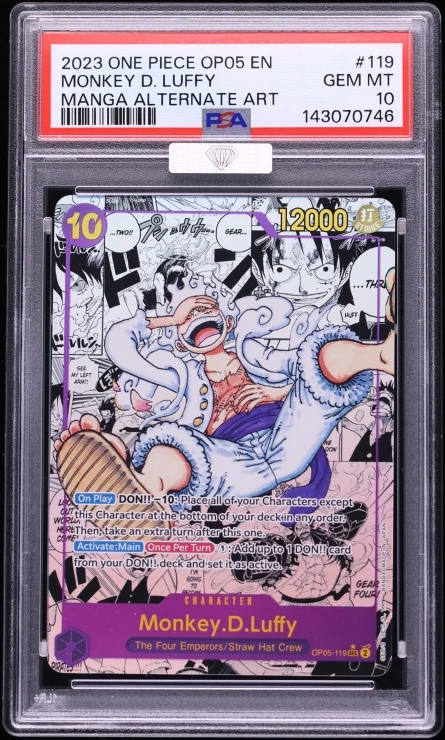
Real sold comps from CardboardSniper's pricing engine · 13 sales(eBay & Fanatics).
$14,500-$17,400and climbing for two years straight: the franchise's defining moment in the game's scarcest slot. Full analysis in the Luffy guide.
2. Zoro OP06 Manga Rare: The Liquid Grail
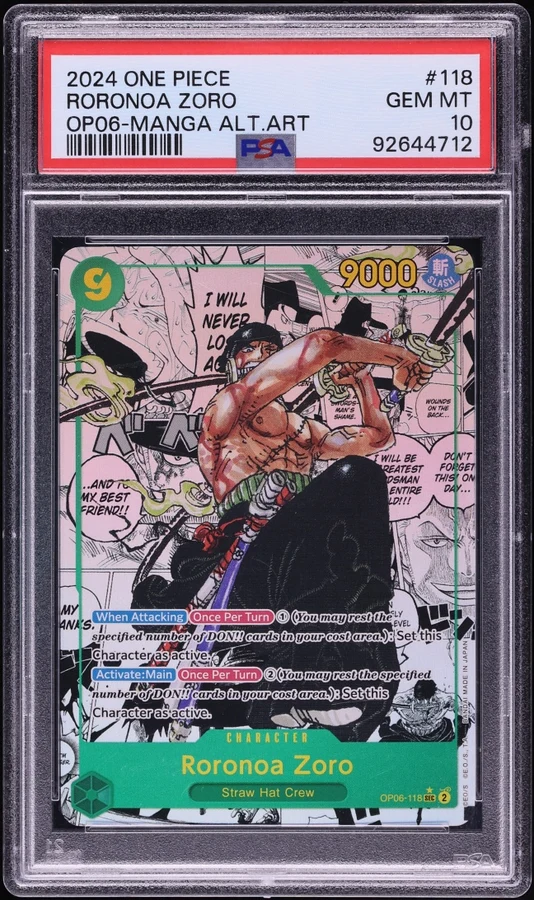
Real sold comps from CardboardSniper's pricing engine · 40 sales(eBay & Fanatics).
$4,500-$5,980 on 58 comps: a third of Luffy's price on four times the volume, which makes it the premium One Piece position you can actually trade. Full analysis in the Zoro guide.
3. Ace OP02 Manga Alt Art: The Vintage Manga
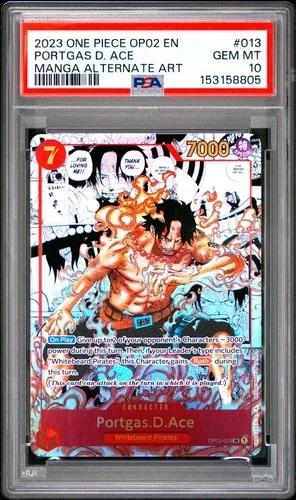
Real sold comps from CardboardSniper's pricing engine · 30 sales(eBay & Fanatics).
$3,400-$4,000 on 30 comps, from Paramount War, the game's second set and the arc where Ace's story makes grown collectors cry. The oldest manga-treatment card in the game and the Ace guide's headline.
4. Nami PRB01 Manga (English): The Art Grail
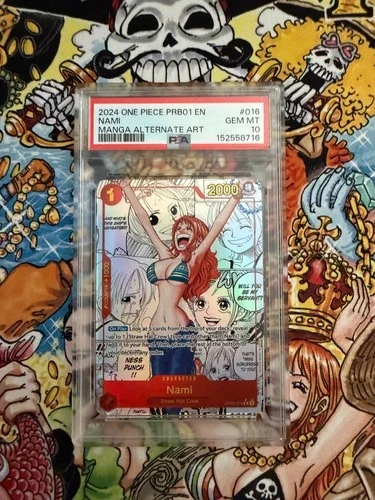
Real sold comps from CardboardSniper's pricing engine · 19 sales(eBay & Fanatics).
$3,601-$3,890, with the Japanese version at $1,375-$1,550: the game's widest language spread, on its purest art-demand card. Full analysis in the Nami guide.
5. Shanks OP09 Manga Rare: The Emperor's Card
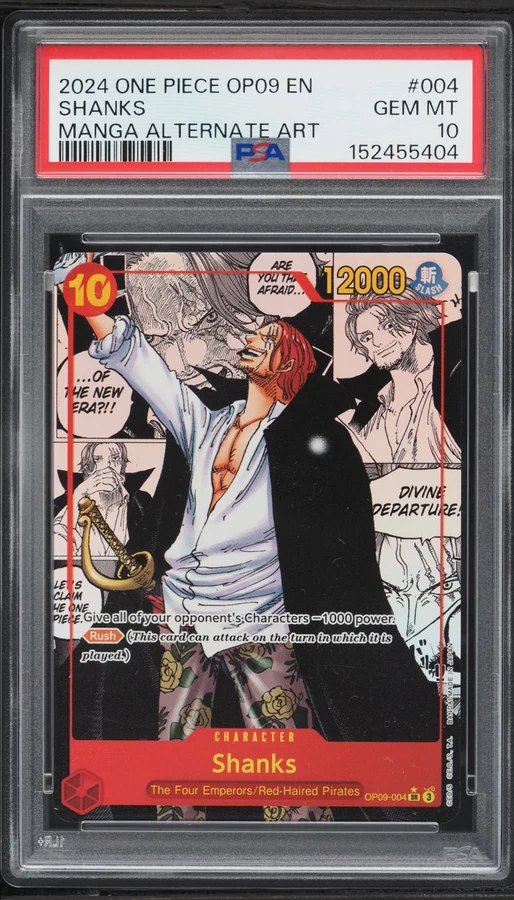
Real sold comps from CardboardSniper's pricing engine · 11 sales(eBay & Fanatics).
$2,640-$3,000for the Red-Haired Emperor's manga treatment, in the set named for him. The Shanks guide maps the full ladder.
6. Luffy OP11 Manga Rare: The Second Manga
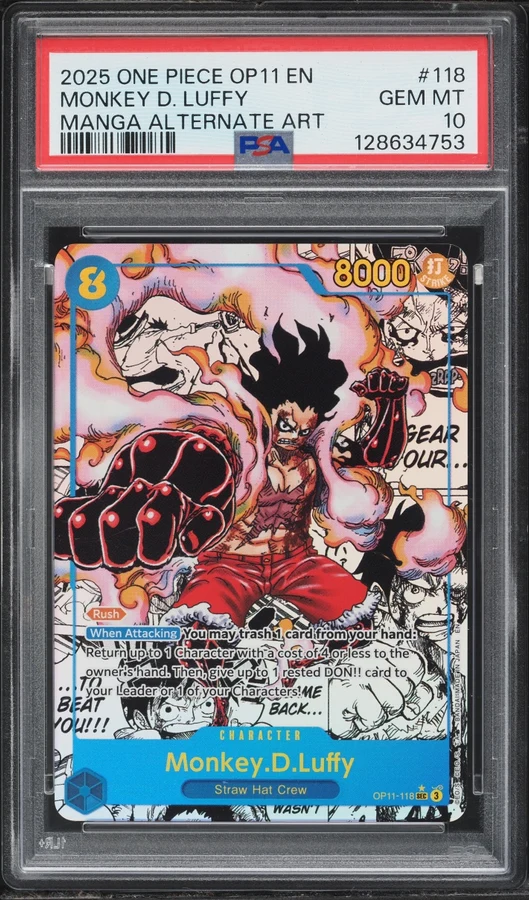
Real sold comps from CardboardSniper's pricing engine · 40 sales(eBay & Fanatics).
~$2,520 on 42 comps: the grail's younger sibling, trading where the Gear 5 manga sat eighteen months after its own release.
7. Luffy OP01 Alt-Art Leader (Errata): The First-Set Icon
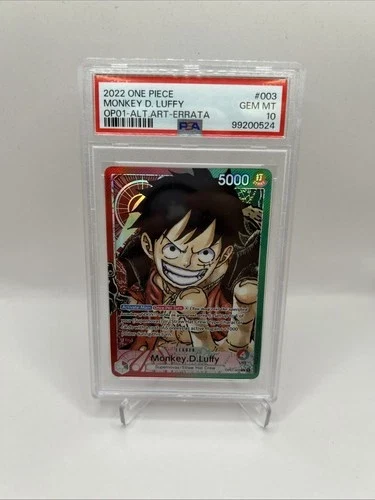
Real sold comps from CardboardSniper's pricing engine · 25 sales(eBay & Fanatics).
$1,575-$1,800: the closest thing the game has to a 1st Edition, from the underprinted Romance Dawn wave.
8. Zoro Dallas Promo (OP07-113): The Event Exclusive
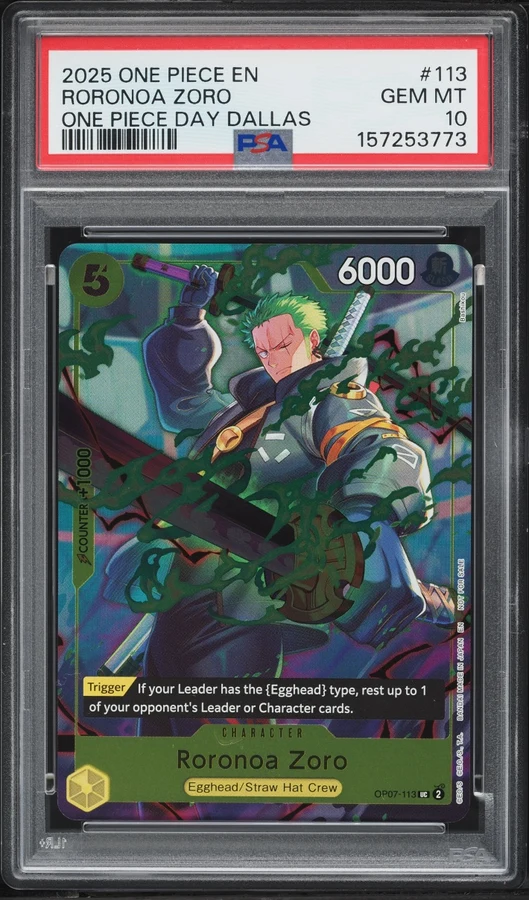
Real sold comps from CardboardSniper's pricing engine · 40 sales(eBay & Fanatics).
$1,490-$1,600 on 40 comps, distributed at one event, once. The cleanest example of event scarcity in the game.
9. Nami OP01 Alt Art: The Founding Art Card
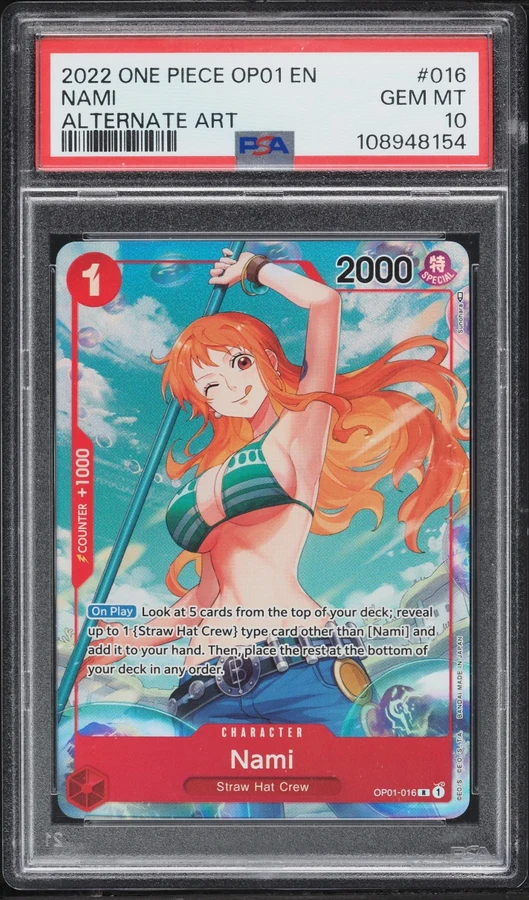
Real sold comps from CardboardSniper's pricing engine · 18 sales(eBay & Fanatics).
~$1,000 on 18 comps: the first Nami collectors chased, carrying both the first-set thesis and the art premium.
10. Championship Finalist Zoro-Juurou: The Trophy Tier
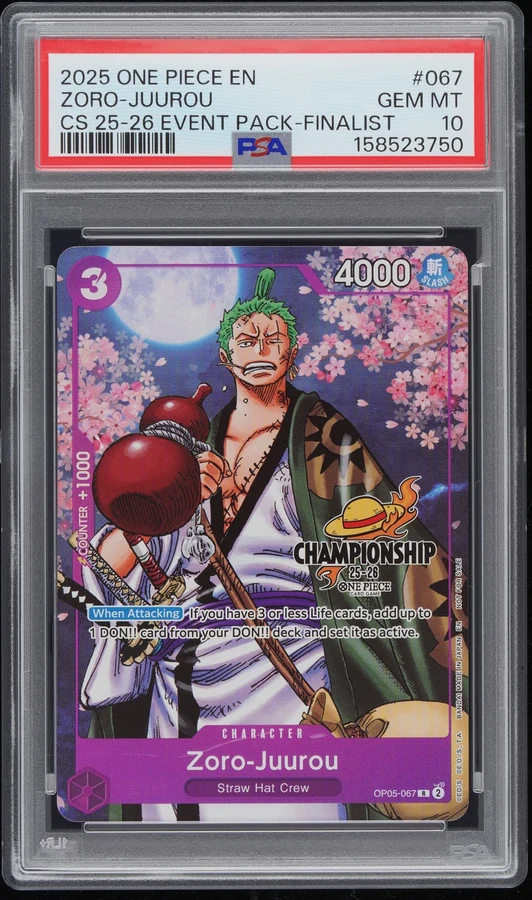
Real sold comps from CardboardSniper's pricing engine · 7 sales(eBay & Fanatics).
$6,700-$7,877on a float measured in dozens: One Piece's first true trophy-card class, and the market to watch as the game's tournament economy matures. (Ranked tenth for float, not price: trophy markets trade by auction, not by week.)
The Treatment Hierarchy, and How to Read It
- Manga > SP > SEC > alt > base: the same card number spans an order of magnitude; the treatment word in the title is the price.
- Stamps are treatments too: FINALIST (12×), pre-release Winner, and PC-style event stamps create separate markets on identical cards.
- Language is a printing: English commands 2-2.5× over Japanese on the premium tier; both markets are real and both are labeled in our comps.
- Number collisions are everywhere:three promos share OP07-113; product and event names are the card's true identity.
The playbook: anchor in the liquid manga tier (Zoro, Ace OP13), hold the grail thesis through the Gear 5 SEC if the manga is out of reach, treat first-set alts as the long-duration position, and size event exclusives knowing their floats cut both ways.
How High Can One Piece Cards Go?
The comparison the market keeps making: One Piece outsells every manga in history, and its card game's grails trade at 3-10% of Pokémon equivalents with demand curves that look like early-2000s Pokémon. The asset class both live in is still tiny:
Total market value: collectibles as an asset class, next to gold, mega-cap tech, and crypto.
The right column is how many times bigger each one is than the entire collectibles market. Collectibles are already a real asset class, larger than a top-ten crypto like Dogecoin, yet still a fraction of a single mega-cap stock and barely a rounding error next to gold. That gap is the runway: as collectibles mature into a transparently priced, investable asset class, the best cards have room to re-rate that the giants no longer do.Figures approximate, 2026: gold = all above-ground gold; equities = market cap; crypto = network value; collectibles = estimated global market size. Bars use a log scale for visibility.
And the returns case is on the board:
Matching One Piece Cards to Your Risk Tolerance
The honest caveat, stated in every guide in this cluster: the game is four years old and has never survived a downturn. The demand structure rhymes with early Pokémon, but rhyme is not a track record. Anchor in liquidity, buy treatments not hype, and size for 50% drawdowns.
Why Every Card Here Is a PSA 10
One Piece collectors graded from day one, so the gem premiums are already structural: the Zoro manga is $1,860 in PSA 9 and $5,200 in PSA 10. Our PSA 10 price guide covers the grade math in depth.
How to Buy One Piece Cards Safely
- Price off sold comps, never listings, via CardboardSniper's value calculator.
- Read the treatment, the event, and the language before the card number; all three change the price by multiples.
- Assume fakes on the manga tier. Cert-verified slabs are the floor.
- Trophy cards trade by auction: never market-buy a Finalist stamp.
- Get pinged when one lists below market. The CardboardSniper scanner watches eBay and Fanatics for this exact card and grade around the clock.
Investing in One Piece Cards on Graded
Everything this guide measures, CardboardSniper does live: real fair-market values with the value calculator, and the live deal feed where below-market listings surface.
FAQs
What is the best One Piece card to invest in?
The Gear 5 Luffy Manga Rare (OP05-119) is the grail: $14,500-$17,400 in PSA 10 with a two-year tape that has never printed a lower cluster. For a position with a real exit market, the Zoro OP06 manga ($4,500-$5,980 on 58 comps) is the game's liquid grail.
Are One Piece cards a good investment?
The structure is compelling: the best-selling manga ever, a Gold-Star-like manga-rare class, dense graded markets, and 2026 tapes that repriced upward across every character we track. The risk is equally real: the game is four years old and unproven in a downturn. Buy scarce treatments at proven grades and size for volatility.
What are manga rares?
Comic-panel-styled secret rares, one per set since OP05, pulled at the game's lowest rates. They are the top of the treatment hierarchy and the class that drove 2026's repricing: the five most valuable cards in this guide are all manga treatments.
What is the most expensive One Piece card?
On real PSA 10 comps: the Gear 5 Luffy Manga Rare at $17,400 (June 2026), then the Championship Finalist Zoro at $7,877, the Zoro OP06 manga at $5,980, and the Ace OP02 manga at $4,000.
Should I buy English or Japanese One Piece cards?
Both markets are real, and the spread is structural: English commands 2-2.5× on premium cards (the Nami manga is $3,890 English versus $1,550 Japanese). English carries the graded-market depth; Japanese offers the same artwork at a discount with thinner exits. Whichever side you buy, price it against comps for that language, never the other.