
The Best Lugia Cards to Invest In (2026): The Crystal Trophy, the Neo Grail & the Ghost Tier, in PSA 10
On this page
- 01The Lugia framework
- 02The Lugia card ladder
- 03Crystal Lugia (Aquapolis)
- 04Neo Genesis 1st Edition
- 05Unseen Forces Lugia ex
- 06The ghost tier
- 07Silver Tempest Alt Art
- 08Lugia VSTAR Gold
- 09Lugia V Full Art
- 10The crystal, the stamp & the premium
- 11How high can they go?
- 12Match cards to your risk
- 13How to buy safely
- 14Investing on Graded
Lugia is the hobby's hardest legendary. Not the most famous, not the most printed: the hardest. Its vintage cards gem so rarely that entire printings have no PSA 10 market at all, and the ones that do trade like trophies. In 2026 the market said it plainly: the Aquapolis Crystal Lugia printed $72,000 and $78,000 in back-to-back April sales, the Unseen Forces Lugia ex ran 5× to $50,400, and the 1st Edition Neo Genesis grail holds $45,000 with four gem sales in four years.
This guide ranks the best Lugia cards to invest in, built the same way as the rest of this series (the Pokémon pillar, Charizard, Umbreon, Mew): on real numbers. Every price below is a real PSA 10 sold comp from CardboardSniper's pricing engine (eBay and Fanatics), not an asking price. We cover every era's definitive Lugia, the ghost tier whose gems never trade at all, and how to buy each one safely.
Nothing here is financial advice. Cards are a real but volatile asset class, and you should never put in money you can't afford to lose. Here's what the data shows.
- The Crystal Lugia is the trophy, and it just repriced violently: real PSA 10 comps ran from $16,200 in March 2025 to $72,000 and $78,000 in April 2026, the same Crystal-class sequence that took the Crystal Charizard to six figures.
- Every card in this guide is quoted in PSA 10,and for Lugia that's the entire story: the same Crystal Lugia is $12,600 in PSA 9 and $72,000 in PSA 10, a 6× premium.
- The 1st Edition Neo Genesis Lugia is the vintage grail: $45,000 on its last gem print, with four PSA 10 sales in four years and a deep PSA 9 market near $12,500.
- The ex-era repriced here too: the Unseen Forces Lugia ex went from $10,000 in January 2025 to $50,400 in May 2026, a 5× move matching the Gold Star class it shares an era with.
- Lugia has a ghost tier. The Unlimited Neo Genesis, the POP Series 5 promo, and the two-piece HGSS Lugia LEGEND have essentially no PSA 10 markets: gems so rare they trade by private negotiation or not at all. We cover them because nobody else can price them honestly.
- The modern icon is the deepest Lugia market ever: the Silver Tempest alt art trades around $1,599 in PSA 10 on 331 real comps, the largest comp pool in this entire series.
The Framework: What Makes a Lugia Card an Investment
Every card below passes the same five-part filter we use across this series. Lugia's twist: condition scarcity is the market. The same silver-white artwork that makes Lugia iconic makes its cards nearly impossible to gem, and the price ladder is really a gem-rarity ladder.
- Legendary demand renews itself. Lugia fronts a mainline game generation, a movie era, and the second-most-famous box art in the franchise (its tower twin has its own guide). Every revival cycle points new demand at supply that froze decades ago.
- White borders, silver holofoil, dark backgrounds: the exact combination that shows every flaw. Neo Genesis and e-Series Lugias gem at rates that make Base Set Charizards look common.
- The print run is the asset,and Lugia's scarcest distributions (the Crystal secret, the POP promo, the two-piece LEGEND) were also its least-graded. Thin float squared.
- The eras reprice as classes. The Crystal class, the ex-era chases, and the WOTC grails all moved in 2026, and Lugia sits in all three classes at once.
- Liquidity is barbell-shaped. The Silver Tempest alt trades daily on hundreds of comps; the vintage tier trades a few times a year; the ghost tier essentially never. Position size accordingly.
The Lugia Card Ladder
"Best Lugia cards" runs from a $150 gold rare to a $72,000 Crystal trophy, all in gem mint. Here's where every era's definitive Lugia actually sits, on real PSA 10 sold comps:
Bars use a logarithmic scale so every rung is visible. Every value is a real 2025-2026 PSA 10 sold comp, not an asking price.
Five rungs, and a warning: this ladder has missing steps on purpose. Three major Lugia cards (the Unlimited Neo Genesis, POP Series 5, and the Lugia LEGEND) have no honest PSA 10 quote at all, because their gems essentially don't trade. They get their own section below.
2003 Aquapolis Crystal Lugia: The Trophy
The Crystal Lugia #149is the Aquapolis secret rare from the e-Reader era's crystalline trinity, and the most valuable Lugia that actually trades. The engine has every recent PSA 10 sale:
The tape is the Crystal-class signature: $16,200 in March 2025, $24,600 in July, $36,000 in October, then $72,000 and $78,000 in back-to-back April 2026 sales:
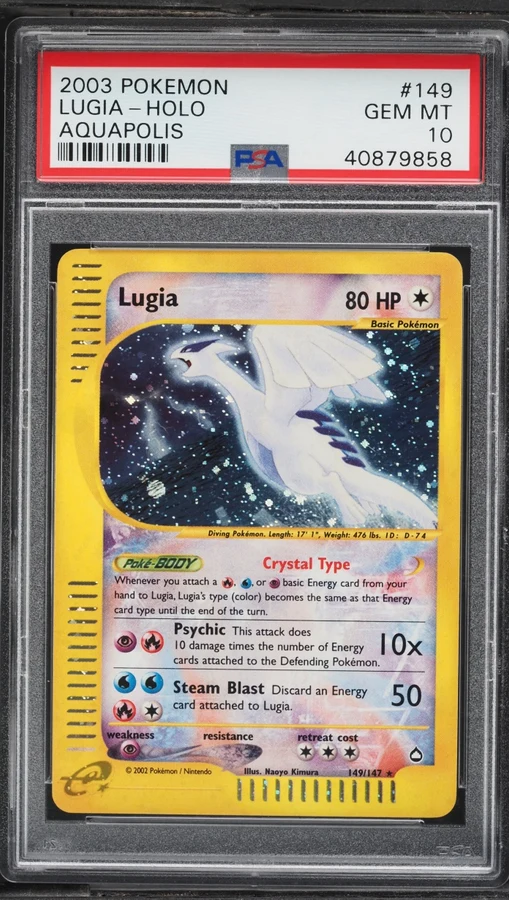
Real sold comps from CardboardSniper's pricing engine · 5 sales(eBay & Fanatics).
It's the exact sequence the Crystal Charizardran six months earlier on its way to $117,000, driven by the same math: Aquapolis was printed into the hobby's 2003 collapse, almost nobody graded it, and the crystal foil gems terribly. The PSA 9 around $12,600 is the sane way to hold the thesis; the gem is a trophy market now.
2000 Neo Genesis 1st Edition Lugia: The Vintage Grail
The 1st Edition Neo Genesis Lugia #9is the legendary bird's first card and one of the hardest gems in the entire hobby: Neo Genesis print quality was notoriously rough, and Lugia's silver body punishes every speck. Real PSA 10 sales:
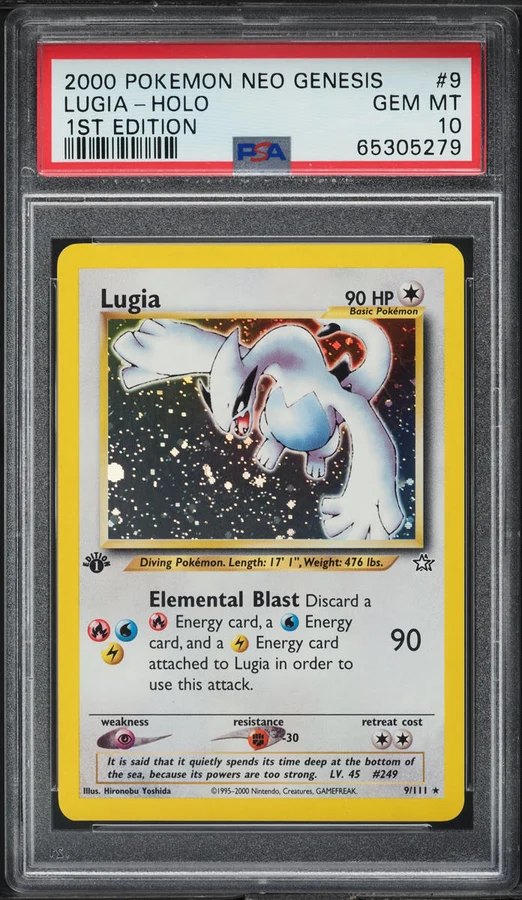
Real sold comps from CardboardSniper's pricing engine · 4 sales(eBay & Fanatics).
Four gem sales in four years ($28,800 to $47,501, most recently $44,999) tell you how thin the top of this market is; the PSA 9 near $12,500 is where the real trading happens. It belongs in the same sentence as the Base Set grails: comparable scarcity, a fraction of the liquidity, and a demand base that runs on the strength of the franchise's second generation.
2005 EX Unseen Forces Lugia ex: The ex-Era 5×
The Unseen Forces Lugia ex #105is the ex era's Lugia: a secret rare above the set number, from the same mid-2000s window whose Gold Stars set four records this year. Real PSA 10 sales:
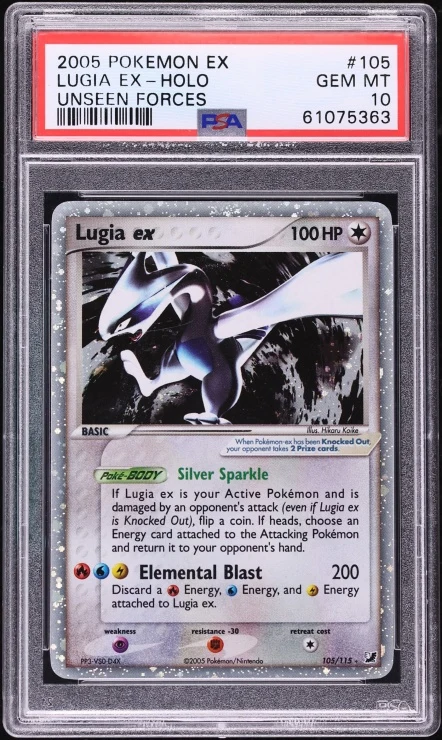
Real sold comps from CardboardSniper's pricing engine · 4 sales(eBay & Fanatics).
A $10,000 card in January 2025 printed $38,400 and $50,400 in spring 2026, a 5× move in sixteen months. The ex-era secret rares are repricing as a class (we documented the same arc on the Legend Maker Mew ex and the Dragon Frontiers Dragonite ex), and this is the class's legendary bird. The PSA 9 around $3,000 is the entry, and the 17× gem premium is the scarcity speaking.
The Ghost Tier: Three Lugias With No Gem Market
Here is something no price guide will tell you, because it can't be scraped from listings: three major Lugia cards have no functioning PSA 10 market at all on recent comps.
- Unlimited Neo Genesis Lugia #9.The engine has PSA 9s trading around $1,999, and zero recent PSA 10 sales. The gem exists in the pop report; it simply never comes to market. If the 1st Edition's $45,000 level holds, the first clean Unlimited gem print will be a price discovery event.
- POP Series 5 Lugia #2. Same 2007 promo packs as the $168,000 Umbreon Gold Star, same distribution scarcity, and its recent comps top out at PSA 8. A gem of this card trading publicly would be the first in years.
- HGSS Lugia LEGEND (two-piece).The 2010 art-deco masterpiece printed as top and bottom halves. One complete PSA 10 pair printed $12,500 back in 2022; the halves trade separately in the hundreds. It's the forgotten-era sleeper of this list, with the Mew Prime's rediscovery arc as the obvious comparable.
For an investor the ghost tier means two things: PSA 9s are the only realistic positions, and any gem that surfaces at auction deserves your full attention, because the comp it prints becomes the market.
2022 Silver Tempest Lugia V Alt Art: The Modern Icon
The Silver Tempest Lugia V alternate art #186, the storm-cresting bird that instantly joined Moonbreon in the modern alt-art pantheon, is the most liquid Lugia ever printed. Real PSA 10 sales:
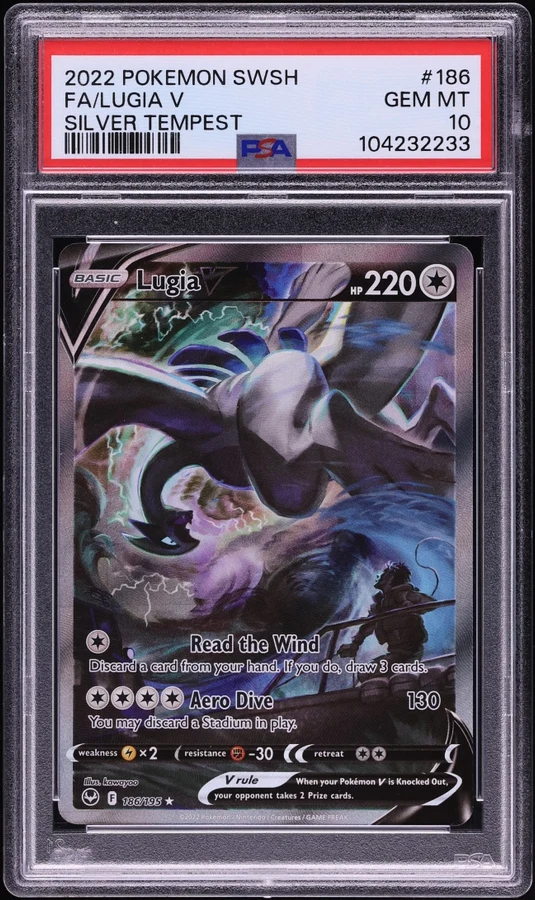
Real sold comps from CardboardSniper's pricing engine · 40 sales(eBay & Fanatics).
The gem trades around $1,599 on 331 real comps, the deepest comp pool of any card in this entire series, with three years of firm, rising tape. Like every modern chase it's a demand bet with a large gem population; unlike most, its demand has the legendary's full renewal cycle behind it. The liquid core of any Lugia portfolio starts here.
2022 Silver Tempest Lugia VSTAR Gold: The Liquid Entry
The gold-rare Lugia VSTAR #211 from the same set is the on-ramp. Real PSA 10 sales:
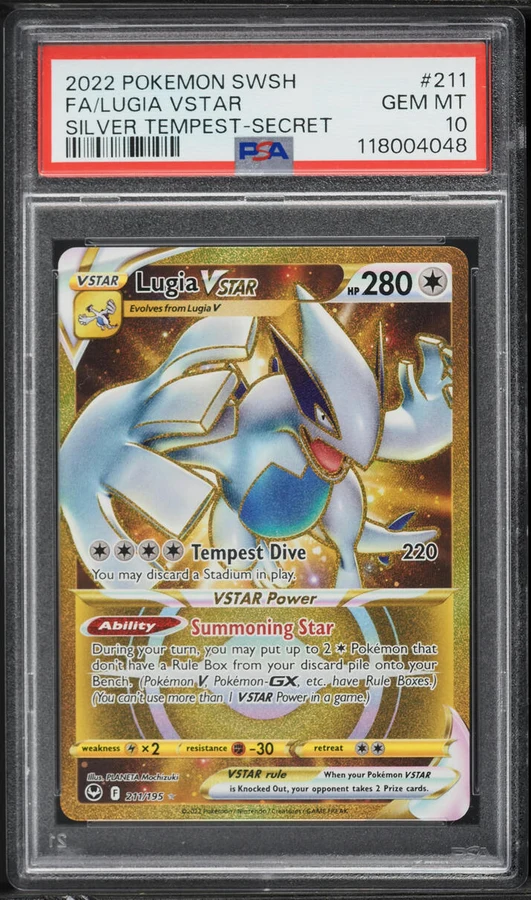
Real sold comps from CardboardSniper's pricing engine · 40 sales(eBay & Fanatics).
Around $150 in gem on steady volume: a liquid, low-stakes index on Lugia sentiment and the right first slab before graduating up the ladder.
2022 Silver Tempest Lugia V Full Art: The Regular-Art Sibling
The Lugia V full art #138is the alt art's set-mate and the budget claim on the same artwork family. Real PSA 10 sales:
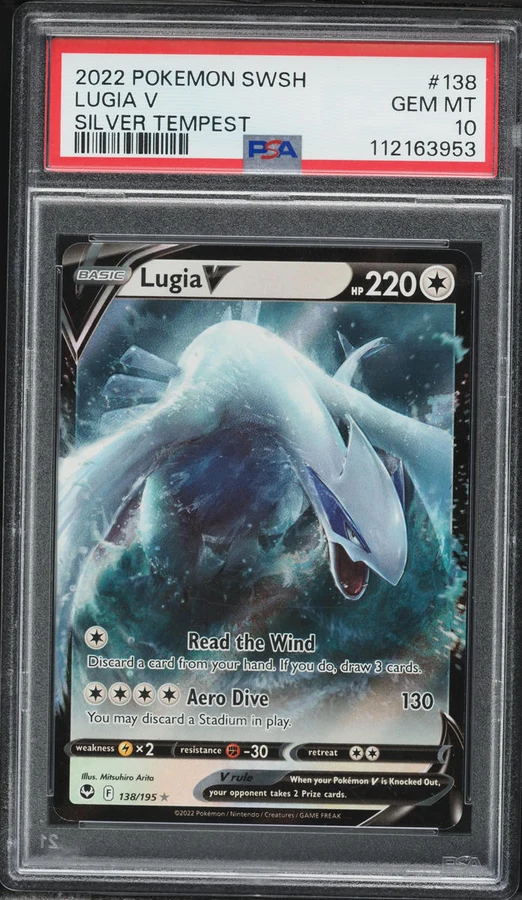
Real sold comps from CardboardSniper's pricing engine · 37 sales(eBay & Fanatics).
Around $260 on 37 real comps: liquid, cheap, and correlated with everything above it.
The Crystal, the Stamp, and the Lugia Premium
Zoom out and Lugia's version of the series discipline is the starkest yet: this is a condition-scarcity market wearing a character market's clothes.
- The gem premium is the widest in the series:Crystal 6×, Unseen Forces 17×, and a ghost tier where the premium is literally unquotable. Lugia's artwork made gems rare in every era it was printed.
- Lugia sits in three repricing classes at once: the WOTC 1st Editions (Neo grail), the Crystal class ($72,000 and counting), and the ex-era secret rares (5× in sixteen months). Each class has higher comps elsewhere; Lugia is the way to own all three theses.
- The ghost tier is unpriced optionality. Cards whose gems never trade have no ceiling comp to anchor them. When one surfaces, it prints the market.
- The modern icon carries the liquidity.With 331 comps, the Silver Tempest alt is the exit door for the whole ladder; its health tells you the tier's health.
The playbook: anchor in the 1st Edition's PSA 9 (the grail exposure with actual liquidity), hold the Crystal thesis through its PSA 9 unless you're buying trophies, size the Unseen Forces ex knowing it just ran 5×, keep the Silver Tempest alt as the liquid core, and watch auction calendars for ghost-tier gems: they're the only free lunch in this market.
How High Can Lugia Cards Go?
Lugia's ceiling argument is the Crystal Charizard: same class, same era, same float profile, and it printed $117,000 while Crystal Lugia sits at $72,000-$78,000. The asset class both live in is still tiny next to the markets it behaves like:
Total market value: collectibles as an asset class, next to gold, mega-cap tech, and crypto.
The right column is how many times bigger each one is than the entire collectibles market. Collectibles are already a real asset class, larger than a top-ten crypto like Dogecoin, yet still a fraction of a single mega-cap stock and barely a rounding error next to gold. That gap is the runway: as collectibles mature into a transparently priced, investable asset class, the best cards have room to re-rate that the giants no longer do.Figures approximate, 2026: gold = all above-ground gold; equities = market cap; crypto = network value; collectibles = estimated global market size. Bars use a log scale for visibility.
And the returns case is on the board. Indexed from 2010, blue-chip cards have out-compounded the S&P 500:
Lugia's specific edge is the combination nobody else on this series has: legendary-tier demand, the hobby's worst gem rates, and a ghost tier that hasn't even priced yet. Condition scarcity doesn't mean-revert; it compounds.
Matching Lugia Cards to Your Risk Tolerance
The tiers sit in very different places on the risk map:
A sane Lugia portfolio anchors in the Neo Genesis grail's PSA 9, holds the Silver Tempest alt as the liquid core, and treats the Crystal and ex-era tiers as thin-market growth positions that just ran 4-5× and can retrace the same way. The most common mistake is quoting ghost-tier cards off stale or imaginary comps; if the last gem print is years old, the market is whatever the next auction says it is.
Why Every Card Here Is a PSA 10
Every card in this guide is quoted in PSA 10 because Lugia is the purest condition-scarcity market in the hobby: the same Crystal Lugia is $12,600 in PSA 9 and $72,000 in PSA 10, and the same Unseen Forces ex is $3,000 versus $50,400. Grading authenticates the card, certifies the condition, and produces the population data this whole analysis runs on. Our Pokémon PSA 10 price guide goes deeper on the grade math.
How to Buy Lugia Cards Safely
- Price off sold comps, never listings. Look up the exact card, printing, and grade on CardboardSniper's value calculator before you bid. Lugia asking prices in thin markets are pure fiction.
- Verify the printing. 1st Edition versus Unlimited Neo Genesis, the Crystal #149 versus the regular Aquapolis Lugia, the ex #105 versus the plain #29, and complete LEGEND pairs versus single halves.
- Respect the ghost tier.If a card has no recent gem comps, nobody knows what it's worth, including the seller. Bid accordingly or buy the PSA 9.
- Assume fakes on the vintage tier. Neo-era holos are widely counterfeited. Graded slabs with verifiable cert numbers are the floor.
- Get pinged when one lists below market. The CardboardSniper scanner watches eBay and Fanatics for this exact card and grade around the clock.
Investing in Lugia Cards on Graded
Everything this guide measures, CardboardSniperdoes live. Look up any Lugia's real fair-market value, population, and gem rate with the value calculator, and let the CardboardSniper scanner watch eBay and Fanatics for below-market listings of every card on this list. No saved-search spam, and the comps math is included with every alert.
FAQs
What is the best Lugia card to invest in?
The Aquapolis Crystal Lugia is the trophy: real PSA 10 comps of $72,000 and $78,000 in April 2026, up from $16,200 a year earlier. The 1st Edition Neo Genesis Lugia (~$45,000 in PSA 10, ~$12,500 in PSA 9) is the vintage grail, the Unseen Forces Lugia ex (~$50,400) is the ex-era play, and the Silver Tempest alt art (~$1,599 on 331 comps) is the liquid modern core.
How much is a 1st Edition Lugia worth?
In PSA 10, real sales run $28,800 to $47,501 with the most recent print at $44,999; gems trade only every year or so. The PSA 9 trades around $12,500 with real depth and is the practical position. The Unlimited printing has no recent PSA 10 comps at all; its PSA 9 trades near $1,999.
Why did the Crystal Lugia price jump to $72,000?
It's the Crystal-class repricing: Aquapolis was printed into the hobby's 2003 collapse, almost nobody graded it, and crystal foil gems terribly, so the PSA 10 float is tiny. When the Crystal Charizard ran to six figures, demand found its classmates: Crystal Lugia went $16,200 (March 2025), $24,600, $36,000, then $72,000-$78,000 in April 2026. Thin markets cut both ways; the PSA 9 near $12,600 is the saner hold.
Is the Silver Tempest Lugia alt art a good investment?
It's the deepest Lugia market ever: around $1,599 in PSA 10 on 331 real sold comps with weekly liquidity and a firm three-year uptrend. As a modern card with a large gem population it's a demand bet, and Lugia's legendary renewal cycle is as strong a demand engine as modern Pokémon has. The gold VSTAR (~$150) is the budget seat.
Are Lugia cards a good investment?
Lugia is the hobby's purest condition-scarcity market: the 2026 tape repriced its Crystal trophy 4.5×, its ex-era secret 5×, and its vintage grail holds $45,000 on a handful of gems, while three major printings have no gem market at all. That scarcity is structural. Like all cards they're volatile and thinly traded at the top, so anchor in PSA 9s, buy scarce printings at proven grades, and price everything off real sold comps.