The Best Mew Cards to Invest In (2026): From the $192,000 Gold Star Down, in PSA 10
On this page
- 01The Mew framework
- 02The Mew card ladder
- 03Mew Gold Star
- 04Southern Islands Mew
- 05Triumphant Mew Prime
- 06Black Star Promo #9
- 07Black Star Promo #8
- 08Ancient Mew
- 09Legend Maker Mew ex
- 10Shining Legends Mew
- 11Shiny Mew ex (SIR)
- 12Mew VMAX Alt Art
- 13151 Mew ex (SIR)
- 14Celebrations Gold Mew
- 15The promo, the star & the premium
- 16How high can they go?
- 17Match cards to your risk
- 18How to buy safely
- 19Investing on Graded
Mew is the hobby's original myth: the 151st Pokémon, the one under the truck, the species every card of which is stamped with a little star of secrecy. And this week the myth got a price. On July 5, 2026, a PSA 10 Mew Gold Star sold for $192,000 on real comps, the largest Gold Star sale ever recorded and nearly double what the Charizard and Pikachu stars printed earlier this year.
This guide ranks the best Mew cards to invest in, ever, built the same way as the rest of this series (Charizard, Pikachu, Gengar, Dragonite, and the flagship guide): on real numbers. Every price below is a real PSA 10 sold comp from CardboardSniper's pricing engine (eBay and Fanatics), not an asking price. We cover every era's definitive Mew, from the $174 movie promo every '90s kid owned to the $192,000 grail, and how to buy each one safely.
Nothing here is financial advice. Cards are a real but volatile asset class, and you should never put in money you can't afford to lose. Here's what the data shows.
- The Mew Gold Star is the grail, and it just went six figures. A real PSA 10 print of $192,000 on July 5, 2026, the biggest Gold Star sale on record, with the PSA 9 trading around $9,650 on deep volume.
- Every card in this guide is quoted in PSA 10, because in Mew collecting the gem is the asset: the Gold Star is a $192,000 card in PSA 10 and a $9,650 card in PSA 9, a 20× premium.
- The sleepers already moved. The Triumphant Mew Prime ran to $9,690-$13,000 on fourteen real 2026 comps, the Black Star Promo #9 tripled to $4,800-$6,900, and a Southern Islands gem printed $24,000.
- Mew's modern market is the deepest in this series. The Paldean Fates Shiny Mew ex trades around $3,950 in PSA 10 on 144 real comps, and the 151 Mew ex SIR around $330 on more than a hundred: institutional-grade liquidity for a trading card.
- Promos are Mew's native format.Like Pikachu, Mew's biggest cards were never in packs: movie handouts (Ancient Mew, Promo #8), League rewards (Promo #9), and box toppers (Southern Islands). Distribution scarcity is the whole game.
- Even the cheap rungs are blue-chip demand. The $174 movie promo and $271 Celebrations gold are the most-owned Mews on earth, and their gems trade weekly. Mew has no dead inventory.
The Framework: What Makes a Mew Card an Investment
Every card below passes the same five-part filter we use across this series. Mew's twist: the character's whole identity is scarcity. The myth of the 151st Pokémon is the demand engine, and the market prices Mew cards the way the games treated Mew itself: the rarer the encounter, the bigger the legend.
- Mythical demand compounds.Mew is the hobby's founding secret, the Mewtwo origin story, and every generation's favorite pink ghost of rumor. That demand renews with every game, movie, and anniversary set.
- Promos over set cards.Mew's trophy cards are giveaways with fixed print windows: movie handouts, League rewards, box toppers. When the window closed, the supply froze forever.
- The star on the card is the star on the label.Gold Stars were the mid-2000s' rarest pulls, and Mew's is the most demanded of the whole series. Its 2026 print re-rated the entire class.
- Gem scarcity is the moat. WOTC-era promos and HGSS foils gem brutally rarely, which is why a Mew Prime PSA 10 is five figures while the PSA 9 is under $1,000.
- Liquidity.Mew's modern chase cards trade daily and its vintage trophies trade monthly; only the one-print markets (Southern Islands, the Gold Star gem) need patience. Match position size to exit depth.
The Mew Card Ladder
"Best Mew cards" spans three orders of magnitude, all of it in gem mint. Here's where every era's definitive Mew actually sits, on real PSA 10 sold comps:
Bars use a logarithmic scale so every rung is visible. Every value is a real 2025-2026 PSA 10 sold comp, not an asking price.
Read it as four tiers. The modern chase (Promo #8, Celebrations gold, 151 SIR, Fusion Strike alt) is the liquid entry. The mid-tier mixes eras: the 2017 shiny, the ex-era secret rare, Ancient Mew, and the shiny SIR. The WOTC League promo and the Mew Prime are the repriced sleepers. And above everything, the one-print Southern Islands trophy and the $192,000 Gold Star.
2006 Dragon Frontiers Mew Gold Star: The Grail
The Mew Gold Star δ #101closes the Dragon Frontiers checklist, one slot after the Charizard star, with Masakazu Fukuda's tiny blue delta-species Mew riding a rainbow wave. Gold Stars were pulled roughly once per two boxes in 2006, Mew's is the series' most demanded alongside Charizard's, and 2026 has repriced the whole class:
The Charizard star printed $100,000 in February, the Pikachu star $107,000-$114,000 in May, and on July 5 the Mew star printed $192,000: the largest Gold Star sale ever recorded. One sale is one sale, but it didn't come from nowhere; the PSA 9 ran from $8,700 to $13,000 across eighteen deep 2026 comps first.
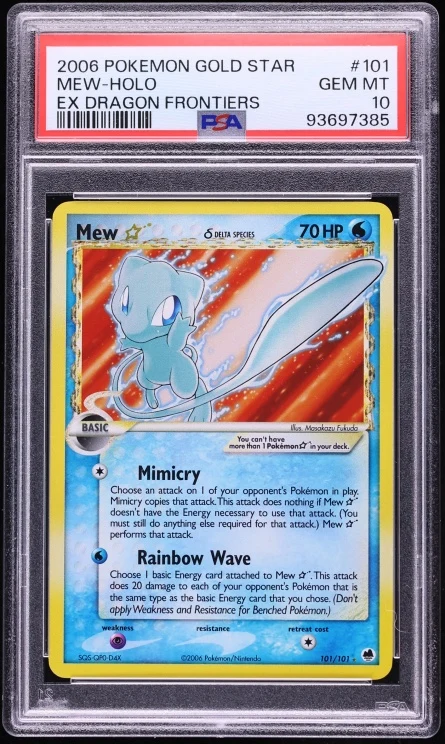
Real sold comps from CardboardSniper's pricing engine · 1 sales(eBay & Fanatics).
The grade math is the steepest in this series: a 20× gap between the $9,650 PSA 9 and the six-figure gem. For almost everyone the PSA 9 isthe position, and it's the most liquid five-figure Mew in the hobby. The gem is a trophy asset that anchors the price of everything below it.
2001 Southern Islands Mew: The One-Print Trophy
The Southern Islands Mew #1 fronts the dreamy 18-card island set WOTC released only as a boxed collection, with Mew leaping over Tropical Island waters under a rainbow. It was never in a pack, and its gem barely ever trades. Real PSA 10 sales:
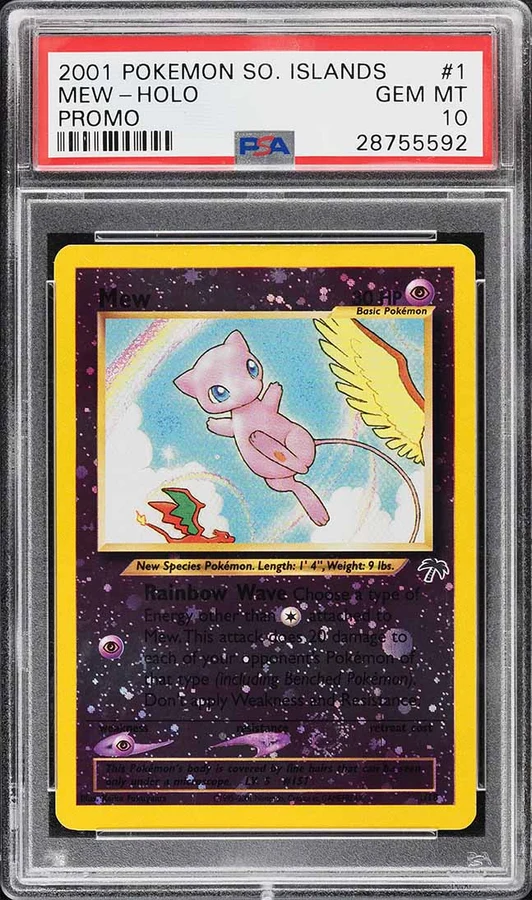
Real sold comps from CardboardSniper's pricing engine · 1 sales(eBay & Fanatics).
The lone recent gem comp is $24,000(June 2025), and that one-print market is the point: Southern Islands cards gem terribly off their 2001 stock, and Mew is the set's face. The PSA 9 around $2,000 trades regularly and is the sane way to own the rainbow. Treat the $24,000 as a float signal, not a quote.
2010 Triumphant Mew Prime: The Five-Figure Sleeper
The Mew Prime #97comes from HGSS Triumphant, the last set before the Black & White era, printed at the absolute bottom of the hobby's 2010 attention cycle. Its etched full-foil surface gems brutally rarely, and in 2026 the market found it. Real PSA 10 sales:
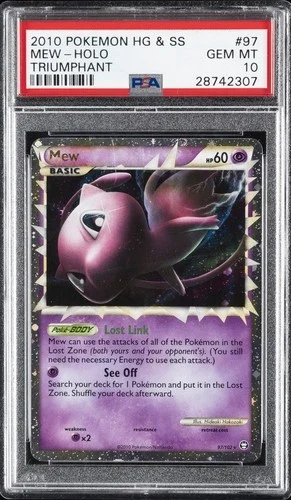
Real sold comps from CardboardSniper's pricing engine · 14 sales(eBay & Fanatics).
Fourteen real gem comps between February and April 2026 running $7,000 to $13,000, up from three figures two years ago. That's the same forgotten-set arithmetic that sent the e-Series Gengars vertical: near-zero graded float meeting a demand wave. The PSA 9 around $995 is the liquid entry, and the 10× gem premium tells you where the scarcity actually lives.
2000 Black Star Promo Mew #9: The League Holo
The Black Star Promo Mew #9 is the WOTC-era Mew that was actually hard to get: a holo League reward, earned across weeks of league play rather than handed out at a theater door. Real PSA 10 sales:
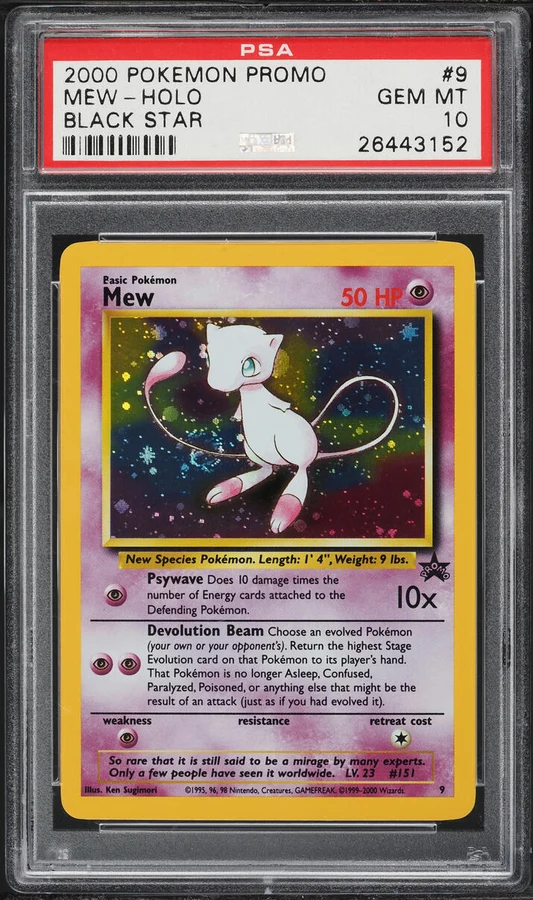
Real sold comps from CardboardSniper's pricing engine · 15 sales(eBay & Fanatics).
The gem ran from $1,590 in May 2025 to $4,800-$6,900by spring 2026, a 3-4× move on steady volume. It's the classic WOTC promo trade: fixed 25-year-old supply, real earn-it scarcity, and a price that spent two decades in the shadow of flashier cards. The PSA 9 around $499 is the entry.
1999 Black Star Promo Mew #8: The Movie Handout
The Black Star Promo Mew #8is the Mew everybody got: handed out at showings of the first movie in 1999, by the millions. It's the cheapest card on this list and the most important one for understanding the market. Real PSA 10 sales:
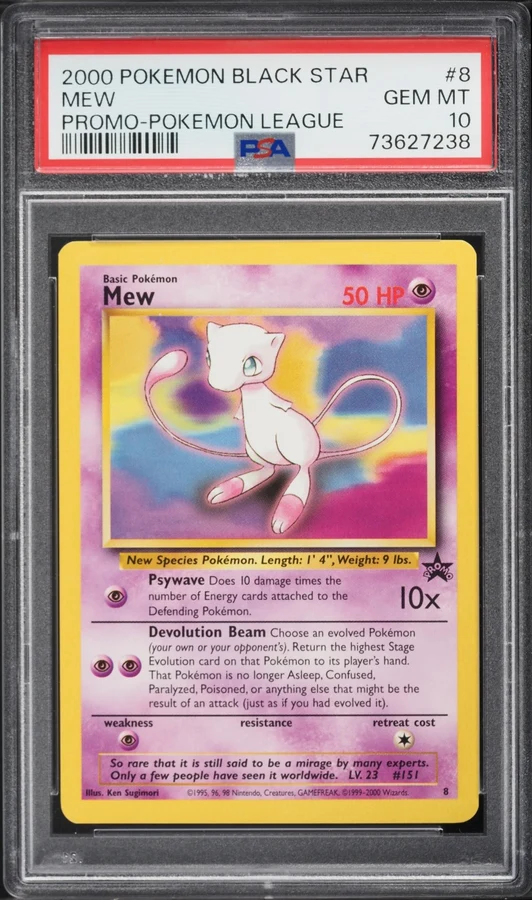
Real sold comps from CardboardSniper's pricing engine · 17 sales(eBay & Fanatics).
The gem trades around $174with recent sales up to $336. Supply is enormous, but so is the audience that owned one, and gems are a small slice of the surviving copies. It's the perfect starter position: pure nostalgia beta on the same demand wave that just printed the $192,000 Gold Star, for the price of dinner.
2000 Ancient Mew: The Hieroglyph
Ancient Mewis the strangest card WOTC ever distributed: a movie-two promo written entirely in runic script, double-holofoil, and unplayable in any format. It's also one of the most-recognized Pokémon cards ever printed. Real PSA 10 sales:
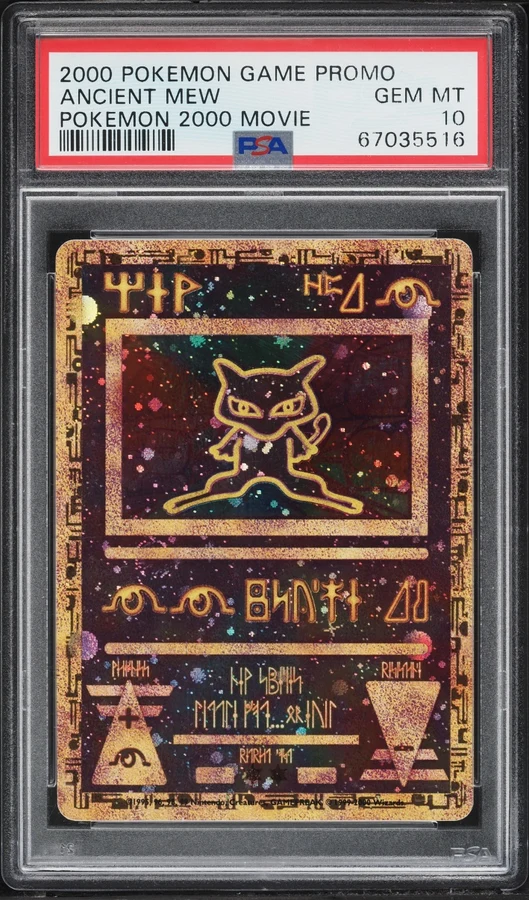
Real sold comps from CardboardSniper's pricing engine · 19 sales(eBay & Fanatics).
The gem trades around $3,419on deep 2026 volume, with 251 PSA 9 comps near $285 beneath it. The full-foil surface scratches if you look at it, so gems are genuinely scarce relative to the millions distributed. It's the rare card that's simultaneously a mass-market icon and a condition rarity, and 2026 repriced it like the latter.
2006 EX Legend Maker Mew ex: The ex-Era Secret
The Legend Maker Mew ex #88is the ex era's Mew: a secret rare above the set number, rainbow-foiled, from the same mid-2000s window that produced the Gold Stars. Real PSA 10 sales:
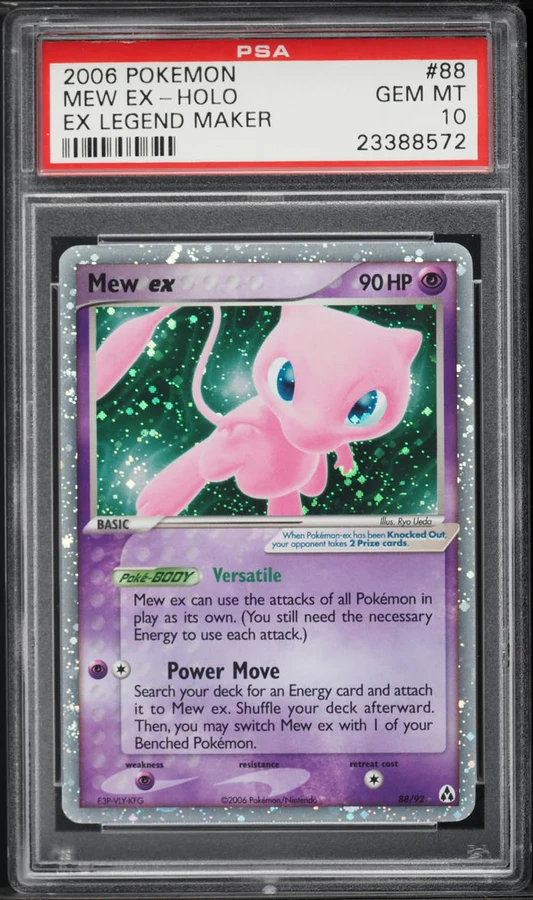
Real sold comps from CardboardSniper's pricing engine · 11 sales(eBay & Fanatics).
The gem ran from four figures to $3,240-$5,700across 2025-2026 on eleven real comps. It's the affordable expression of the exact thesis the Gold Star just proved at $192,000: mid-2000s secret rares with tiny gem floats, still trading at a fraction of their WOTC-era equivalents. The PSA 9 around $250 is almost free by comparison.
2017 Shining Legends Shining Mew: The Modern Shining
Twenty years after Neo Destiny invented the Shining, the Shining Legends Shining Mew #40 brought it back as a pink starfield. It became the defining card of its set and the modern era's first real Mew chase. Real PSA 10 sales:
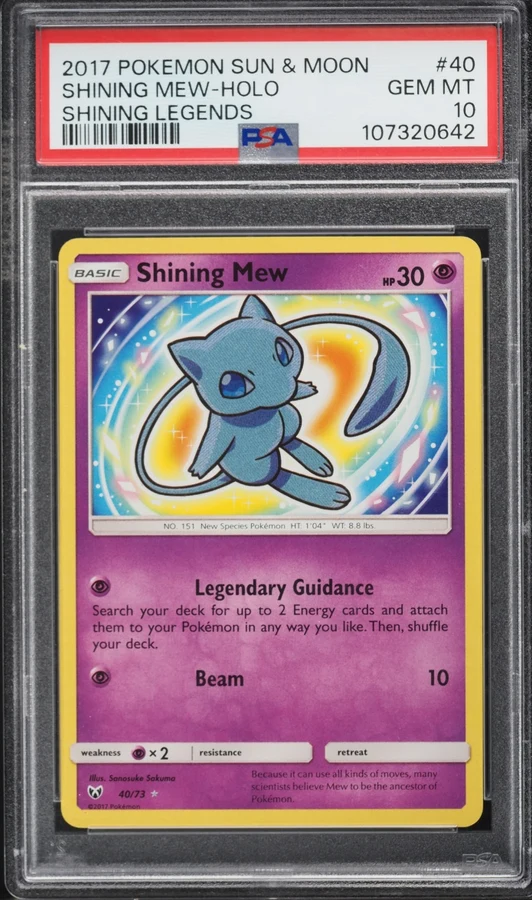
Real sold comps from CardboardSniper's pricing engine · 28 sales(eBay & Fanatics).
The gem trades around $1,250on recent comps, up from the mid-hundreds a year ago, on 28 real sales. Shining Legends was a special set with no booster-box distribution in the usual sense, so sealed supply is thinner than its era suggests. It's the bridge card between Mew's vintage trophies and its modern liquidity.
2024 Paldean Fates Shiny Mew ex: The Shiny SIR
The modern era's big Mew is the Paldean Fates Shiny Mew ex #232: the special illustration rare of the shiny-hunting set, and the single most liquid four-figure Mew in the hobby. Real PSA 10 sales:
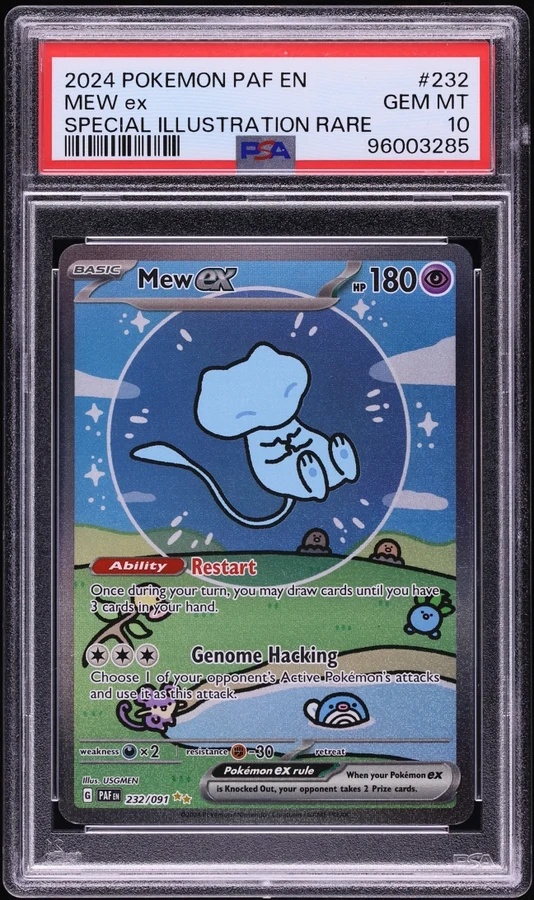
Real sold comps from CardboardSniper's pricing engine · 40 sales(eBay & Fanatics).
The gem trades around $3,950on 144 real comps with weekly depth, climbing steadily since release. Like every modern chase in this series it's a demand bet with a growing gem population rather than a scarcity bet, but the demand side is exceptional: it's already trading level with Ancient Mew and the Legend Maker ex on two years of existence. Size it as the liquid sleeve.
2021 Fusion Strike Mew VMAX Alt Art: The Modern Classic
The Fusion Strike Mew VMAX alternate art #269is modern Mew's signature card: the floating genome child over a glitch-art cityscape, from the same alt-art class as the Evolving Skies Dragonite. Real PSA 10 sales:
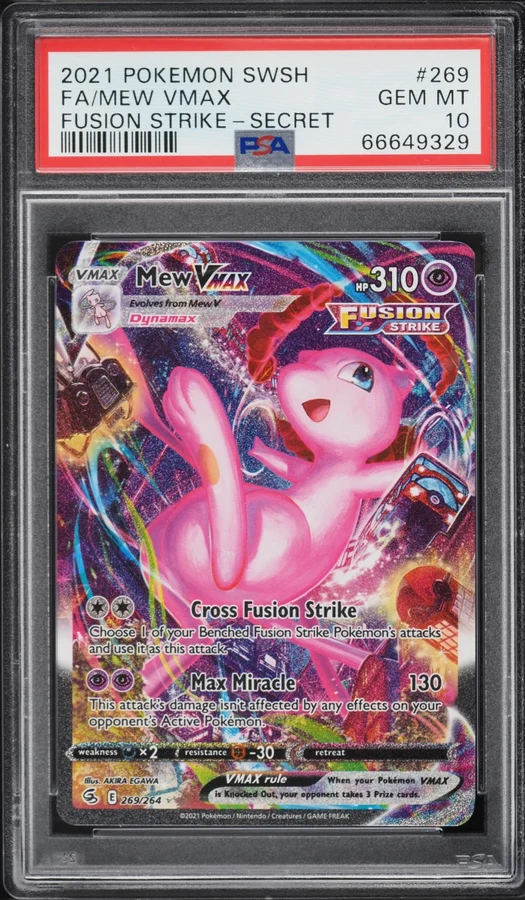
Real sold comps from CardboardSniper's pricing engine · 40 sales(eBay & Fanatics).
The gem trades around $500on 61 real comps with weekly liquidity (the rainbow #268 runs about $340). The alt-art class of 2021-2022 is the modern era's most collected cohort, and this is its Mew. Liquid, iconic, and correlated with everything above it.
2023 Pokémon 151 Mew ex: The Homecoming Card
The 151 Mew ex SIR #205is the chase of the set literally named for Mew's myth: the 151-card homage to the original Pokédex, with Mew as its secret finale. Real PSA 10 sales:
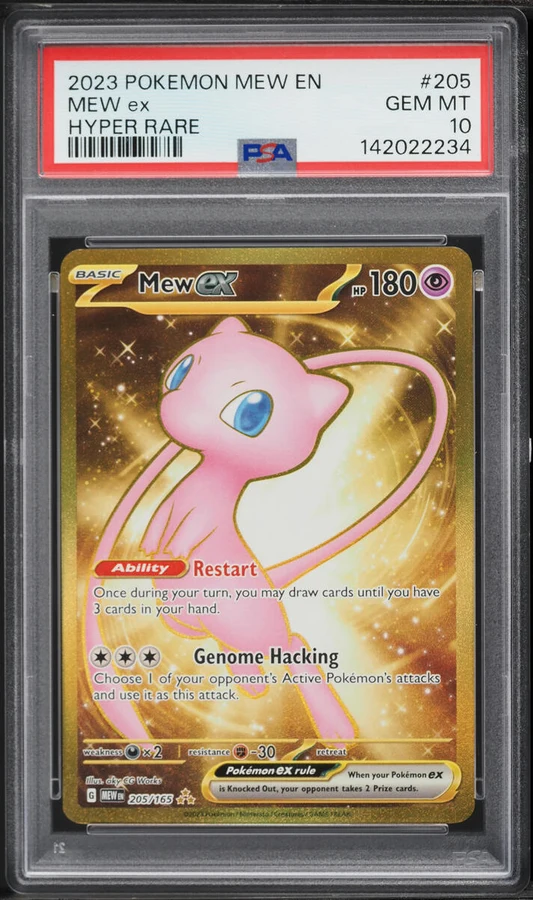
Real sold comps from CardboardSniper's pricing engine · 40 sales(eBay & Fanatics).
The gem trades around $330on more than a hundred real comps. The 151 set mints new collectors faster than any product of its generation, and this card is its endgame. A large and growing gem population caps the scarcity case, but as a liquid, low-stakes claim on Mew demand it's the obvious first slab.
2021 Celebrations Gold Mew: The Anniversary Piece
For the franchise's 25th anniversary, the Celebrations set crowned exactly one Pokémon in gold: Mew #025. Real PSA 10 sales:
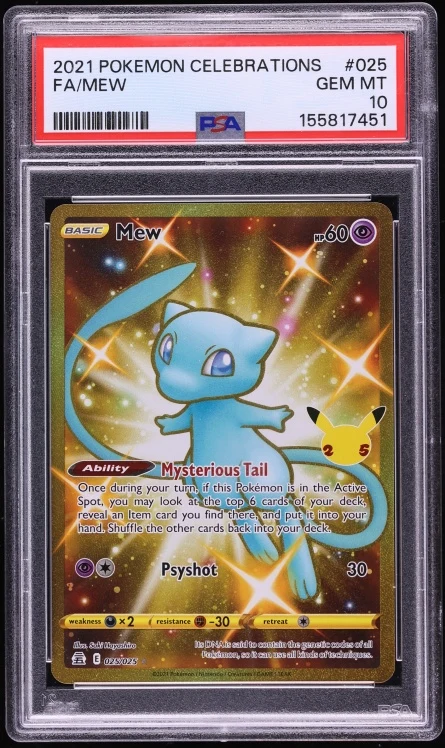
Real sold comps from CardboardSniper's pricing engine · 40 sales(eBay & Fanatics).
The gem trades around $271on 66 real comps. Celebrations was printed to the moon, so this is a demand play pure and simple, but the symbolism is working for it: when the Pokémon Company picked one card to be the anniversary's golden face, it picked Mew. The market remembers things like that.
The Promo, the Star, and the Mew Premium
Zoom out on the twelve cards above and Mew's version of the series discipline emerges: Mew is priced by distribution, and 2026 repriced its scarcest distributions first.
- The pull rate is the printing.Mew's ladder isn't 1st Edition stamps; it's how each card reached the world. Once-per-two-boxes (Gold Star, $192,000), one boxed set (Southern Islands, $24,000), forgotten-era foil (Mew Prime, $9,690), League reward (#9, $4,800), movie handout (#8, $174). The scarcer the channel, the harder the 2026 repricing hit.
- The Gold Star class moved together. Charizard $100,000, Pikachu $114,000, Mew $192,000, all inside five months, all from the same once-per-two-boxes rarity. When a whole class reprices in sequence, the remaining members of that class (Espeon, Umbreon, Rayquaza) are the obvious research list.
- The gem premium is the moat, again. Gold Star 20×, Mew Prime 10×, Ancient Mew 12× over their own PSA 9s. Foil-heavy Mews gem terribly, and grading turned that into fixed supply.
- Modern Mew is a liquidity machine.Four hundred-plus real comps across the Shiny SIR, 151 SIR, alt art, and gold: the deepest modern order book of any character in this series. Demand is not Mew's question; supply is.
The playbook: hold the Gold Star thesis through its PSA 9 (the gem is a trophy market), make the repriced sleepers (Prime, Promo #9) core positions only on pullbacks, keep the Shiny SIR and 151 SIR as the liquid sleeve, and let the movie promos be what they are: cheap, joyful exposure to the myth that started it all.
How High Can Mew Cards Go?
Mew's ceiling argument just got its proof: $192,000 for a card that traded at a fraction of that twelve months ago. The asset class it sits in is still tiny next to the markets it behaves like:
Total market value: collectibles as an asset class, next to gold, mega-cap tech, and crypto.
The right column is how many times bigger each one is than the entire collectibles market. Collectibles are already a real asset class, larger than a top-ten crypto like Dogecoin, yet still a fraction of a single mega-cap stock and barely a rounding error next to gold. That gap is the runway: as collectibles mature into a transparently priced, investable asset class, the best cards have room to re-rate that the giants no longer do.Figures approximate, 2026: gold = all above-ground gold; equities = market cap; crypto = network value; collectibles = estimated global market size. Bars use a log scale for visibility.
And the returns case is on the board. Indexed from 2010, blue-chip cards have out-compounded the S&P 500:
Mew's specific edge is renewal. The character headlines something roughly every three years (a movie, an anniversary, a 151 set, a shiny set), and each cycle mints new demand for a supply that froze decades ago. That's the same geometry as the vintage grails in every guide in this series, with the most mythology per dollar.
Matching Mew Cards to Your Risk Tolerance
The tiers sit in very different places on the risk map:
A sane Mew portfolio anchors in the repriced-but-liquid tier (Mew Prime PSA 9, Promo #9, Ancient Mew), holds the modern SIRs as the tradable sleeve, and treats the trophy tier (Gold Star gem, Southern Islands gem) as one-print markets: buy on the second comp, not the headline. The most common mistake right now is extrapolating the $192,000 print to every Mew on the ladder; the Gold Star is a class of its own, and the rest of the market knows it.
Why Every Card Here Is a PSA 10
Every card in this guide is quoted in PSA 10 because, for Mew above all, the gem is the asset. The same Gold Star is $9,650 in PSA 9 and $192,000 in PSA 10; the same Mew Prime is $995 versus $9,690. Grading authenticates the card, certifies the condition, and produces the population data this whole analysis runs on. Our Pokémon PSA 10 price guide goes deeper on the grade math, and the flagship guide covers grading from first principles.
How to Buy Mew Cards Safely
- Price off sold comps, never listings. Look up the exact card, printing, and grade on CardboardSniper's value calculator before you bid. Post-print asking prices are fantasy.
- Verify which Mew it is.The Dragon Frontiers Gold Star versus the 2008 Worlds "Empotech" reprint of the same card (a $192,000 gap), Promo #8 versus #9, the alt art #269 versus the rainbow #268, the SIR #232 versus the plain #216.
- Respect one-print markets. The Gold Star gem and Southern Islands gem have traded once each recently. Never market-buy a headline; the PSA 9s are where the real markets live.
- Assume fakes on the trophy tier. Gold Stars are heavily counterfeited. Graded slabs with verifiable cert numbers are the floor, full stop.
- Get pinged when one lists below market. The CardboardSniper scanner watches eBay and Fanatics for this exact card and grade around the clock.
Investing in Mew Cards on Graded
Everything this guide measures, CardboardSniperdoes live. Look up any Mew's real fair-market value, population, and gem rate with the value calculator, and let the CardboardSniper scanner watch eBay and Fanatics for below-market listings of every card on this list. No saved-search spam, and the comps math is included with every alert.
FAQs
What is the best Mew card to invest in?
The Dragon Frontiers Mew Gold Star is the grail: a real PSA 10 print of $192,000 in July 2026, the largest Gold Star sale ever, with the PSA 9 around $9,650 as the practical position. For real-world budgets, the repriced sleepers (Triumphant Mew Prime ~$9,690, Black Star Promo #9 ~$4,800) and the liquid modern SIRs (Paldean Fates Shiny Mew ex ~$3,950, 151 Mew ex ~$330) cover every price point.
How much is a Mew Gold Star worth?
In PSA 10, the real July 2026 comp is $192,000, the biggest Gold Star sale on record. The PSA 9 trades around $9,650 on eighteen deep 2026 comps that ran from $8,700 to $13,000. Watch the label: the 2008 World Championships "Empotech" reprint of the same card is a different market entirely, with its gem trading around $20,400.
What is the most expensive Mew card?
On real sold comps, the PSA 10 Dragon Frontiers Mew Gold Star at $192,000 (July 2026), followed by the Southern Islands Mew gem at $24,000 and the 2008 Worlds Gold Star reprint at $20,400. Among cards with deep repeat sales, the Triumphant Mew Prime leads at $9,690-$13,000 in PSA 10.
Is Ancient Mew a good investment?
It has quietly become one: the gem trades around $3,419 on deep 2026 volume, up from the hundreds a few years ago, because the double-holofoil surface gems so rarely. With 251 recent PSA 9 comps near $285, the grade spread is roughly 12×. It's a mass-distributed card whose top grade is genuinely scarce; buy the condition, not the print run.
Are Mew cards a good investment?
Mew's 2026 tape is the strongest in this series: the Gold Star printed the biggest Gold Star sale ever at $192,000, the Mew Prime and Promo #9 ran 3-10×, and the modern SIRs trade on hundreds of real comps. The character's myth renews demand every product cycle while its trophy supply froze decades ago. Like all cards they're volatile, so buy scarce distributions at proven grades, price everything off real sold comps, and size for the swings.