The Best Pokémon Cards to Invest In (2026): The Definitive PSA 10 List
On this page
- 01The framework
- 02The Pokémon card ladder
- 03Pikachu Illustrator
- 041st Ed Base Charizard
- 05The Gold Star class of 2026
- 06Crystal Charizard
- 071st Ed Base Blastoise
- 081st Ed Shining Charizard
- 091st Ed Neo Genesis Lugia
- 101st Ed Fossil Gengar
- 111st Ed Red Cheeks Pikachu
- 12Moonbreon
- 13Van Gogh Pikachu
- 14How this market reprices
- 15How high can they go?
- 16Match cards to your risk
- 17How to buy safely
- 18Investing on Graded
The most valuable trading card on the planet is a Pokémon card. So are four of the five biggest card sales of 2026. In February the one PSA 10 Pikachu Illustrator sold for $16.49 million, the record for any trading card ever, and behind it an entire market has spent 2026 repricing: the 1st Edition Base Charizard printed $504,000, four different Gold Stars set six-figure records in five months, and grails from Blastoise to Lugia to Gengar re-rated era by era.
This is the definitive guide to the best Pokémon cards to invest in, across every character and every era. It's the hub of our investing series; each major character has its own deep-dive (Charizard, Pikachu, Gengar, Dragonite, Mew), and this page ranks the thirteen cards that define the asset class. Every price is a real PSA 10 sold comp from CardboardSniper's pricing engine (eBay and Fanatics), not an asking price.
Nothing here is financial advice. Cards are a real but volatile asset class, and you should never put in money you can't afford to lose. Here's what the data shows.
- Pokémon holds the all-time record.The PSA 10 Pikachu Illustrator's $16.49 million sale in February 2026 is the most ever paid for a trading card of any kind, and the 1st Edition Base Charizard ($456,000-$528,000 on 2026 comps) is the hobby's bellwether beneath it.
- Every card in this guide is quoted in PSA 10, because at the top of this market the gem is the asset: the same Blastoise is $10,700 in PSA 9 and $84,000 in PSA 10.
- The Gold Star class repriced in sequence: Charizard $100,000 (February), Pikachu $114,000 (May), Umbreon $168,000 (June), Mew $192,000 (July). Four record prints in five months from one once-per-two-boxes rarity tier.
- The WOTC 1st Edition grails moved as a class too. Blastoise ran $26,000 to $90,000 in a year, the Fossil Gengar $6,000 to $48,000, and the thin-float Neo Genesis Lugia holds $45,000 on its last print.
- Modern has one king.The Evolving Skies Umbreon VMAX alt art ("Moonbreon") trades around $4,680 in PSA 10 on 129 real comps: the deepest premium market of the modern era.
- The asset class is still tiny. All of graded Pokémon is a rounding error next to the markets it behaves like, and it just spent 2026 proving the demand is global and compounding.
The Framework: What Makes a Pokémon Card an Investment
Every card below passes the same five-part filter we apply throughout this series, tuned for the asset class as a whole:
- Character demand is permanent demand.Pokémon is the highest-grossing media franchise in history and mints new collectors on every continent every year. The demand question is never "whether"; it's which characters and which printings.
- The print run is the asset. 1st Edition stamps, promo windows, secret-rare pull rates, parallel presses: every card on this list is the scarcest distribution of its icon.
- Gem scarcity is the moat. Vintage holofoil punished every shuffle, and grading turned 25 years of playground damage into fixed supply. Gem premiums on this list run 5× to 20×.
- Eras reprice as classes. The 2026 tape moved the Gold Stars together, the WOTC 1st Editions together, and the e-Series trophies together. When one member of a scarcity class re-rates, research its classmates.
- Liquidity varies wildly. Moonbreon trades daily; the Illustrator trades once a decade. Match position size to exit depth, always.
The Pokémon Card Ladder
"Best Pokémon cards" spans four orders of magnitude, all of it in gem mint. Here's where the thirteen defining cards actually sit, on real PSA 10 sold comps:
Bars use a logarithmic scale so every rung is visible. Every value is a real 2025-2026 PSA 10 sold comp, not an asking price.
Read it as four tiers. The modern chase and crossovers are the liquid entry. The WOTC 1st Edition grails are the blue-chip core. The Gold Stars and e-Series trophies are the repriced six-figure middle. And the top two rungs, the bellwether Charizard and the Illustrator, are where Pokémon stopped being a hobby market and started trading like fine art.
Pikachu Illustrator: The Most Valuable Trading Card on Earth
The 1998 Pikachu Illustrator was never sold in a pack: it was awarded to winners of a CoroCoro illustration contest, 39 copies exist, and exactly one is a PSA 10. Logan Paul bought that copy for $5.275 million in 2021 and sold it at Goldin in February 2026 for $16.49 million, the most ever paid for a trading card of any kind:
Lower-grade copies trade too: real comps of $360,000 (PSA 8) and $300,000 (PSA 8.5) sit in the engine. The full story is in the Pikachu guide; for this list, the Illustrator is the ceiling that anchors everything below it.
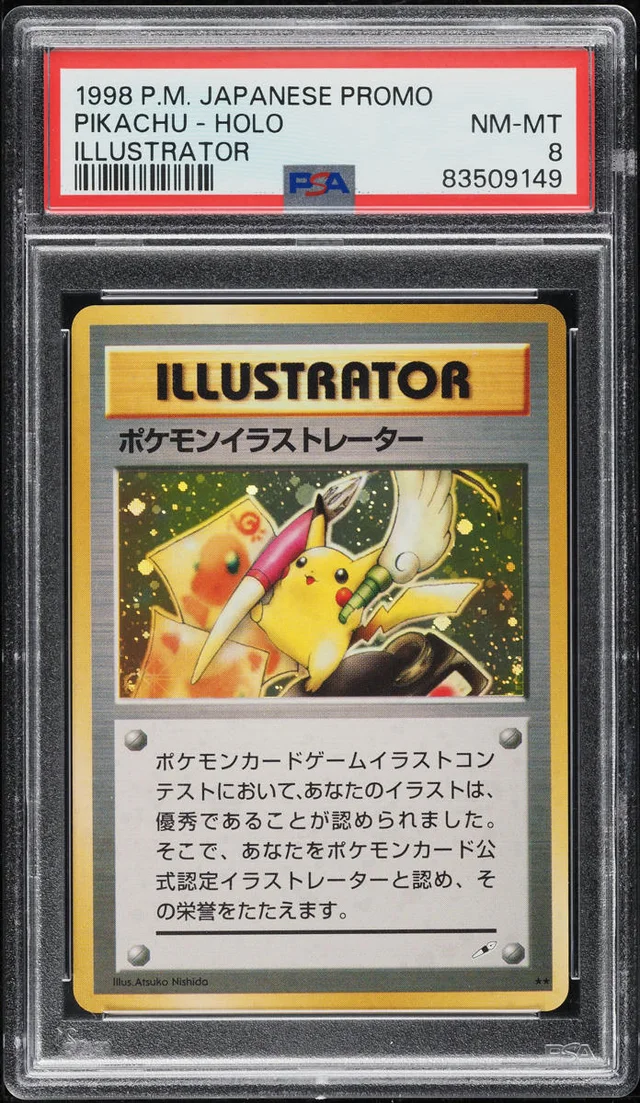
Real sold comps from CardboardSniper's pricing engine · 2 sales(eBay & Fanatics).
1st Edition Base Set Charizard: The Bellwether
Stocks have the S&P 500; Pokémon has the 1st Edition Base Set Charizard. Roughly 120 PSA 10s exist, and the 2026 tape ran $456,000-$528,000 with a $504,000 May sale, triple the card's early-2024 low:
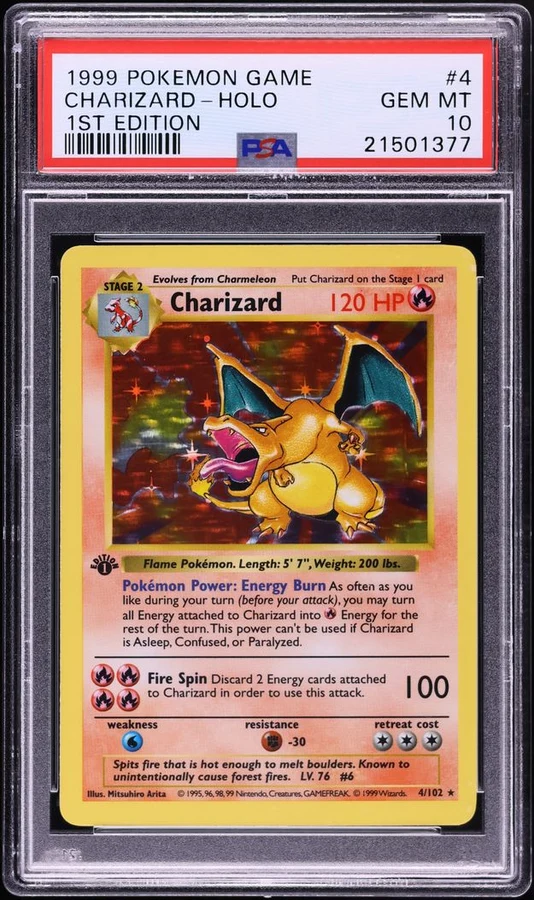
Real sold comps from CardboardSniper's pricing engine · 21 sales(eBay & Fanatics).
When people say "Pokémon cards are back," this is the card they're quoting. The full breakdown of every WOTC Charizard holo is in the Charizard guide.
The Gold Star Class of 2026: Mew, Umbreon, Pikachu
Gold Stars were the mid-2000s' rarest pull, roughly once per two booster boxes, and 2026 repriced the whole class in sequence:
The Mew Gold Star capped it with a $192,000 print on July 5, the largest Gold Star sale ever recorded:
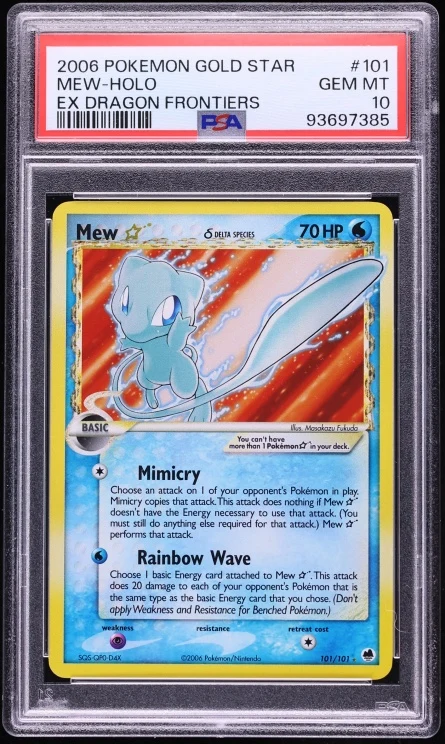
Real sold comps from CardboardSniper's pricing engine · 1 sales(eBay & Fanatics).
The Umbreon Gold Star, the 2007 POP Series 5 original that anchors Eeveelution collecting (the full Umbreon guide covers the whole ladder), printed $168,000 a week earlier, with its PSA 9 trading around $24,300:
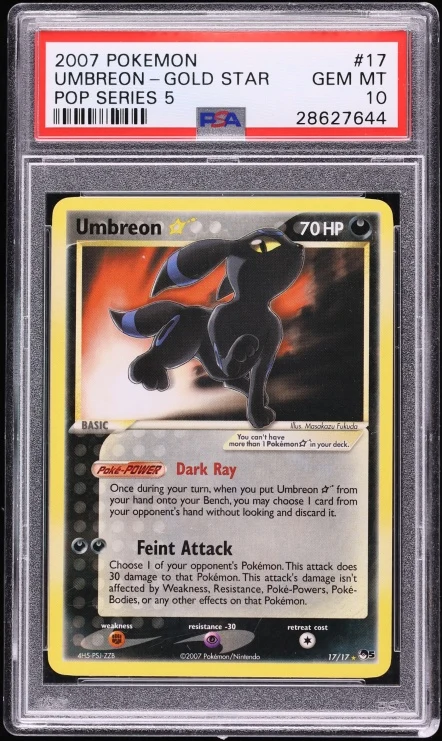
Real sold comps from CardboardSniper's pricing engine · 1 sales(eBay & Fanatics).
And the Pikachu Gold Starran from $15,000 to $107,000-$114,000 inside a year. Across the class, the PSA 9s are where the liquid markets live; the gems are trophy assets now. The remaining untested Gold Stars (Espeon, Rayquaza, Charizard's classmates in other sets) are the obvious research list.
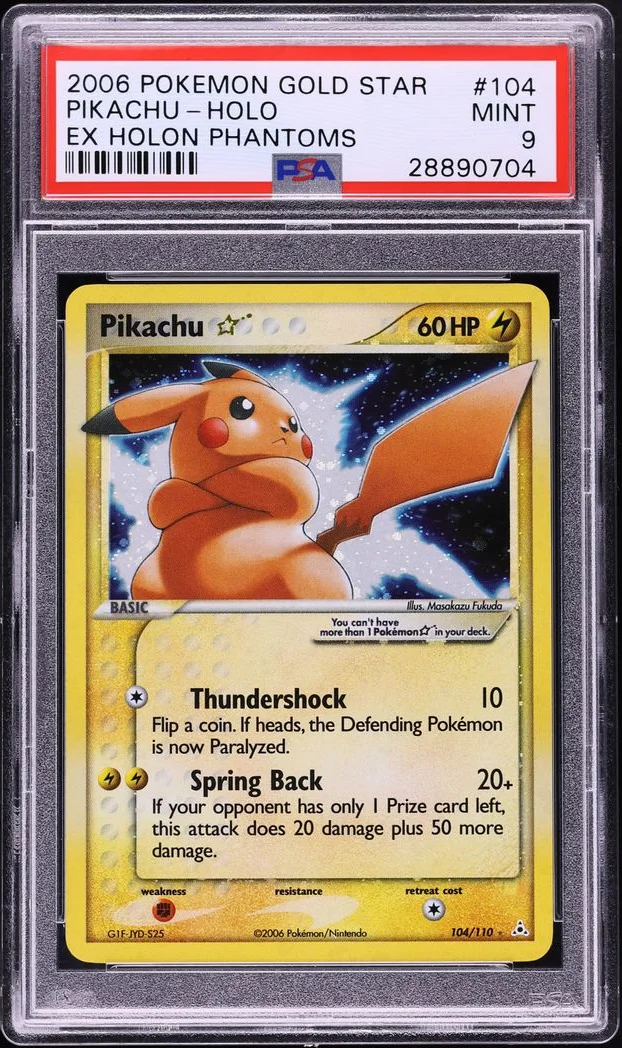
Real sold comps from CardboardSniper's pricing engine · 8 sales(eBay & Fanatics).
Crystal Charizard: The e-Series Trophy
The Skyridge Crystal Charizardis what happens when demand finds a set nobody opened: WOTC's final, lowest-print era, repriced from $11,700 in 2023 to five sales between $98,000 and $117,000 in mid-2026:
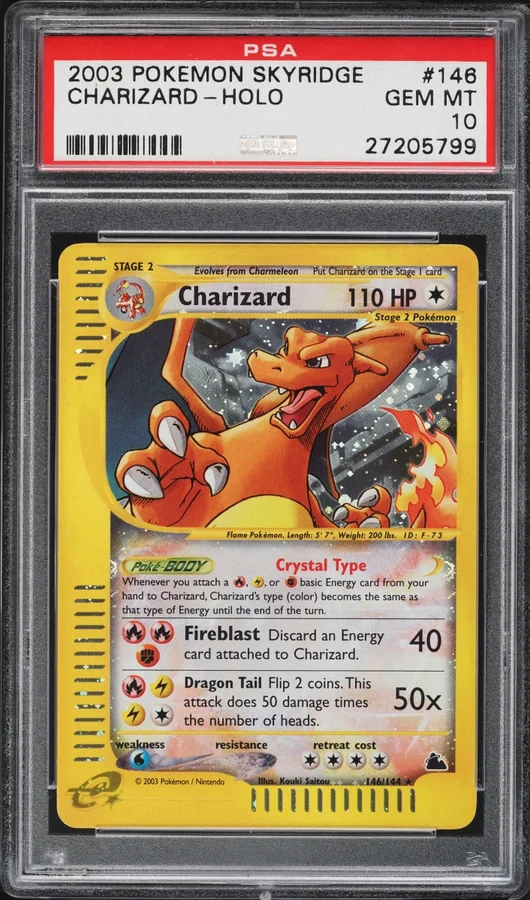
Real sold comps from CardboardSniper's pricing engine · 11 sales(eBay & Fanatics).
The same thin-float arithmetic is working through every e-Series chase; the Gengar guide documents its $55,000 Expedition print and the Charizard guide the rest.
1st Edition Base Set Blastoise: The Other Base Grail
The 1st Edition Blastoiseis the Base Set's second pillar, and its 2026 tape is one of the cleanest repricings in the hobby: $26,000 in July 2025, $47,500 in September, then a six-month cluster between $78,000 and $90,000 on eighteen real comps:
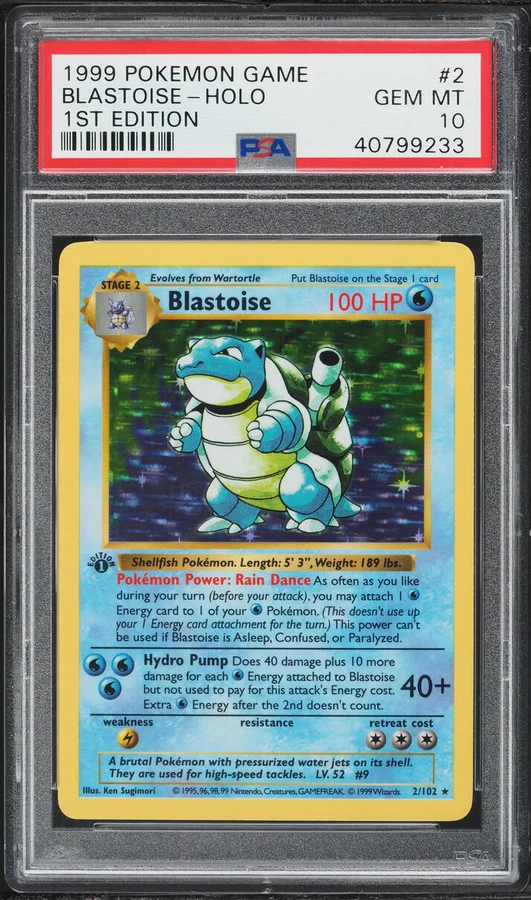
Real sold comps from CardboardSniper's pricing engine · 18 sales(eBay & Fanatics).
Blastoise spent two decades priced like Charizard's sidekick. At roughly one-sixth of the bellwether's price with a fraction of its gem population, the market has started treating it like what it is: the same 1999 scarcity wearing a different starter.
1st Edition Shining Charizard: The Original Chase Card
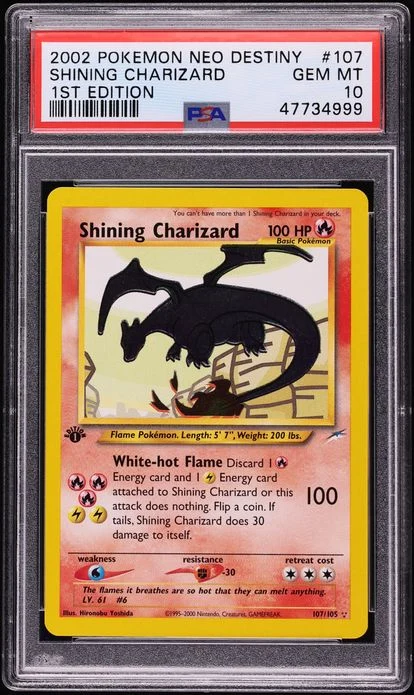
Before alt arts and rainbow rares, Neo Destiny's Shining Charizard invented the chase card: numbered above the set, triple-holo, and now trading at $49,200-$70,000 in PSA 10 after running from $8,100 in 2023:
Real sold comps from CardboardSniper's pricing engine · 20 sales(eBay & Fanatics).
Every secret rare printed since descends from this card. The Charizard guide covers both printings.
1st Edition Neo Genesis Lugia: The Neo-Era Grail
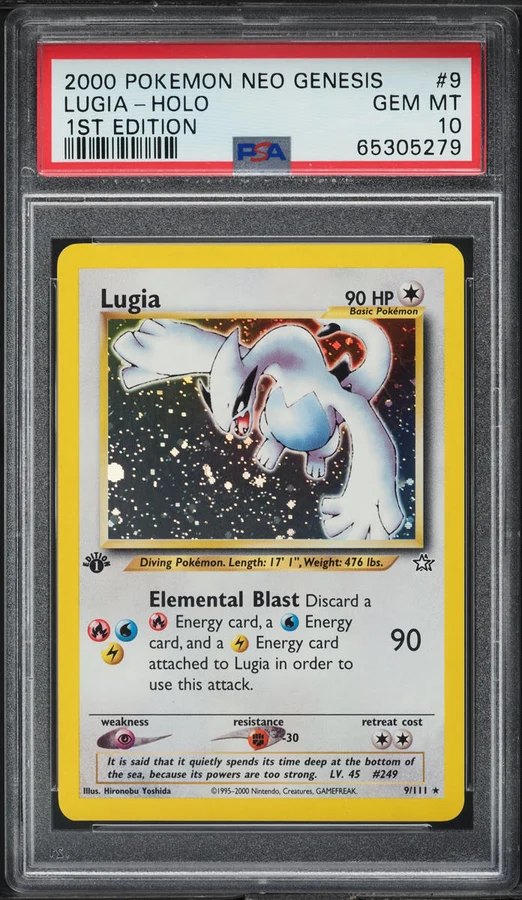
The 1st Edition Neo Genesis Lugia is one of the hardest gems in the entire hobby: the Neo-era printing quality made PSA 10s genuinely rare, and the card barely trades at the top grade. Real PSA 10 sales:
Real sold comps from CardboardSniper's pricing engine · 4 sales(eBay & Fanatics).
The last print is $44,999(October 2024), with four gem sales in four years and a deep PSA 9 market around $12,500. It's the legendary-bird counterpart to the Base grails (the full Lugia guide covers the whole ladder): lower liquidity, comparable scarcity, and a demand base that renews with every Lugia headline card the modern game prints.
1st Edition Fossil Gengar: The Cult Grail
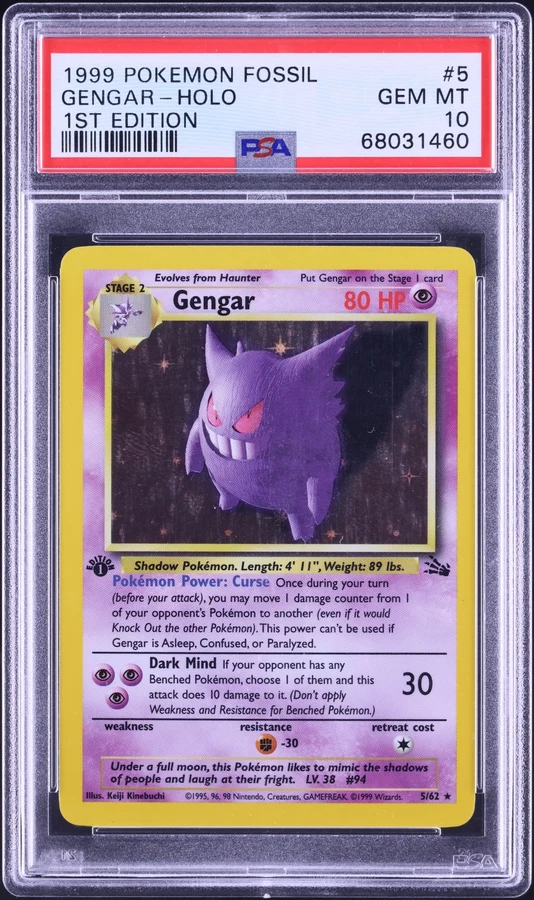
The hobby's biggest non-mascot franchise has one grail: the 1st Edition Fossil Gengar, repriced from $1,800 in 2021 to a $48,000 May 2026 sale:
Real sold comps from CardboardSniper's pricing engine · 11 sales(eBay & Fanatics).
The whole ghost tier moved with it; the Gengar guide has the full ladder.
1st Edition Red Cheeks Pikachu: The Error Premium
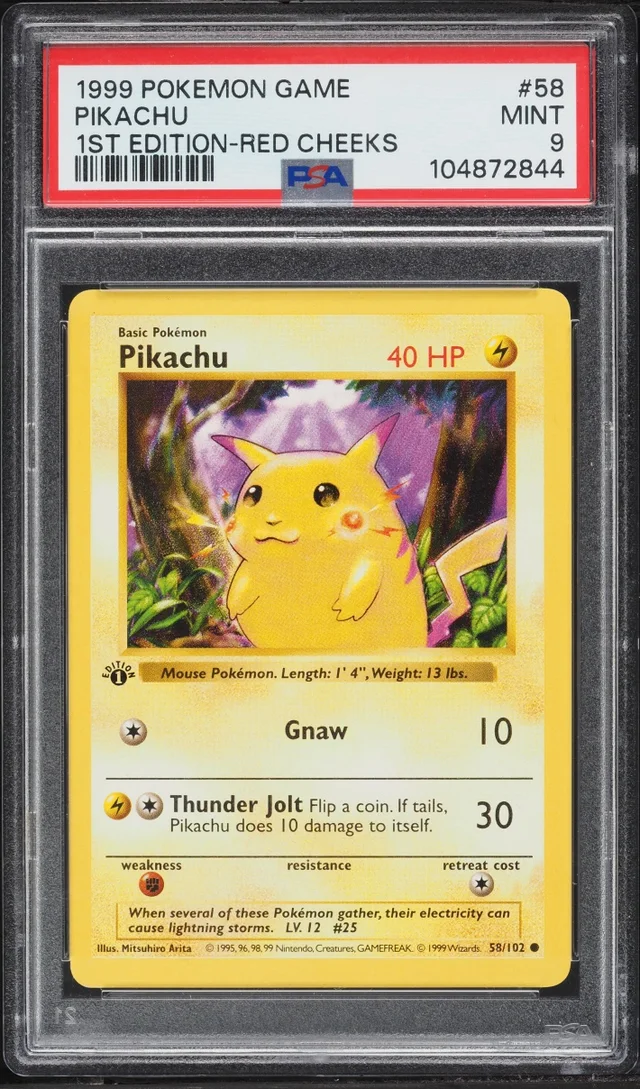
The mascot's vintage blue-chip is the Base Set Red Cheeks Pikachu, the first-print error that trades at roughly 5× the corrected version, with recent gems around $17,400:
Real sold comps from CardboardSniper's pricing engine · 18 sales(eBay & Fanatics).
In Pokémon, the misprint the printer fixed is the asset the market wants. The Pikachu guide covers the whole promo-and-error ecosystem.
Umbreon VMAX Alt Art "Moonbreon": The Modern King
One modern card outranks every other: the Evolving Skies Umbreon VMAX alternate art, universally known as Moonbreon. Real PSA 10 sales:
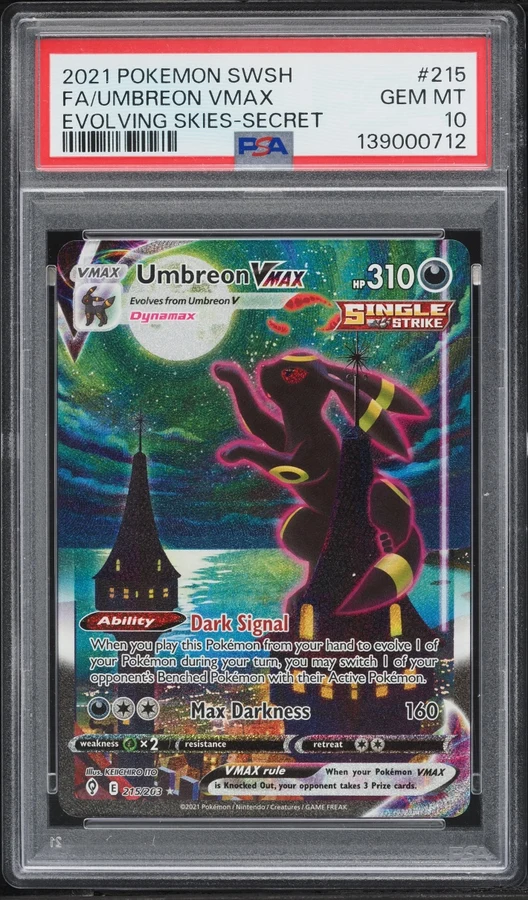
Real sold comps from CardboardSniper's pricing engine · 40 sales(eBay & Fanatics).
The gem trades around $4,680on 129 real comps with weekly depth, climbing steadily for three years, the most expensive card of the modern era with the deepest market. It's a demand bet rather than a scarcity bet, but the demand has outlasted every cycle since 2021. In a modern portfolio it's the anchor; everything else in the alt-art class prices off it.
Van Gogh Pikachu: The Cultural Crossover
The Van Gogh Museum Pikachu, a free 2023 giveaway that now trades around $3,300 in PSA 10 on deep weekly volume, is the proof that Pokémon demand extends beyond the hobby entirely:
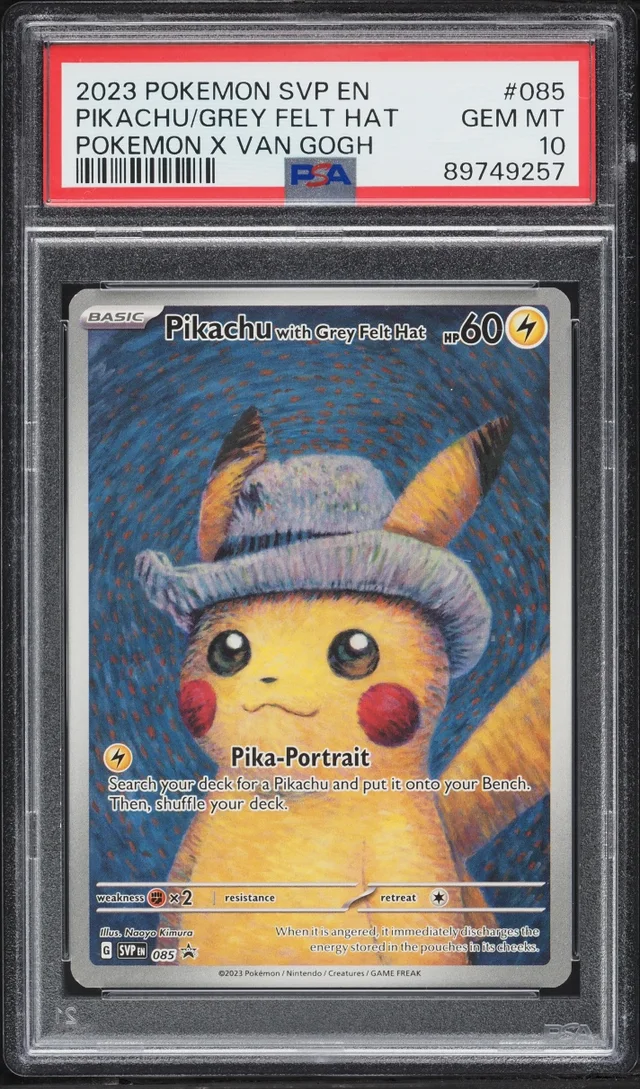
Real sold comps from CardboardSniper's pricing engine · 60 sales(eBay & Fanatics).
Art-world buyers and card collectors now compete for the same slab. It's the cheapest card on this list and the clearest signal about where the next decade's demand comes from.
The Classes: How This Market Actually Reprices
Zoom out on the thirteen cards above and the structure of the whole asset class emerges: Pokémon reprices by scarcity class, not by card.
- The Gold Stars moved as a unit: four record prints in five months, in ascending order. When a class starts repricing, the untested members are the opportunity.
- The WOTC 1st Editions moved as a unit:Charizard tripled off its 2024 low, then Blastoise 3×'d, Gengar 4×'d, and the Fossil and Neo grails followed. The stamps are one market.
- The e-Series trophies moved as a unit:Crystal Charizard to six figures, the Expedition Gengar's $55,000 print, Skyridge gems vanishing. Lowest-print era, latest discovery.
- Modern is a demand market:Moonbreon, the SIRs, and the crossovers trade on hundreds of comps. They index the hobby's health; the vintage classes leverage it.
The playbook: hold the bellwether tier at the best grade you can afford (PSA 9s of the grails are the practical positions), buy repricing classes early rather than chasing their headlines, keep a liquid modern sleeve, and read each character's deep-dive before buying its cards; every guide in this series exists because the printing details decide everything.
How High Can Pokémon Cards Go?
The ceiling argument got tested in public this year: $16.49 million for one card, and the asset class it leads is still tiny next to the markets it behaves like:
Total market value: collectibles as an asset class, next to gold, mega-cap tech, and crypto.
The right column is how many times bigger each one is than the entire collectibles market. Collectibles are already a real asset class, larger than a top-ten crypto like Dogecoin, yet still a fraction of a single mega-cap stock and barely a rounding error next to gold. That gap is the runway: as collectibles mature into a transparently priced, investable asset class, the best cards have room to re-rate that the giants no longer do.Figures approximate, 2026: gold = all above-ground gold; equities = market cap; crypto = network value; collectibles = estimated global market size. Bars use a log scale for visibility.
And the returns case is on the board. Indexed from 2010, blue-chip cards have out-compounded the S&P 500:
Pokémon's specific edge is renewal: the franchise mints new collectors every year, every new product cycle points demand back at the vintage supply, and that supply froze decades ago. The 2026 tape, from the Illustrator record to four Gold Star prints to the 1st Edition class repricing, is what that geometry looks like in motion.
Matching Pokémon Cards to Your Risk Tolerance
The tiers sit in very different places on the risk map:
A sane Pokémon portfolio anchors in the bellwether tier (or its PSA 9s), sizes the repriced classes as growth positions that can retrace as fast as they ran, and keeps the modern kings as the liquid sleeve. The most common mistake in 2026 is paying headline prices in thin markets: half the records this year were set by single prints, and single prints are signals, not levels.
Why Every Card Here Is a PSA 10
Every card in this guide is quoted in PSA 10 because at the top of this market the gem is the asset: the same Blastoise is $10,700 in PSA 9 and $84,000 in PSA 10; the same Mew Gold Star is $9,650 versus $192,000. Grading authenticates the card, certifies the condition, and produces the population data this whole analysis runs on. Our Pokémon PSA 10 price guide goes deeper on the grade math, and the flagship guide covers the cross-category view (sports, TCGs, and more).
How to Buy Pokémon Cards Safely
- Price off sold comps, never listings. Look up the exact card, printing, and grade on CardboardSniper's value calculator before you bid.
- Read the printing, not the picture. 1st Edition stamps, shadowless boxes, error variants, reprint sets, promo numbering: every guide in this series exists because two identical-looking cards can differ by 100×.
- Respect thin markets.Several of 2026's records were single prints. Let second comps confirm levels, or buy the PSA 9 where the depth is.
- Assume fakes at every tier. Pokémon is the most counterfeited hobby on earth. Graded slabs with verifiable cert numbers are the floor, full stop.
- Get pinged when one lists below market. The CardboardSniper scanner watches eBay and Fanatics for this exact card and grade around the clock.
Investing in Pokémon Cards on Graded
Everything this guide measures, CardboardSniperdoes live. Look up any Pokémon card's real fair-market value, population, and gem rate with the value calculator, and let the CardboardSniper scanner watch eBay and Fanatics for below-market listings of every card on this list. No saved-search spam, and the comps math is included with every alert.
FAQs
What are the best Pokémon cards to invest in?
At the top: the Pikachu Illustrator ($16.49 million record) and the 1st Edition Base Charizard ($456,000-$528,000 on 2026 comps). The investable core is the WOTC 1st Edition grails (Blastoise ~$84,000, Shining Charizard ~$57,600, Lugia ~$45,000, Fossil Gengar ~$40,800 in PSA 10), the repriced Gold Stars (Mew $192,000, Umbreon $168,000, Pikachu ~$110,000), and the modern king Moonbreon (~$4,680). Each character's deep-dive guide covers every price point below those.
What is the most expensive Pokémon card ever sold?
The PSA 10 Pikachu Illustrator, sold for $16.49 million at Goldin in February 2026, the most ever paid for a trading card of any kind. Only 39 copies exist and exactly one is a PSA 10. Among cards that trade with any regularity, the 1st Edition Base Set Charizard leads with a 2026 cluster of $456,000-$528,000.
Are Gold Star cards a good investment?
The 2026 tape says the market thinks so: Charizard $100,000 (February), Pikachu $107,000-$114,000 (May), Umbreon $168,000 (June), and Mew $192,000 (July), four record prints in five months from the mid-2000s' rarest pull tier. The gems are trophy markets now; the PSA 9s ($9,000-$25,000) are where the liquidity lives, and the class's untested members are the research list.
What is the best modern Pokémon card to invest in?
The Evolving Skies Umbreon VMAX alt art ("Moonbreon") is the modern era's king: around $4,680 in PSA 10 on 129 real comps with weekly liquidity, and still climbing three years after release. Behind it, the SIR chases (Paldean Fates Shiny Mew ex ~$3,950) and the alt-art class of 2021-2022 hold the deepest modern markets.
Are Pokémon cards a good investment?
The blue-chip tier has the strongest track record in collectibles: the all-time trading card record ($16.49 million), a 2026 in which every major scarcity class repriced, and a demand engine (the highest-grossing media franchise ever) that renews every year against supply that froze decades ago. They are volatile and cyclical like all cards, so buy scarce printings at proven grades, price everything off real sold comps, and size for the swings.