Legendary Collection Pop Report (2026): PSA 10 Population for Every Card, Reverse Holo and Holo
On this page
There are 149 PSA 10 Legendary Collection cards across the 8 printings with resolved population counts — out of 18 printings we track, in a set that costs $708,653 to complete. A triple-digit gem census for an entire WOTC set. This page lists every count: the PSA 10 population of each Legendary Collection card in both printings — Reverse Holo (the first reverse holos ever made) and standard Holo — with the gem-mint price next to each number. There is no 1st Edition in this set; the reverse class is the chase. PSA's own population report now sits behind a login; ours is free, built on GemRate population chains (5 exact, the rest modeled and marked †), and refreshed monthly. It is one chapter of the full WOTC pop report — and the cost side of the same data lives in what a complete PSA 10 Legendary Collection set costs.
How Many PSA 10 Legendary Collection Cards Exist?
149 PSA 10s across the 8 printings with resolved counts — one of the thinnest gem supplies of any WOTC set we track, from a set printed in the millions. For scale, a single card — the Unlimited Base Set Charizard, pop 487 — has more than three times as many PSA 10s as this entire set. The table below is the full census, scarcest first; 5 counts are exact GemRate chains and the rest are modeled (†). The other ten tracked printings have no resolved population chain yet — their gem markets are so thin that most have traded one to three PSA 10s ever in our sales archive.
| Card | PSA 10 pop | PSA 10 price | Gem market cap | |
|---|---|---|---|---|
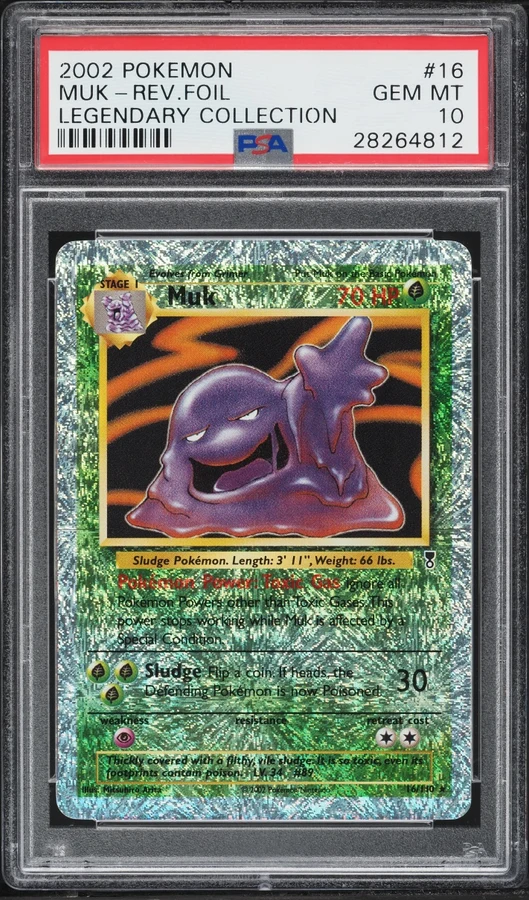 | 2002 Legendary Collection Holo Muk #16 | 6† | $405 | $2,430 |
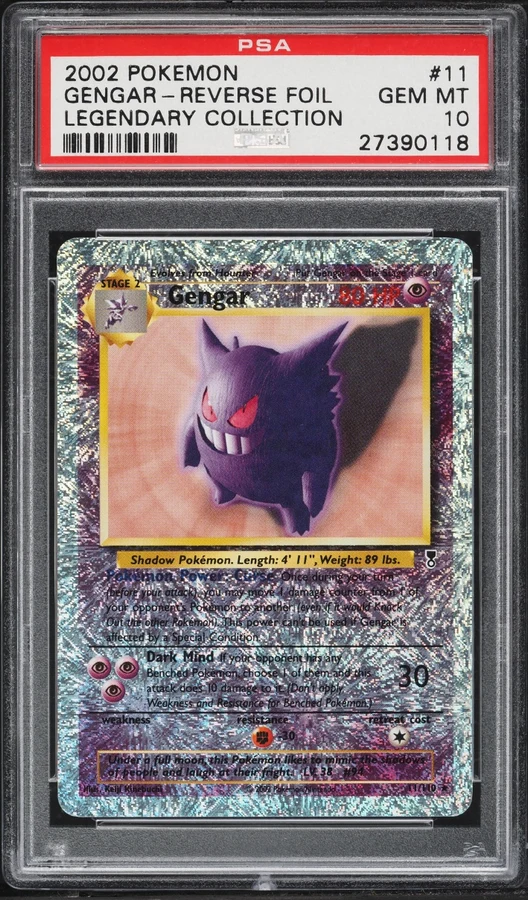 | 2002 Legendary Collection Reverse Holo Gengar #11 | 12 | $408,000 | $4,896,000 |
| 2002 Legendary Collection Reverse Holo Muk #16 | 12† | $4,500 | $54,000 |
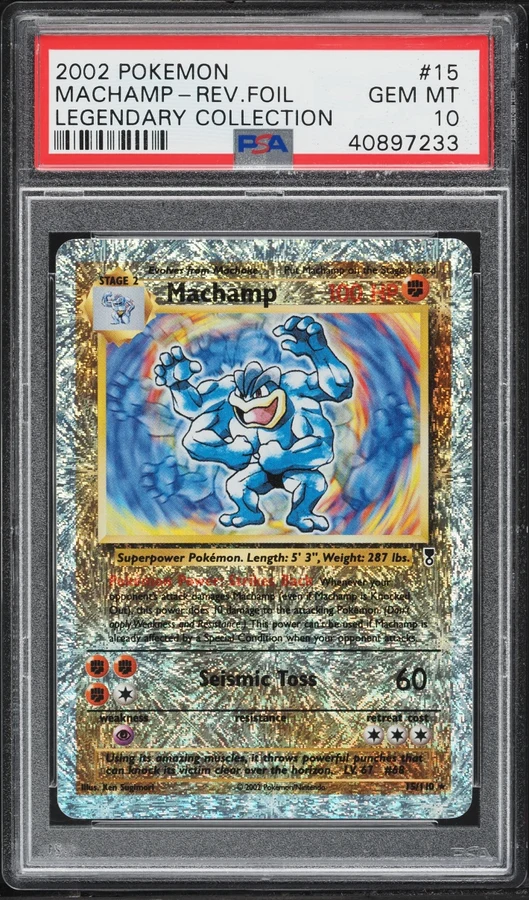 | 2002 Legendary Collection Holo Machamp #15 | 16 | $3,960 | $63,360 |
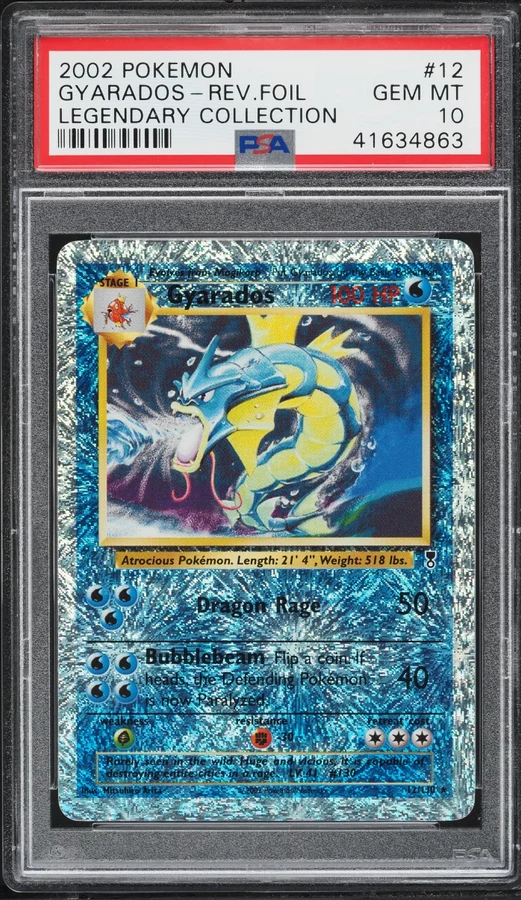 | 2002 Legendary Collection Reverse Holo Gyarados #12 | 21 | $39,300 | $825,300 |
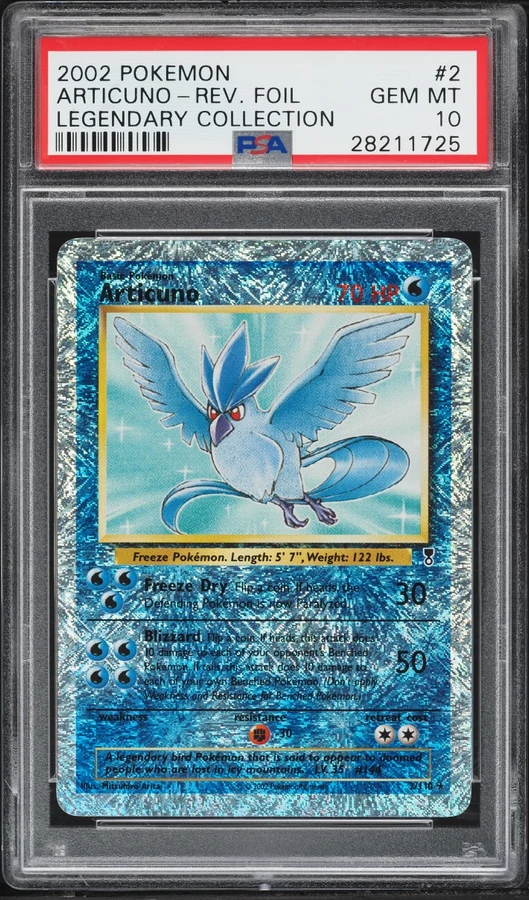 | 2002 Legendary Collection Reverse Holo Articuno #2 | 21 | $15,000 | $315,000 |
| 2002 Legendary Collection Reverse Holo Machamp #15 | 26† | $5,820 | $151,320 |
| 2002 Legendary Collection Holo Gyarados #12 | 35 | $1,530 | $53,550 |
How Many PSA 10 Reverse Holo Gengars Are There?
Twelve. From 2,075 total PSA gradings, 12 Reverse Holo Gengars have ever earned the 10 — a 0.58% gem rate — and one of them sold for $408,000 on June 14, 2026. Among exact-count WOTC cards, only the Neo Revelation 1st Edition Ampharos (pop 10) is rarer. The full grade pyramid explains why:
Read that pyramid closely, because it is unlike any 1999 card's. The most common grade is PSA 6 (480 cards) — not 8 or 9 — and there are more PSA 1 Gengars (146) than PSA 9s (84). Legendary Collection's 2002 reverse sheets came out of the printer with atrocious centering and foil damage, so the population is bottom-heavy in a way binder wear alone cannot produce. The card was everywhere; the gem never existed. That condition scarcity is the entire price:
Real sold comps from CardboardSniper's pricing engine · 1 sales(eBay & Fanatics).
View live data on CardboardSniper →What Is the Rarest Legendary Collection Card in PSA 10?
The Reverse Holo Gengar, at pop 12 — the thinnest exact count in the set and the second-thinnest in all of WOTC. Two footnotes keep the census honest: the Reverse Holo Muk also models to pop 12† and the Holo Muk to pop 6†, but those are grading-rate estimates, not exact chains — and they price at $4,500 and $405, which tells you the market only pays for scarcity it has heard of. Behind the Gengar, the exact counts run: Holo Machamp at pop 16, then the Reverse Gyarados (pop 21) and Reverse Articuno (pop 21) tied. A pop-21 card at $39,300:
Real sold comps from CardboardSniper's pricing engine · 2 sales(eBay & Fanatics).
View live data on CardboardSniper →Are Reverse Holos Rarer Than Regular Holos in PSA 10?
Usually — but not always, and the exceptions are the most interesting rows on this page. The side-by-side census for every card with a count on either side; the orange number is the rarer printing:
| # | Card | Reverse Holo pop 10 | Holo pop 10 | Rarer printing |
|---|---|---|---|---|
| #2 | Articuno | 21 | — | — |
| #11 | Gengar | 12 | — | — |
| #12 | Gyarados | 21 | 35 | Reverse Holo |
| #15 | Machamp | 26† | 16 | Holo |
| #16 | Muk | 12† | 6† | Holo |
The Gyarados behaves the way the prices assume: reverse pop 21 against holo pop 35. But the Machamp flips — the standard Holo (pop 16, exact) is rarer than its Reverse (pop 26†) — and the Muk pair models the same way (6† holo vs 12† reverse). Same lesson as Base Set's Shadowless class: the printing everyone chases gets graded relentlessly, while the "common" one goes unslabbed and quietly ends up scarcer. The market prices the fireworks foil, not the census.
Which Legendary Collection Cards Are Hardest to Gem?
Gem rate is the other half of a pop report: not how many 10s exist, but what fraction of all submissions earned one. The 2002 reverse sheets produced some of the most brutal gem rates in the entire hobby:
| # | Card | Gem rate | PSA 10s / total graded | PSA 10 price | |
|---|---|---|---|---|---|
| 1 | | 2002 Legendary Collection Reverse Holo Gengar #11 | 0.6% | 12 / 2,075 | $408,000 |
| 2 | | 2002 Legendary Collection Reverse Holo Gyarados #12 | 1.4% | 21 / 1,532 | $39,300 |
| 3 | | 2002 Legendary Collection Reverse Holo Articuno #2 | 1.4% | 21 / 1,532 | $15,000 |
| 4 | | 2002 Legendary Collection Holo Machamp #15 | 2.4% | 16 / 664 | $3,960 |
| 5 | | 2002 Legendary Collection Holo Gyarados #12 | 4.2% | 35 / 824 | $1,530 |
Every reverse on that list gems at 1.4% or worse. If you are weighing a raw submission — and raw Legendary Collection reverses are exactly what people submit hoping for a lottery ticket — the PSA 10 value calculator turns these gem rates into expected value before you pay the grading fee.
Is Legendary Collection Scarcity Priced In?
At the top, more than anywhere in WOTC — and at the bottom, not at all. Price divided by PSA 10 population is what the market pays per unit of gem supply:
| Card | PSA 10 price | PSA 10 pop | Price per pop unit |
|---|---|---|---|
| 2002 Legendary Collection Reverse Holo Gengar #11 | $408,000 | 12 | $34,000 |
| 2002 Legendary Collection Reverse Holo Gyarados #12 | $39,300 | 21 | $1,871 |
| 2002 Legendary Collection Reverse Holo Articuno #2 | $15,000 | 21 | $714 |
| 2002 Legendary Collection Holo Machamp #15 | $3,960 | 16 | $248 |
| 2002 Legendary Collection Holo Gyarados #12 | $1,530 | 35 | $44 |
The Reverse Gengar costs $34,000 per unit of supply — the highest of any WOTC card we track, 8.4x the 1st Edition Base Set Charizard's $4,065 — while the Holo Gyarados, with a pop of just 35, costs $44. Attention, not census data, sets vintage prices. The full ranked scarcity list across all fifteen WOTC sets is in the 50 rarest WOTC cards — where this set holds the #2 spot.
Legendary Collection Pop Report FAQ
How many PSA 10 Legendary Collection cards exist?
149 across the 8 printings with resolved population counts (5 exact GemRate chains, the rest modeled), out of 18 tracked printings — one of the thinnest gem supplies of any WOTC set, per the July 2026 snapshot.
How many PSA 10 Reverse Holo Gengars are there?
12 as of the July 2026 GemRate snapshot, from 2,075 total gradings — a 0.58% gem rate. One sold for $408,000on June 14, 2026, the set's record.
What is the rarest Legendary Collection card in PSA 10?
The Reverse Holo Gengar at pop 12 — the second-rarest exact-count WOTC card we track, behind only the pop-10 Neo Revelation 1st Edition Ampharos. The Holo Muk models even thinner at pop 6†, but that count is an estimate, and the card trades at $405.
Is the PSA pop report free?
PSA's official population report now requires an account login. This page — and the full WOTC pop report it belongs to — is free, exact where GemRate chains resolve, and refreshed monthly with the monthly market report.
Trade the census:every population above links to the card's live price page, the Legendary Collection index prices the whole set daily, the investing guide ranks every card in both printings, the WOTC set-cost guide shows what this census costs to own, and the live deal feed is where underpriced supply surfaces.