
Pokemon Gold Star Cards: The Complete 2026 Investing Guide, in PSA 10
On this page
In 2026, one class of Pokémon card repriced the entire vintage market, and this guide is its complete record. Gold Stars, the shiny-Pokémon chase cards printed at roughly one per two booster boxes between 2004 and 2007, have printed record after record this year: Charizard $100,000 in February, Pikachu $114,000 in May, Umbreon $168,000 and Espeon $90,000 on the same June day, Mew $192,000 in July, and, almost unnoticed, Metagross at $48,000 and Suicune at $23,400. Two stars still sit on stale prints. Two more have no gem market at all.
We've documented this repricing across eight character guides; this is the class-level view, with every card's real PSA 10 tape in one place. Every price is a real sold comp from CardboardSniper's pricing engine (eBay and Fanatics), not an asking price. Ten cards: five record-setters, three live repricings, and the unpriced tier where the next headlines live.
Nothing here is financial advice. Cards are a real but volatile asset class. Here's what the data shows.
- The 2026 record sequence:Charizard $100,000 (Feb) → Pikachu $114,000 (May) → Umbreon $168,000 + Espeon $90,000 (June 28) → Mew $192,000 (July 5), with Metagross's $48,000 printing June 28 as well.
- Every price in this guide is PSA 10, where the class premium is steepest: the same Espeon star is $12,600 in PSA 9 and $90,000 in PSA 10.
- The beast tier is repricing right now: Suicune $23,400 (July 5) and Entei $12,000 (June), both multiples of their 2024 levels.
- Two stars are stale:Rayquaza's last print is $38,400 (2023) with $27,000 PSA 9s; Latios's is $15,600 (2023) with PSA 9s trading above old gem levels at $16,200.
- Two stars are ghosts: Latias (PSA 9s at $8,562, zero recent gems) and Gyarados (PSA 9s at $4,650) have no functioning PSA 10 market; the next gem print writes their price.
- The class thesis held all year: classes converge. Every prediction this series made from that rule (Espeon, Metagross, the beasts) has since printed.
What Gold Stars Are, and Why They Rule the Class Market
Gold Stars are the 27-card class of shiny Pokémon printed across seven sets (EX Team Rocket Returns through EX Power Keepers, plus the POP Series promos), identifiable by the gold star after the name and the character bursting out of the frame. Pull rates were brutal, mid-2000s print runs were small, and almost nobody graded them for fifteen years. The result is the purest scarcity class in English Pokémon:
- One class, one behavior:when one star repriced in 2026, every star with a liquid market followed within months. That's the whole investment logic of a class.
- Character demand sets the ranking (Mew and Umbreon over the beasts), but scarcity sets the floor, and the floors all moved together.
- The gem premium is extreme: 7-10× over PSA 9 across the class, because the holofoil-on-gold surface shows every flaw.
- The stragglers are the opportunity: stale prints and ghost markets in a repriced class are the closest thing this hobby has to a published arbitrage.
The Gold Star Ladder
Ten stars with real PSA 10 markets, ranked:
Bars use a logarithmic scale so every rung is visible. Every value is a real 2025-2026 PSA 10 sold comp, not an asking price.
The Record Tier: Mew, Umbreon, Pikachu, Charizard, Espeon
Five stars set all-time records in 2026, and each has a full character guide in this series. The Mew star (POP Series 5) leads the class at $192,000:
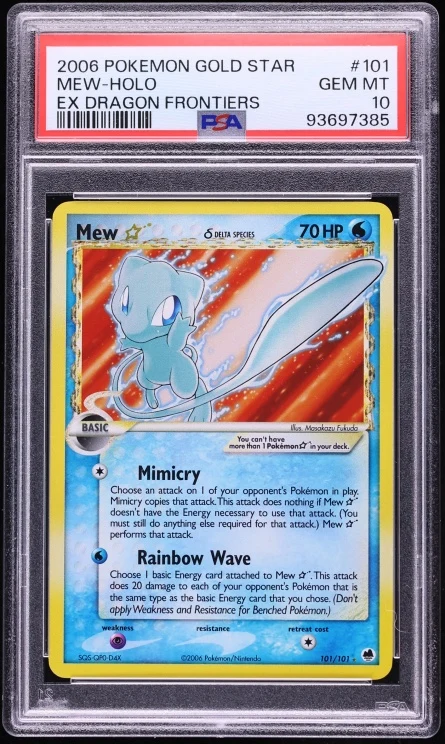
Real sold comps from CardboardSniper's pricing engine · 1 sales(eBay & Fanatics).
The Umbreon star, the most famous card in the class, printed $168,000:
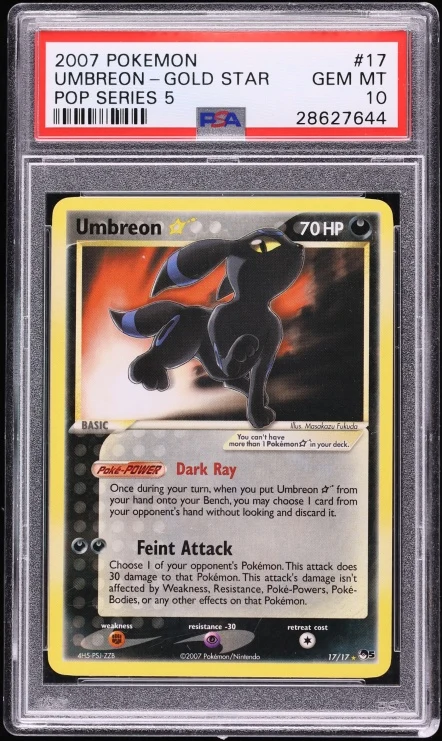
Real sold comps from CardboardSniper's pricing engine · 1 sales(eBay & Fanatics).
The Pikachu star (Holon Phantoms) holds $114,000, the Charizard star $100,000, and the Espeon star, the year's quietest 6.5× move, $90,000:
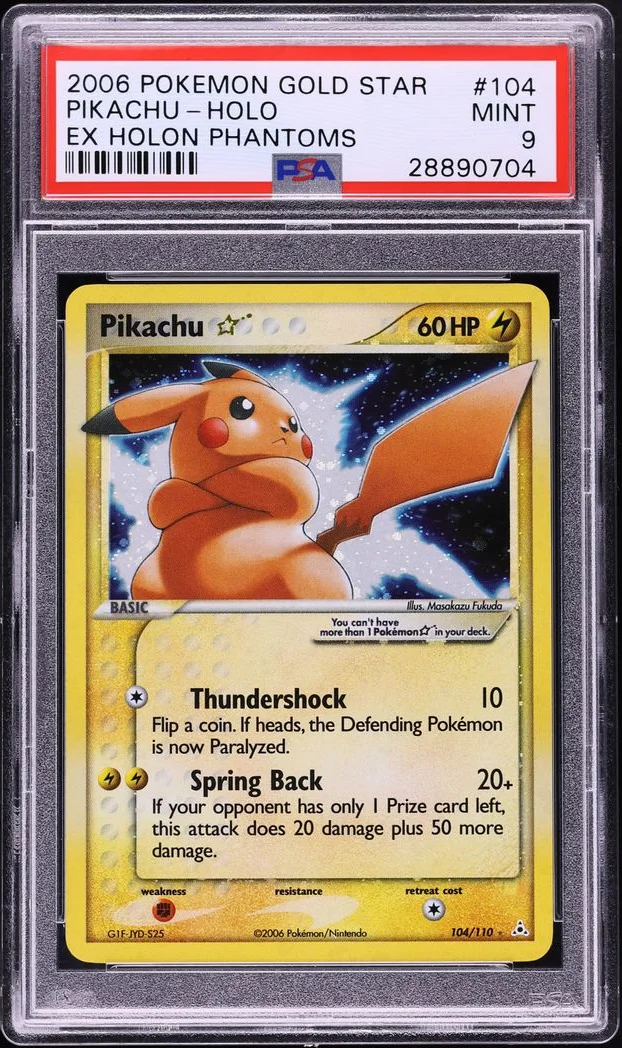
Real sold comps from CardboardSniper's pricing engine · 8 sales(eBay & Fanatics).
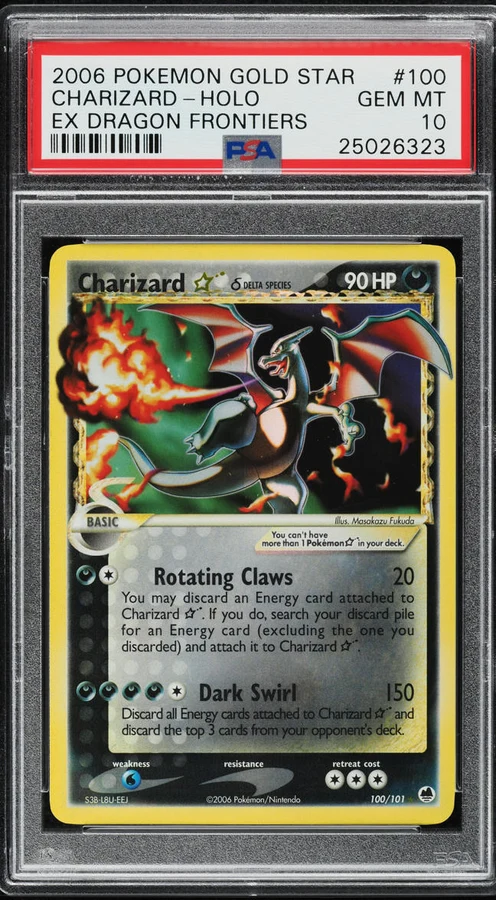
Real sold comps from CardboardSniper's pricing engine · 4 sales(eBay & Fanatics).
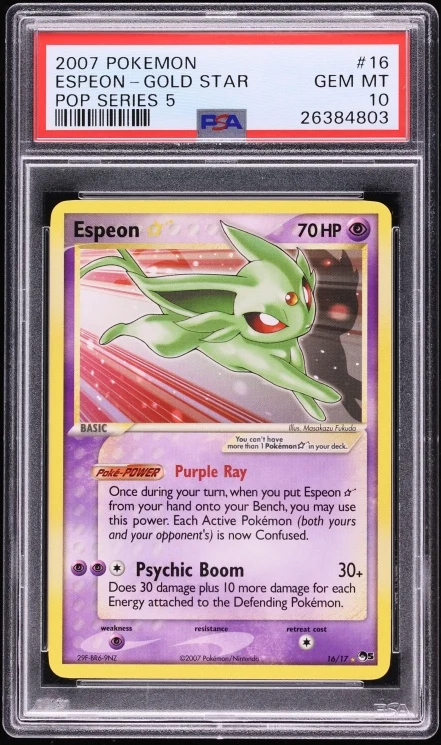
Real sold comps from CardboardSniper's pricing engine · 5 sales(eBay & Fanatics).
Full analysis of each lives in the character guides: Mew, Umbreon, Pikachu, Charizard, Espeon.
The Live Tier: Metagross, Suicune, Entei
Below the records, the repricing is happening in real time. The Metagross star (EX Power Keepers) printed $48,000 on June 28, the same day as the Umbreon and Espeon records, against a longer-run median near $15,000:
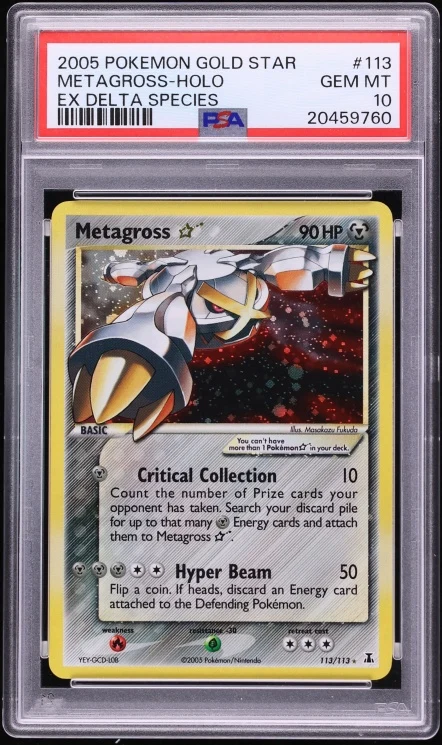
Real sold comps from CardboardSniper's pricing engine · 5 sales(eBay & Fanatics).
The Suicune star (EX Unseen Forces) printed $23,400 on July 5. The engine has its full tape:
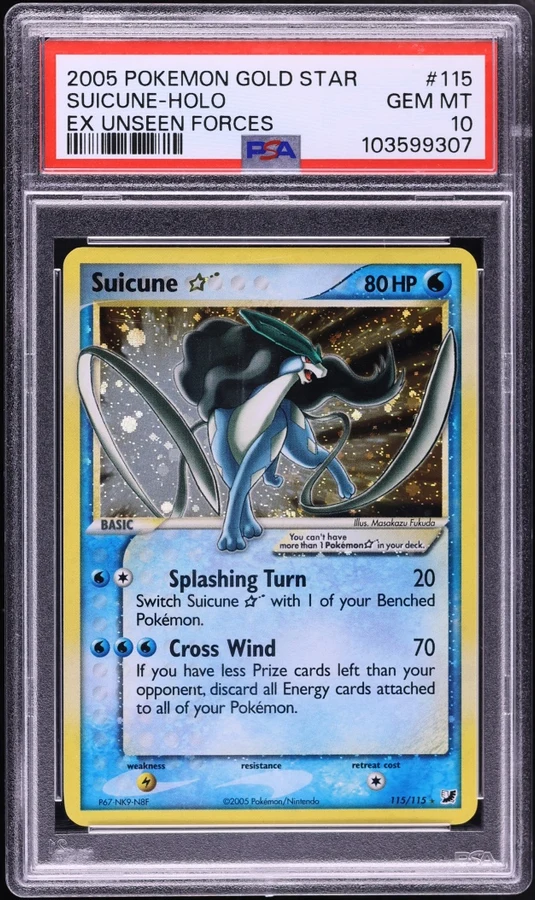
Real sold comps from CardboardSniper's pricing engine · 6 sales(eBay & Fanatics).
And the Entei star ran to $12,000in June, with Raikou's star (thin comps, same set) implied to follow the beast trio's pattern:
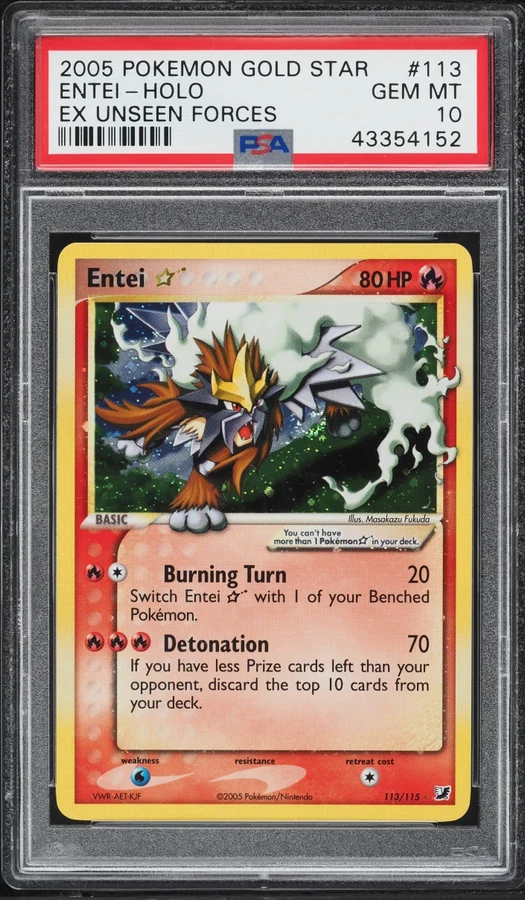
Real sold comps from CardboardSniper's pricing engine · 12 sales(eBay & Fanatics).
The Stale Tier: Rayquaza and Latios
Two stars haven't printed a gem since 2023, and both now trade against a fully repriced class. The Rayquaza star (last print $38,400; PSA 9s at $27,000) is the setup our Rayquaza guide documents in depth:
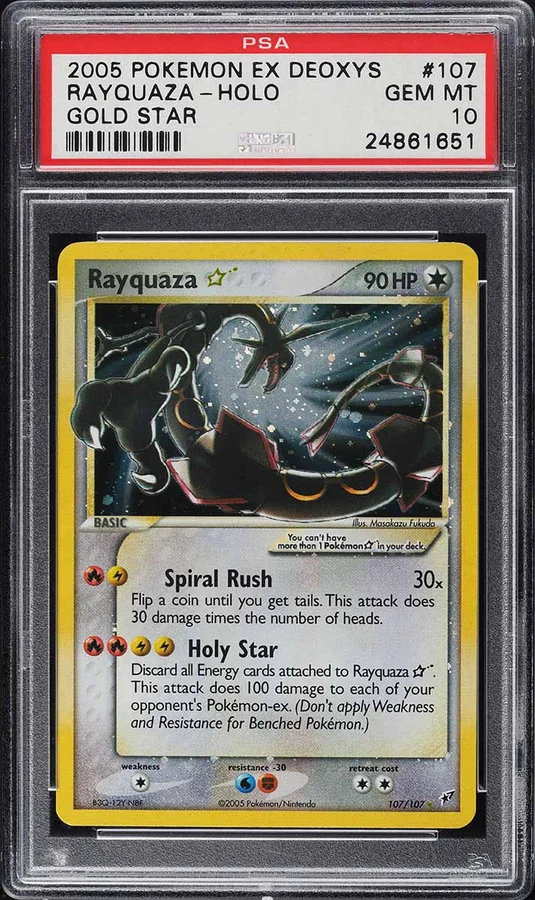
Real sold comps from CardboardSniper's pricing engine · 4 sales(eBay & Fanatics).
The Latios star (EX Deoxys) is stranger still: its last gem prints ($15,000-$15,600, 2023) now sit below its own PSA 9 market at $16,200. A card whose 9s outprice its stale 10s is a market shouting that the next gem print will be a multiple:
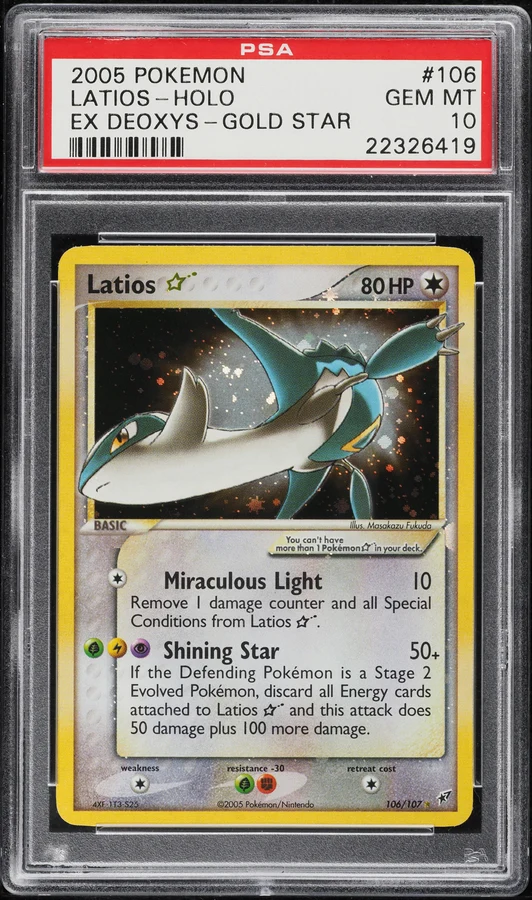
Real sold comps from CardboardSniper's pricing engine · 3 sales(eBay & Fanatics).
The Ghost Tier: Latias and Gyarados
Two stars have no functioning PSA 10 market at all, and they are the class's purest lottery tickets:
- Latias Gold Star (EX Deoxys): zero recent gem comps; PSA 9s trade at $8,562. Its twin Latios's market frames the floor; the class records frame the ceiling.
- Gyarados Gold Star δ (EX Holon Phantoms): zero recent gem comps; PSA 9s at $4,650, from the same set as the $114,000 Pikachu star. Full story in the Gyarados guide.
The pattern to remember: Espeon was effectively a ghost in 2024 (rare prints, low teens), and its next two gems printed $78,000 and $90,000. Ghost stars don't stay ghosts; they surface at auction, and the class prices them on arrival.
Reading the Class: What 2026 Proved
- Classes converge, in order of fame: mascots first, Eeveelutions next, beasts and dragons after, ghosts last. The 2026 tape ran exactly that sequence.
- The June 28 cluster is the tell: three stars printing records the same day means class-level money, not character-level fandom.
- PSA 9s lead gems in stale markets: Rayquaza and Latios 9s repriced while their 10s slept, which is how a class signals before it prints.
- Population is destiny:every star's gem pop is three digits or fewer; there is no supply response possible, ever.
The playbook: own the records through PSA 9s (the gems are trophy markets now), position in the live tier before its records finish printing, hold the stale pair's thesis through their 9s, and watch every auction house for the ghosts.
How High Can Gold Stars Go?
The class went from "five-figure curiosities" to "six-figure records" in eighteen months, and its total gem population across all 27 cards is smaller than a single modern set's print run. The asset class it leads is still tiny:
Total market value: collectibles as an asset class, next to gold, mega-cap tech, and crypto.
The right column is how many times bigger each one is than the entire collectibles market. Collectibles are already a real asset class, larger than a top-ten crypto like Dogecoin, yet still a fraction of a single mega-cap stock and barely a rounding error next to gold. That gap is the runway: as collectibles mature into a transparently priced, investable asset class, the best cards have room to re-rate that the giants no longer do.Figures approximate, 2026: gold = all above-ground gold; equities = market cap; crypto = network value; collectibles = estimated global market size. Bars use a log scale for visibility.
And the returns case is on the board:
Matching Gold Stars to Your Risk Tolerance
The honest caveat: this class just ran harder than any vintage segment in the hobby, and fresh records retrace. The records tier is now a wealth-preservation market; the asymmetry lives in the live tier, the stale prints, and the ghosts, priced accordingly.
Why Every Card Here Is a PSA 10
The Gold Star surface, holofoil character on textured gold, is among the least forgiving in the hobby, and the class premium proves it: Espeon $12,600 in 9 versus $90,000 in 10; Suicune $2,310 versus $23,400. Our PSA 10 price guide covers the grade math in depth.
How to Buy Gold Stars Safely
- Price off sold comps, never listings, via CardboardSniper's value calculator.
- Know your printing: POP Series originals versus 25th-anniversary reprints and non-English editions; the reprint trap runs the whole class.
- Assume fakes everywhere: six-figure cards attract six-figure counterfeiting. Cert-verified slabs only.
- Never market-buy a fresh record: let clusters confirm. The class prints monthly now; patience is cheap.
- Get pinged when one lists below market. The CardboardSniper scanner watches eBay and Fanatics for this exact card and grade around the clock.
Investing in Gold Stars on Graded
Everything this guide measures, CardboardSniper does live: real fair-market values with the value calculator, and the live deal feed where below-market listings surface.
FAQs
What are Gold Star Pokémon cards?
The 27-card class of shiny Pokémon printed 2004-2007 across the EX-era sets and POP promos, marked by a gold star after the name, with pull rates near one per two booster boxes. They are the scarcest chase class in English Pokémon, and in 2026 they became its price leaders.
What is the most expensive Gold Star card?
On real PSA 10 comps: Mew at $192,000 (July 5, 2026), then Umbreon $168,000, Pikachu $114,000, Charizard $100,000, and Espeon $90,000, all record prints from this year.
Which Gold Stars are still undervalued?
The data points at four: Rayquaza (stale $38,400 print, $27,000 PSA 9s), Latios (stale $15,600 print with PSA 9s at $16,200, above the old gems), and the two ghosts, Latias ($8,562 9s, no gem market) and Gyarados ($4,650 9s, no gem market). In a repriced class, the unrepriced members are the standing research list.
Why did Gold Stars reprice in 2026?
Class dynamics: tiny fixed gem populations, fifteen years of under-grading, and record-hunting capital that moved from card to card in fame order. Three records printing on one day (June 28) shows the money was class-level, not character-level.
Are Gold Star cards a good investment?
The record tier is now a trophy market; the investment case lives in the live repricings (Suicune, Entei), the stale prints, and the ghosts, all backed by populations that can never grow. Fresh records retrace, so buy clusters, not headlines, and hold through PSA 9s where gems are trophy-priced.