The Best LeBron James Cards to Invest In (2026): The Full Rookie Ladder, in PSA 10
On this page
- 01The LeBron framework
- 02The LeBron card ladder
- 03Chrome Black Refractor /500
- 04Exquisite RPA
- 05Topps Chrome Refractor
- 06Topps Chrome #111
- 07Bowman Chrome #123
- 08Topps #221
- 092012 Prizm Silver
- 10The liquid entries
- 11The parallel, the patch & the premium
- 12How high can they go?
- 13Match cards to your risk
- 14How to buy safely
- 15Investing on Graded
No athlete has ever carried a card market the way LeBron James carries his. Twenty-three seasons, four rings, the all-time scoring record, and still on the floor: every year he plays, the 2003 rookie class gets scarcer relative to the legend it documents. In 2026 the market moved accordingly. The Topps Chrome Refractor rookie printed $60,000 in June, the Black Refractor grail holds six figures, and the base Topps rookie has more than doubled in a year.
This guide ranks the best LeBron James cards to invest in, built the same way as our basketball investing guide and the flagship guide: on real numbers. Every price below is a real PSA 10 sold comp from CardboardSniper's pricing engine (eBay and Fanatics), not an asking price. We cover the whole 2003 rookie spectrum plus the Prizm era, from $930 to $108,000, and how to buy each one safely — tracked live on the LeBron James market index.
Nothing here is financial advice. Cards are a real but volatile asset class, and you should never put in money you can't afford to lose. Here's what the data shows.
- The Topps Chrome Black Refractor /500 is the grail. Real PSA 10 comps run $102,000-$144,000 across 2023-2025 (with a $264,000 print at the 2021 peak), the most valuable LeBron that actually trades.
- Every card in this guide is quoted in PSA 10, because in LeBron collecting the gem is the asset: the same Refractor is $13,800 in PSA 9 and $60,000 in PSA 10.
- The Refractor is 2026's mover: from $33,600 in November 2025 to $60,000 in June 2026 on deep, steady volume, the strongest premium-parallel tape in sports cards this year.
- The rookie core repriced together. The base Topps #221 ran $2,560 to $6,000, Bowman Chrome to $8,700, and the reference Topps Chrome #111 holds $12,600 on sixty real comps.
- The trophy tier trades in private-jet sizes. The 2003 Exquisite RPA printed $132,000 and $63,000 in PSA 10, and its Limited Logos sibling sold for $504,000. These are auction-house markets, not eBay markets.
- The Prizm era is the second act.The 2012 Silver Prizm, LeBron's first-year Prizm parallel, ran $10,650 to $24,600 in eighteen months, and the base Prizm at $930 is the liquid entry.
The Framework: What Makes a LeBron Card an Investment
Every card below passes the same five-part filter we use across this series, tuned for the greatest basketball market of the modern era:
- One player, one rookie year.The market anchors nearly all of LeBron's value to the 2003-04 releases. Everything else, including the Prizm era, prices off that anchor.
- The parallel is the asset. Same #111, three markets: base Chrome ($12,600), Refractor ($60,000), Black Refractor /500 ($108,000). Print runs and serial numbers decide everything.
- Gem scarcity is the moat. 2003 Topps Chrome centering was notoriously cruel, so PSA 10 premiums run 4-5× the PSA 9 across the rookie core.
- Career risk is retired. Unlike the modern rookies in our basketball guide, LeBron's resume is complete and unmatched. What remains is the retirement cycle: markets historically re-rate legends around their farewell season and Hall induction.
- Liquidity is elite. The rookie core trades weekly on both eBay and Fanatics; only the trophy tier (Exquisite, Black Refractor) moves through auction houses. Exits are the easiest in the hobby.
The LeBron Card Ladder
"Best LeBron cards" spans two orders of magnitude, all of it in gem mint. Here's where the nine defining cards actually sit, on real PSA 10 sold comps:
Bars use a logarithmic scale so every rung is visible. Every value is a real 2025-2026 PSA 10 sold comp, not an asking price.
Read it as four tiers. The liquid entries (base Prizm, Star Rookie) are the on-ramp. The rookie core (Topps, Bowman Chrome, Topps Chrome) is the blue-chip middle. The premium parallels (Silver Prizm, Refractor) are where the 2026 repricing concentrated. And the grails (Exquisite, Black Refractor) trade like the trophy assets they are.
Topps Chrome Black Refractor /500: The Grail
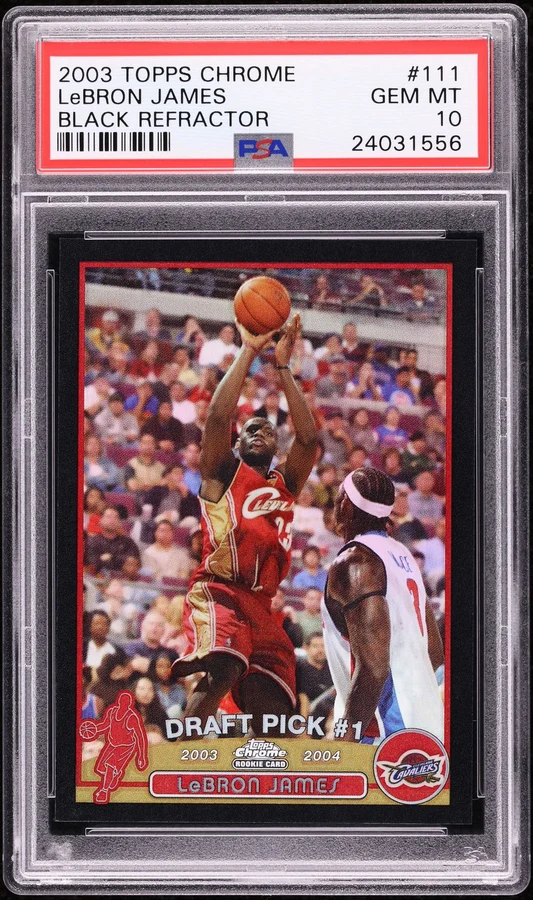
The 2003 Topps Chrome Black Refractor #111, serial-numbered to 500, is the definitive LeBron: the scarcest parallel of the definitive rookie, in the set that defines the era. Real PSA 10 sales:
Real sold comps from CardboardSniper's pricing engine · 6 sales(eBay & Fanatics).
View live data on CardboardSniper →The tape tells the whole market's story in one card: a $264,000 print at the 2021 peak, the 2022-2023 cooldown to $102,000, and a firming trend since ($132,000 in late 2024, $108,000 in July 2025). With the PSA 9 around $33,600, the gem premium is a comparatively gentle 3×, because at /500 the card itself is the scarcity. This is the LeBron that behaves like the 1st Edition Charizard: the bellwether the rest of the ladder prices off.
2003 Exquisite Rookie Patch Auto /99: The Trophy
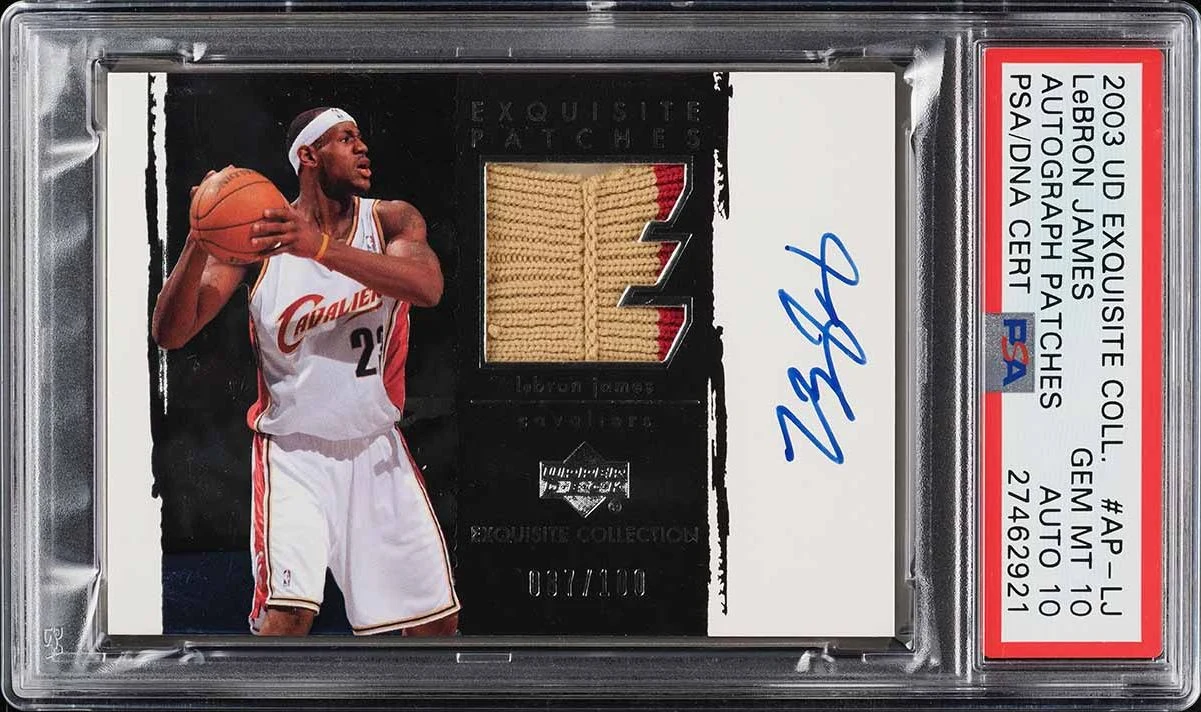
The 2003-04 Exquisite Collection RPA is the most famous basketball card of the century: on-card auto, game-worn patch, serial-numbered to 99, from the set that invented the modern high-end. Real PSA 10 sales:
Real sold comps from CardboardSniper's pricing engine · 2 sales(eBay & Fanatics).
PSA-graded copies printed $132,000 (2021) and $63,000(2023), and the market's true ceiling shows in the family: an Exquisite Limited Logos /75 patch auto sold for $504,000 in PSA 10, and BGS-graded copies of the /99 RPA have traded into seven figures at auction. This is a trophy market: thin, auction-house-driven, and the single most prestigious LeBron that exists. Buy it as art, position-size it like real estate.
Topps Chrome Refractor: The 2026 Mover
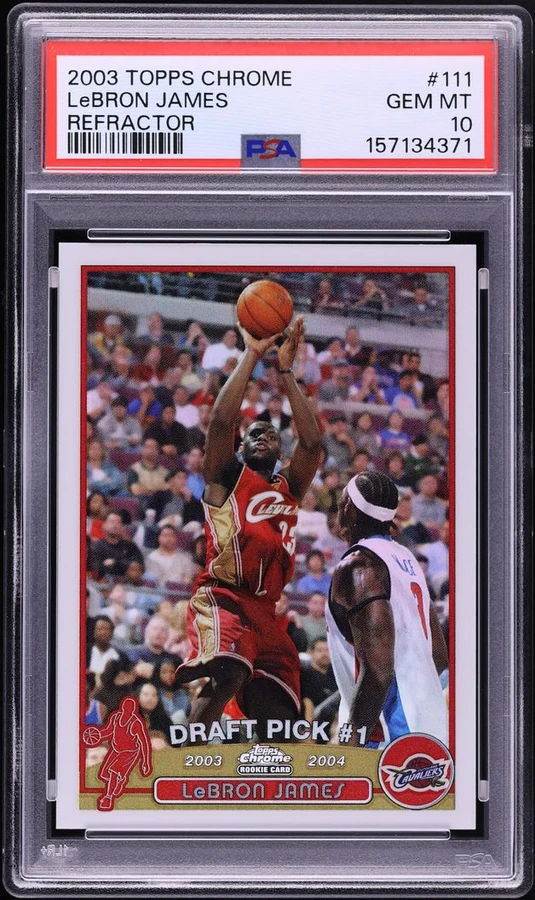
The Topps Chrome Refractor #111is the premium parallel with real liquidity, and it's been the strongest LeBron tape of 2026:
From $33,600 in November 2025 to $60,000 in June 2026, on thirty-two real comps stretching back years:
Real sold comps from CardboardSniper's pricing engine · 32 sales(eBay & Fanatics).
View live data on CardboardSniper →The Refractor sits in the sweet spot: 5× the base Chrome's price with genuine weekly liquidity, unlike the serial-numbered grails above it. The PSA 9 at $13,800 is the value entry, and the 4.3× gem premium is pure 2003 centering scarcity.
Topps Chrome #111: The Reference Rookie
The base Topps Chrome #111 is the reference asset of modern basketball: the card every LeBron conversation starts with, and the deepest premium rookie market in the sport. Real PSA 10 sales:
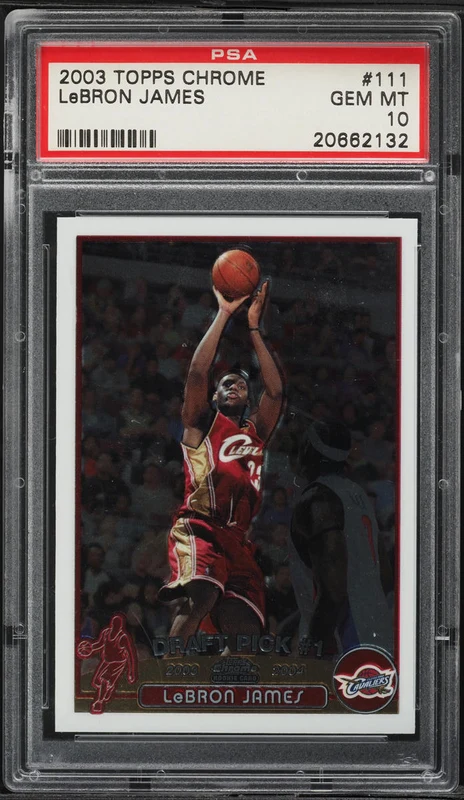
Real sold comps from CardboardSniper's pricing engine · 60 sales(eBay & Fanatics).
View live data on CardboardSniper →The gem trades around $12,600 on sixty real comps, up from a $7,700 longer-run median. Our basketball guideranks it among the sport's chrome-era grails alongside the 1996 Kobe; within the LeBron ladder it's the liquid core holding, the one you can size up or exit any week of the year.
Bowman Chrome #123: The Other Chrome Rookie
The 2003 Bowman Chrome #123is the Chrome rookie's quieter sibling, printed shallower than Topps Chrome and long undervalued against it. Real PSA 10 sales:
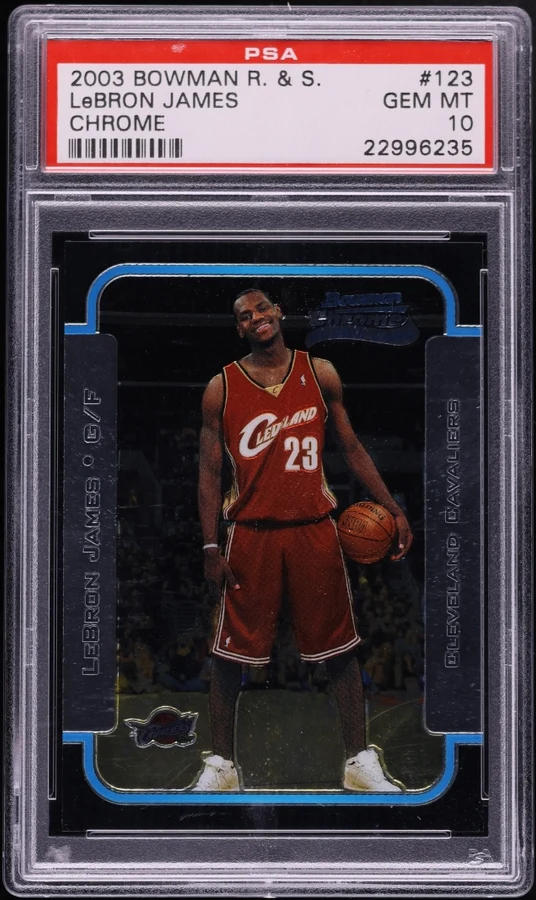
Real sold comps from CardboardSniper's pricing engine · 33 sales(eBay & Fanatics).
View live data on CardboardSniper →The gem ran from a $5,400 median to $8,700 on the latest print (July 5), with the PSA 9 around $1,110. The Topps Chrome trades at just 1.4× this card despite far greater fame, which makes Bowman Chrome the relative-value pick of the rookie core.
Topps #221: The Flagship Paper Rookie
The 2003 Topps #221is the people's LeBron rookie: the flagship paper card, pulled from packs sold at every grocery store in America in 2003. Real PSA 10 sales:
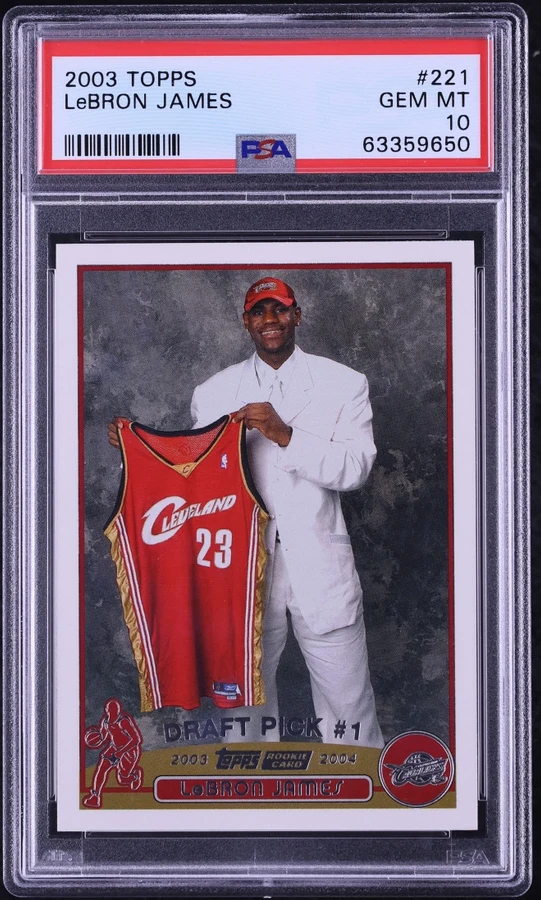
Real sold comps from CardboardSniper's pricing engine · 40 sales(eBay & Fanatics).
View live data on CardboardSniper →The gem more than doubled inside a year, from a $2,560 median to $6,000on the July 5 print, with deep PSA 9 liquidity around $1,200. Paper gems are harder than they look (2003 Topps chipped badly), and the card's cultural reach is the widest of any LeBron. It's the classic first-serious-position card.
2012 Prizm Silver: The Prizm-Era Chase
Prizm arrived in 2012 and became the sport's modern currency; the 2012-13 Silver Prizm LeBron #1, card number one of the entire Prizm era, is its first-year chase. Real PSA 10 sales:
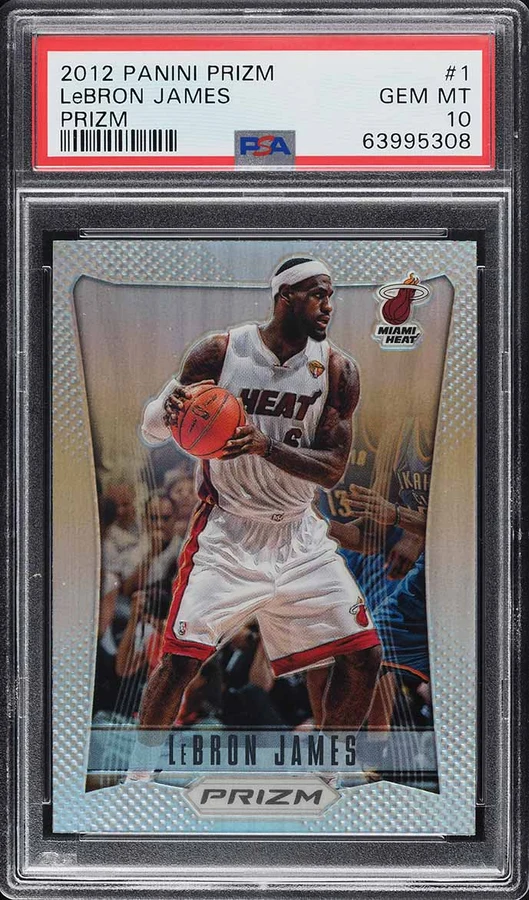
Real sold comps from CardboardSniper's pricing engine · 3 sales(eBay & Fanatics).
View live data on CardboardSniper →From $10,650 in April 2024 to $24,600 in August 2025, mirroring the Silver Prizm repricing our basketball guidedocumented across the modern rookies. First-year Prizm silvers gem brutally rarely, and LeBron's is the one the set is remembered for. Watch the label: the "MVP Silver" insert of the same year is a different, cheaper card.
The Liquid Entries: UD Star Rookie and Base Prizm
Two cards make the on-ramp. The 2003 Upper Deck Star Rookie #301 is the classic mass-market rookie, around $1,100 in PSA 10:
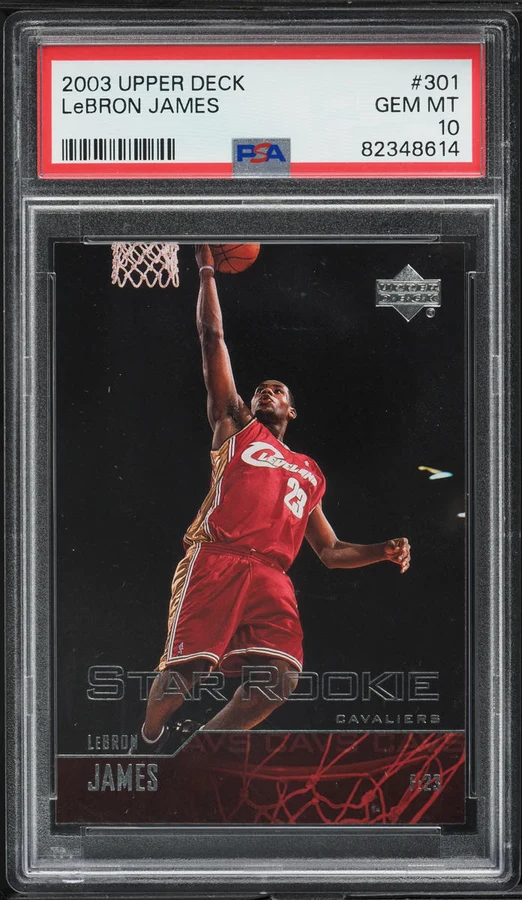
Real sold comps from CardboardSniper's pricing engine · 17 sales(eBay & Fanatics).
View live data on CardboardSniper →And the 2012 base Prizm #1, the first card of the Prizm era, trades around $930:
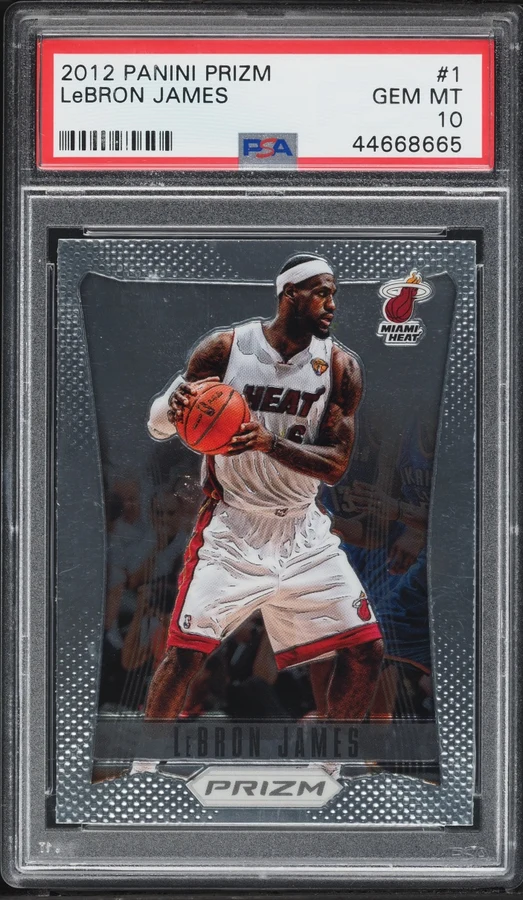
Real sold comps from CardboardSniper's pricing engine · 24 sales(eBay & Fanatics).
View live data on CardboardSniper →Both are demand plays with real populations, not scarcity plays. They index LeBron sentiment, trade any day of the week, and are the right size for a first position before graduating up the ladder.
The Parallel, the Patch, and the LeBron Premium
Zoom out on the nine cards above and the discipline is the same one that runs this whole series: the print run is the asset, and LeBron's 2026 repricing concentrated in the scarcest presses.
- The parallel ladder is the market. One photograph, one card number, an 8.5× spread: base Chrome $12,600, Refractor $60,000, Black Refractor $108,000. Serial numbers are the whole game.
- The premium tier moved first. The Refractor nearly doubled in seven months while the base Chrome held steady, classic late-cycle behavior where money concentrates up the scarcity curve.
- The paper rookies are the value tier. Topps #221 and Bowman Chrome repriced hard off small bases and still trade at fractions of the Chrome. The fame gap exceeds the scarcity gap.
- The retirement cycle is the catalyst nobody prices.Legends historically re-rate around farewell tours and Hall induction. LeBron's is the most anticipated in sports history, and every card on this list is a claim on that moment.
The playbook: make the Topps Chrome (or its PSA 9) the core, treat the Refractor as the growth position with real liquidity, size the grails like the auction-house assets they are, and use the paper rookies and Prizms as the accumulation tier while the spread to the Chrome lasts.
How High Can LeBron Cards Go?
LeBron's ceiling argument is generational math: the most-watched basketball player of all time, a two-decade global fanbase entering its peak earning years, and a rookie class whose gem supply was fixed in 2003. The asset class it leads is still tiny next to the markets it behaves like:
Total market value: collectibles as an asset class, next to gold, mega-cap tech, and crypto.
The right column is how many times bigger each one is than the entire collectibles market. Collectibles are already a real asset class, larger than a top-ten crypto like Dogecoin, yet still a fraction of a single mega-cap stock and barely a rounding error next to gold. That gap is the runway: as collectibles mature into a transparently priced, investable asset class, the best cards have room to re-rate that the giants no longer do.Figures approximate, 2026: gold = all above-ground gold; equities = market cap; crypto = network value; collectibles = estimated global market size. Bars use a log scale for visibility.
And the returns case is on the board. Indexed from 2010, blue-chip cards have out-compounded the S&P 500:
The comparison the market keeps making is the 1986 Fleer Jordan: the last time a basketball legend's defining rookie met a retirement-era demand wave, it became a $300,000 card. LeBron's equivalents still trade at a third of that. That gap, and whether it closes, is the LeBron trade.
Matching LeBron Cards to Your Risk Tolerance
The tiers sit in very different places on the risk map:
A sane LeBron portfolio anchors in the rookie core (Topps Chrome at the grade your budget allows), rides the premium parallels as the growth sleeve, and treats the trophy tier as illiquid art. The most common mistake is buying the hype cards of his later seasons instead of the 2003 class; the market has voted for two decades, and it votes for the rookies.
Why Every Card Here Is a PSA 10
Every card in this guide is quoted in PSA 10 because, in the 2003 class, the gem is the asset: the same Refractor is $13,800 in PSA 9 and $60,000 in PSA 10, and the same Topps #221 is $1,200 versus $6,000. 2003 Topps Chrome centering was merciless, so the gem populations are small fractions of the graded totals. Grading authenticates the card, certifies the condition, and produces the population data this whole analysis runs on. The flagship guide covers grading from first principles.
How to Buy LeBron Cards Safely
- Price off sold comps, never listings. Look up the exact card, parallel, and grade on CardboardSniper's value calculator before you bid.
- Verify the parallel. Base versus Refractor versus Black Refractor, Silver Prizm versus MVP Silver insert, and always check serial numbers against the print run.
- Trophy tier means auction houses. Exquisite and Black Refractor gems move through Goldin and Fanatics auctions, not fixed-price listings. Patience is part of the position.
- Assume fakes and trimmed cards. The 2003 class is heavily counterfeited and historically trimmed. Graded slabs with verifiable cert numbers are the floor.
- Get pinged when one lists below market. The CardboardSniper scanner watches eBay and Fanatics for this exact card and grade around the clock.
Investing in LeBron Cards on Graded
Everything this guide measures, CardboardSniperdoes live. Look up any LeBron card's real fair-market value, population, and gem rate with the value calculator, and let the CardboardSniper scanner watch eBay and Fanatics for below-market listings of every card on this list. No saved-search spam, and the comps math is included with every alert.
FAQs
What is the best LeBron James card to invest in?
The 2003 Topps Chrome Black Refractor /500 is the grail, with real PSA 10 comps of $102,000-$144,000. For real-world budgets, the Topps Chrome Refractor (~$60,000), the base Topps Chrome #111 (~$12,600 on sixty comps), Bowman Chrome (~$8,700), and the base Topps #221 (~$6,000) cover the rookie core, with the 2012 Silver Prizm (~$24,600) as the modern-era chase.
How much is a LeBron James rookie card worth?
In PSA 10 on real 2026 comps: base Topps Chrome #111 ~$12,600, Topps Chrome Refractor ~$60,000, Black Refractor /500 ~$108,000, Bowman Chrome #123 ~$8,700, Topps #221 ~$6,000, and Upper Deck Star Rookie #301 ~$1,100. PSA 9s run roughly a quarter to a fifth of those numbers.
What is the most expensive LeBron James card?
The 2003-04 Exquisite Collection rookie patch autos: PSA 10 prints of $132,000 and $63,000 for the /99 RPA, a $504,000 sale for the Limited Logos /75, and BGS-graded copies have reached seven figures at auction. Among cards that trade with regularity, the Topps Chrome Black Refractor /500 leads at $102,000-$144,000 in PSA 10.
Is the Topps Chrome Refractor LeBron a good investment?
It's been 2026's best LeBron tape: from $33,600 in November 2025 to $60,000 in June 2026 on thirty-two real PSA 10 comps with genuine weekly liquidity. It occupies the sweet spot between the liquid base Chrome and the illiquid serial-numbered grails. The PSA 9 around $13,800 is the value entry.
Are LeBron James cards a good investment?
The 2003 rookie class has two decades of track record, elite liquidity, and a completed resume with the retirement re-rating still ahead. The 2026 tape shows money concentrating up the scarcity curve: the Refractor nearly doubled while the base held. Like all cards they are volatile and cyclical, so buy the scarcest parallel your budget allows at proven grades, price everything off real sold comps, and size for the swings.