Trading Card Deal Alerts Based on Sold Prices (2026): 12 Real Snipes, With Receipts
On this page
A trading card deal alert based on sold prices compares every new listing against recorded sales of the same card, at the same grade, from the same grader, and tells you within minutes when a listing is priced below that number. It is a different animal from a keyword alert, which fires on every match, and from a price alert, which fires on a ceiling you typed in last month. This page shows twelve real alerts the CardboardSniper scanner fired between July 25 and September 22, 2026, with receipts: the listing price, the grade-matched comp at the moment of the alert, the recorded sales behind that comp, and what happened to the card afterward, checked on eBay. Read it next to how grade-matched comps work and the card sniping playbook.
How CardboardSniper Works, Step by Step
You tell it one card. It watches eBay and Fanatics Collect every minute, prices every new listing of that card against what the same card in the same grade actually sold for, and emails you when one lists below that number. You buy it on eBay yourself. That is the whole product. Here is what each step looks like in the app, using the real catches from this article.
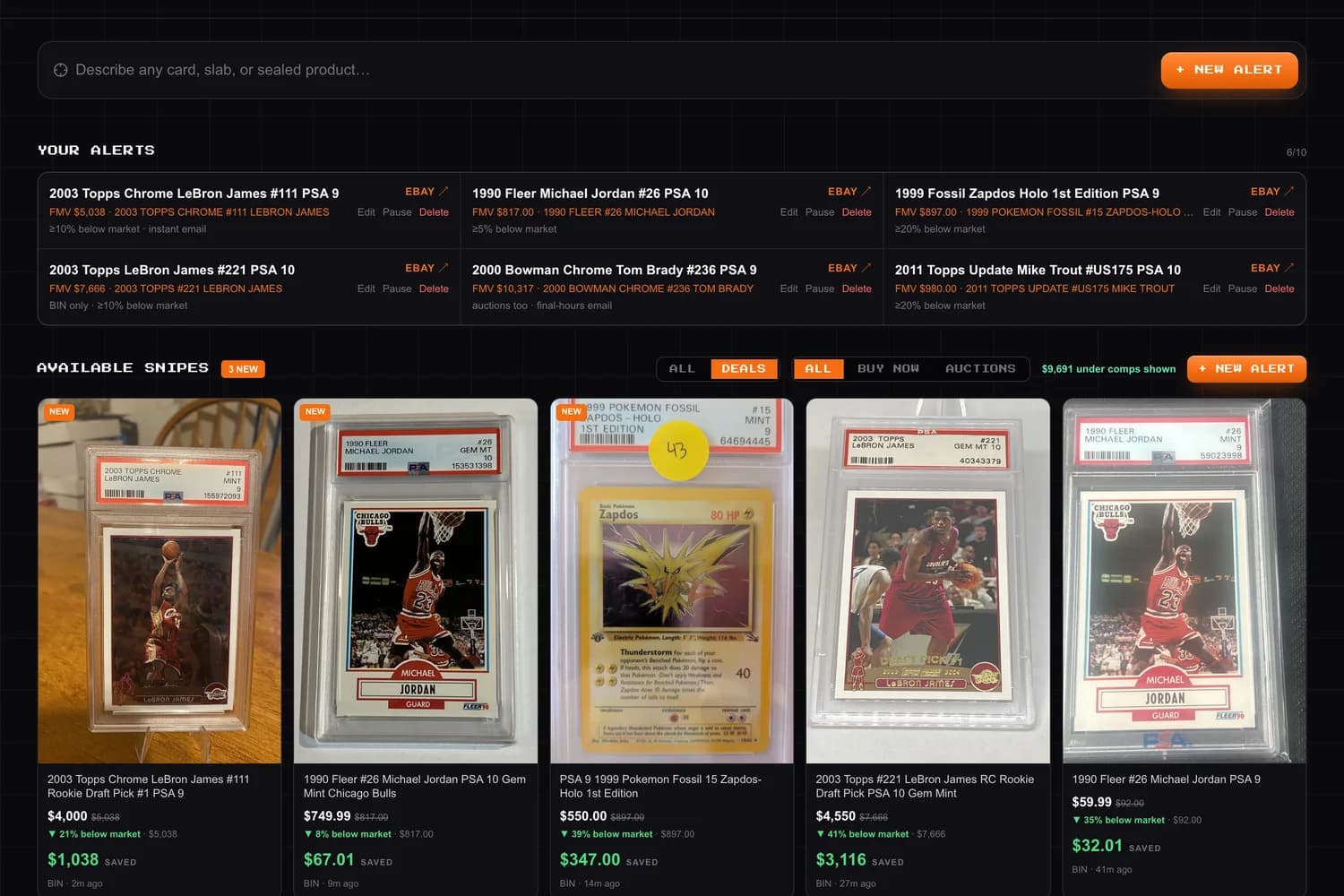
1. You describe the card you want
Type it the way you would say it: 2003 Topps Chrome LeBron James #111 PSA 9. The app identifies the exact card and grade, pulls the recent sales for it, and shows you the number it will judge every listing against. That number is the comp: the average of the last three recorded sales of that exact card at that exact grade. For the LeBron it was $5,038. You then choose how far below the comp a listing has to be before you want to hear about it. Ten percent for a card you want to own, twenty for a card you want to flip.
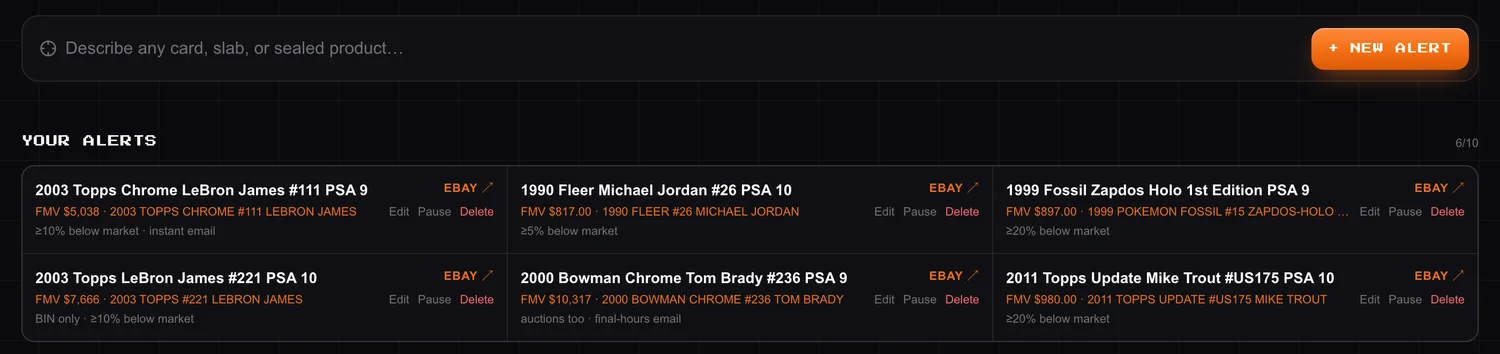
2. It watches the marketplaces around the clock
From that moment the scanner checks eBay and Fanatics Collect for your card every minute, all day and all night. Nothing to refresh, no saved search email that arrives once a day. When a new listing of your card appears, the app sees it inside the first minute or two.
3. Every new listing gets priced against the comp
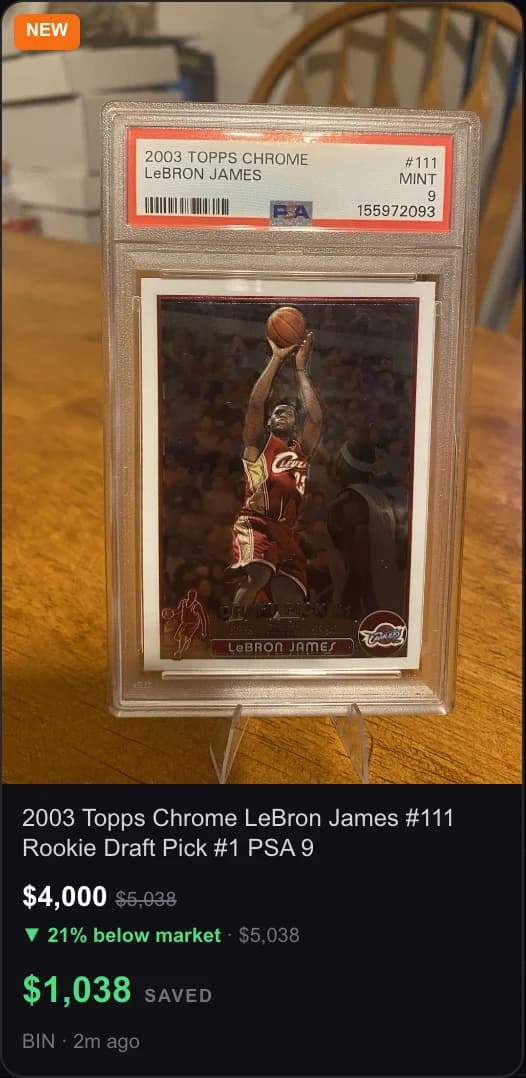
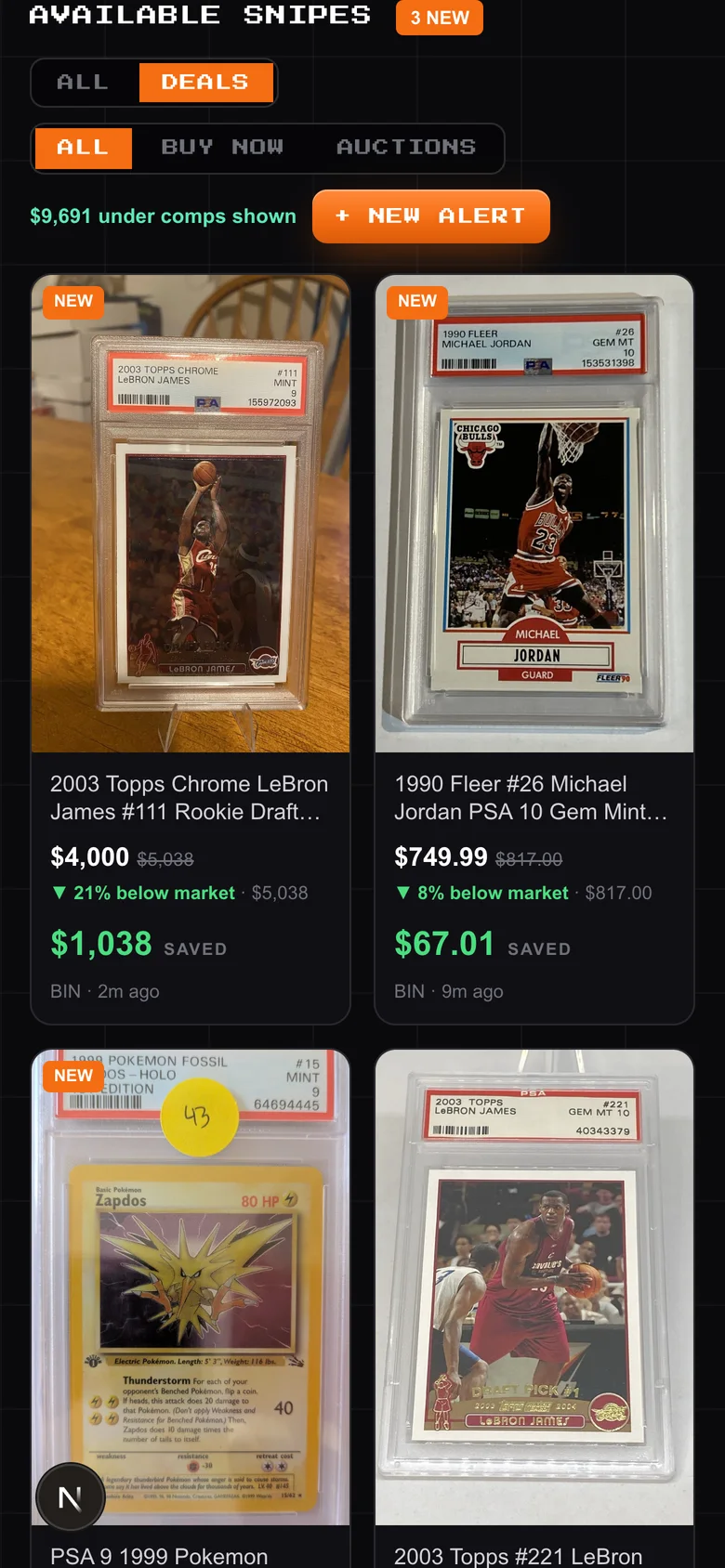
This is the part a keyword alert cannot do. The app does not just tell you a LeBron listed; it tells you the LeBron listed at $4,000 against a $5,038 comp, which is 21 percent below market and $1,038 under what the last three sold for. If the listing is above your threshold, it stays in the feed and does not email you. If it is below, it does.
4. You get the alert in minutes, and you buy it yourself
The alert lands as an email (and in the feed, and on your phone) within minutes of the listing going up, with the price, the comp, and the link. CardboardSniper never buys or sells anything. You tap through to eBay or Fanatics and buy from the same listing page you would have found yourself, with that marketplace's own buyer protection. The LeBron sold two minutes after the alert. The buyer did not need to research anything, because the number was in the email.
What it costs and what it does not do
Plans start at $20 a month for two alerts and go up to twelve alerts for dealers, every plan starts with a free 7 day trial, and alerts are unlimited on every plan. It does not bid for you, it does not buy for you, and it does not hold your money. It finds the listing, attaches the number, and gets it to you first.
What a Sold-Price Deal Alert Actually Is
Most card alerts tell you a listing exists. A sold-price alert tells you whether it is cheap. An eBay saved search emails you at most once per day, and only when new listings match in the prior 24 hours; it cannot tell a steal from a listing at double the going rate. A price alert is one step better, but the number you typed in goes stale the first time the market moves. A sold-price alert already knows what the card last sold for at that exact grade, so each new listing is judged against a number the market set, not one you set.
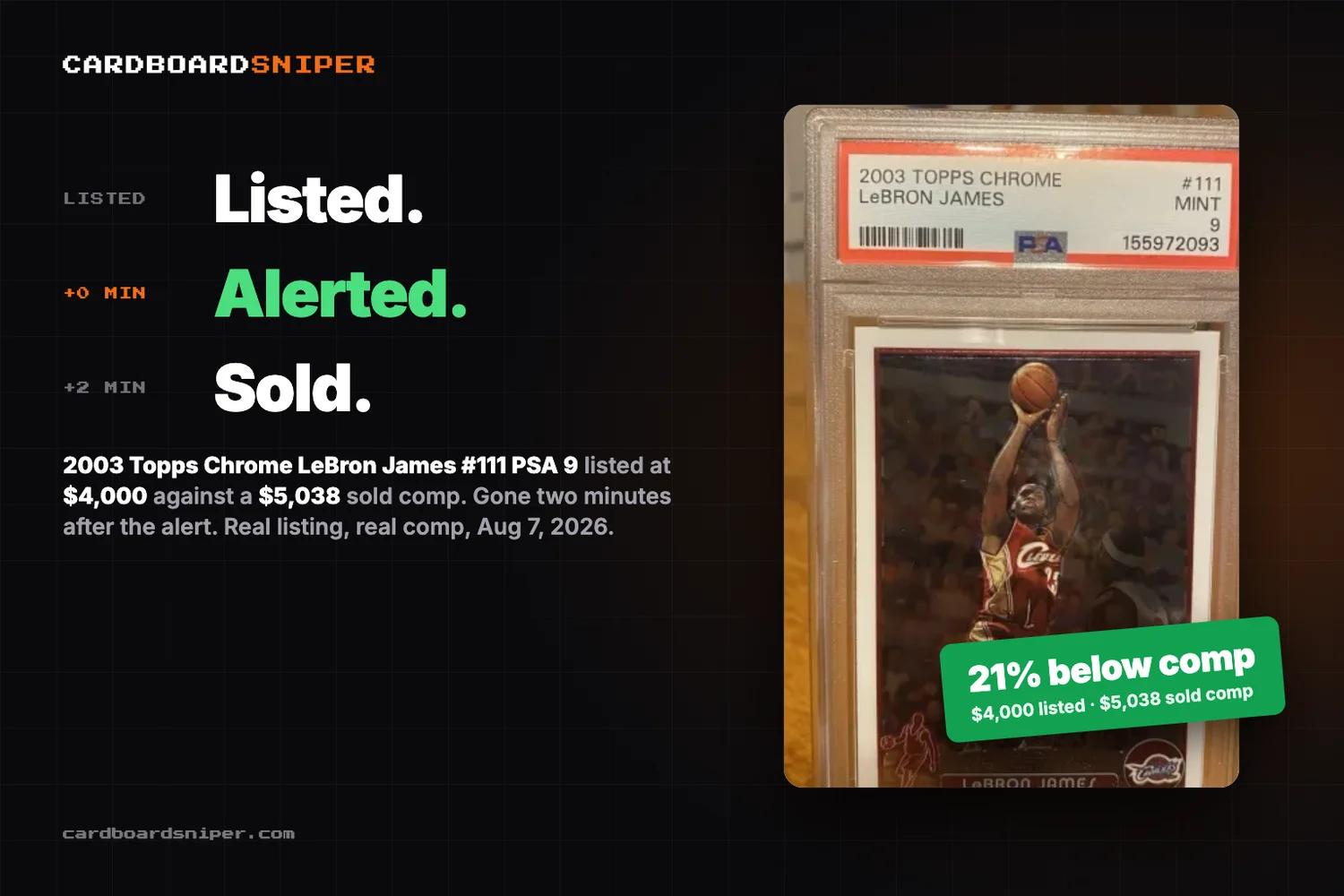
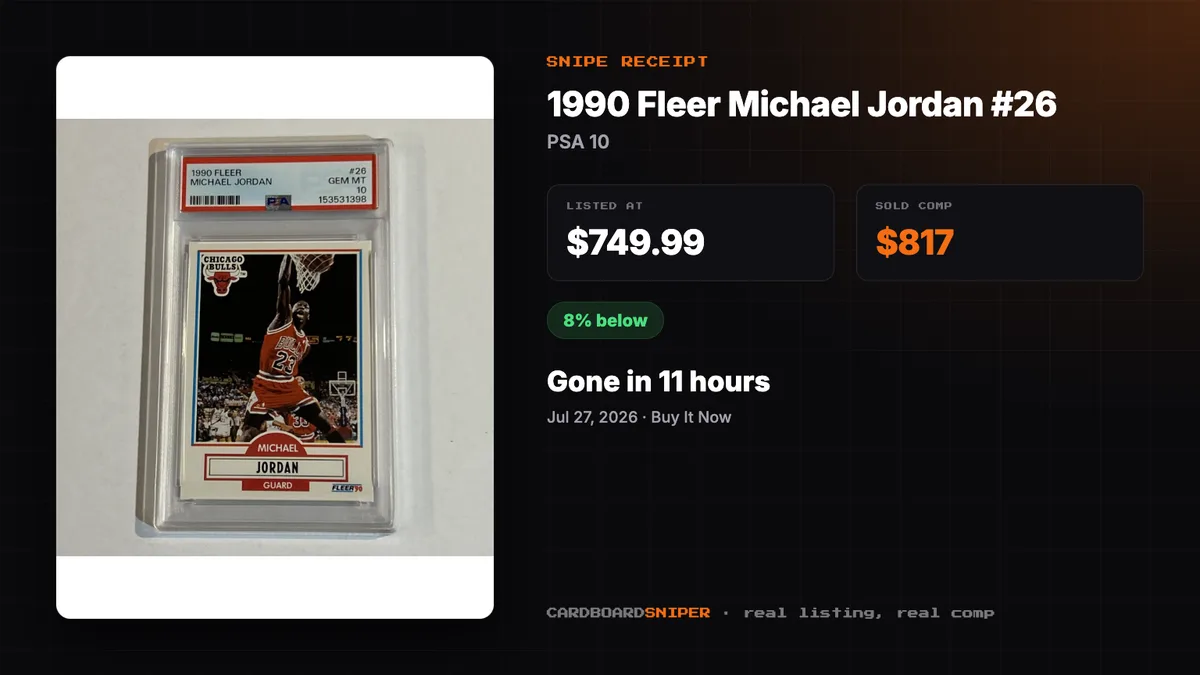
Two details decide whether this kind of alert is worth anything. The comp has to be grade matched, meaning a PSA 9 is judged against PSA 9 sales and never against the PSA 10 price. And the alert has to arrive while the listing is still buyable, which for an underpriced Buy It Now listing is measured in minutes, not days. CardboardSniper's comp is the average of the last three sane recorded sales of the exact card and grade, with obvious outliers trimmed; when a grade has no recent sales the alert shows no verdict rather than borrowing a number from another grade. The first receipt in this article, in one frame:
Twelve Real Snipes, With Receipts
Start with the eight Buy It Now catches, because those are the ones where minutes matter. For each one the table shows the price it listed at, the grade-matched comp at the moment the alert fired, and what the listing did next. Outcomes come from the eBay listing pages themselves, re-checked in October. The first six were bought; the last two were pulled by the seller before anyone bought them.
| Card | Alert | Listed at | Sold comp | Gap | What happened |
|---|---|---|---|---|---|
| 2003 Topps Chrome LeBron James #111 PSA 9 | Aug 7 | $4,000 | $5,038 | 21% | Sold 2 minutes after the alert |
| 1990 Fleer Michael Jordan #26 PSA 9 | Jul 27 | $59.99 | $92 | 35% | Gone in 28 minutes |
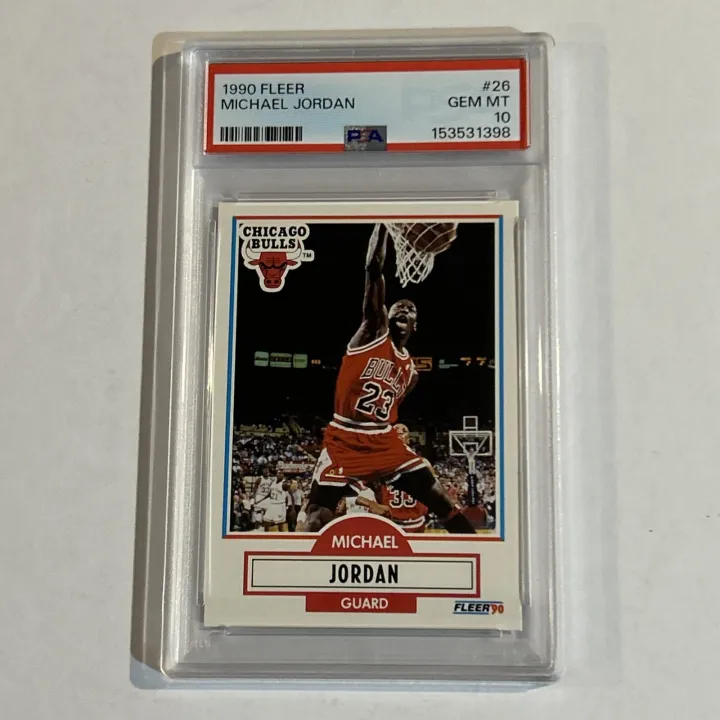
| 1990 Fleer Michael Jordan #26 PSA 10 | Jul 27 | $749.99 | $817 | 8% | Gone in 11 hours |
| 1990 Fleer Michael Jordan #26 PSA 10 | Jul 25 | $739 | $817 | 10% | Gone in 19 hours |
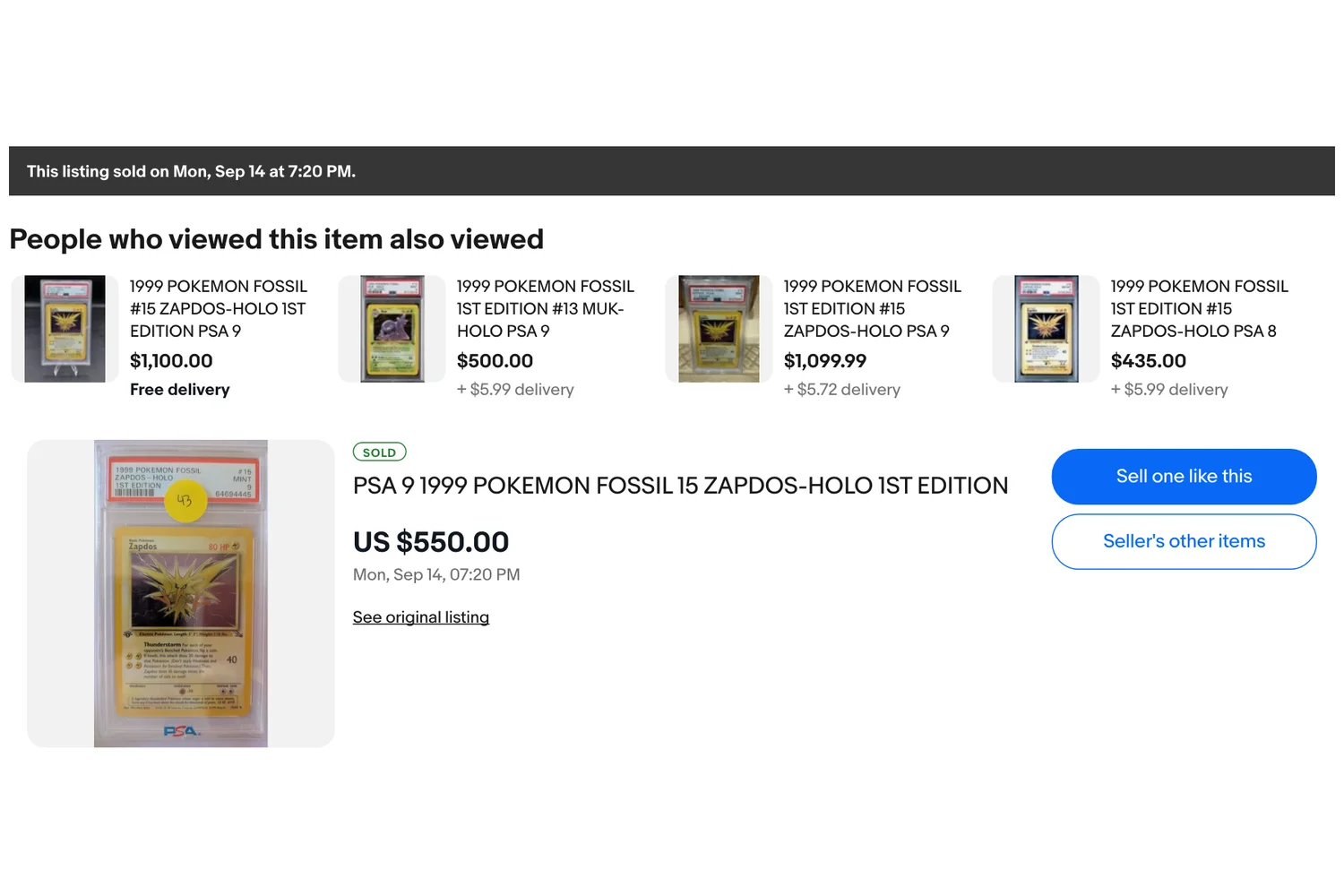
| 1999 Fossil Zapdos Holo 1st Edition PSA 9 | Sep 14 | $550 | $897 | 39% | Sold in 19 hours |
| 2002 Expedition Kingler Holo PSA 9 | Sep 22 | $497.55 | $893 | 44% | Sold in 5 days |
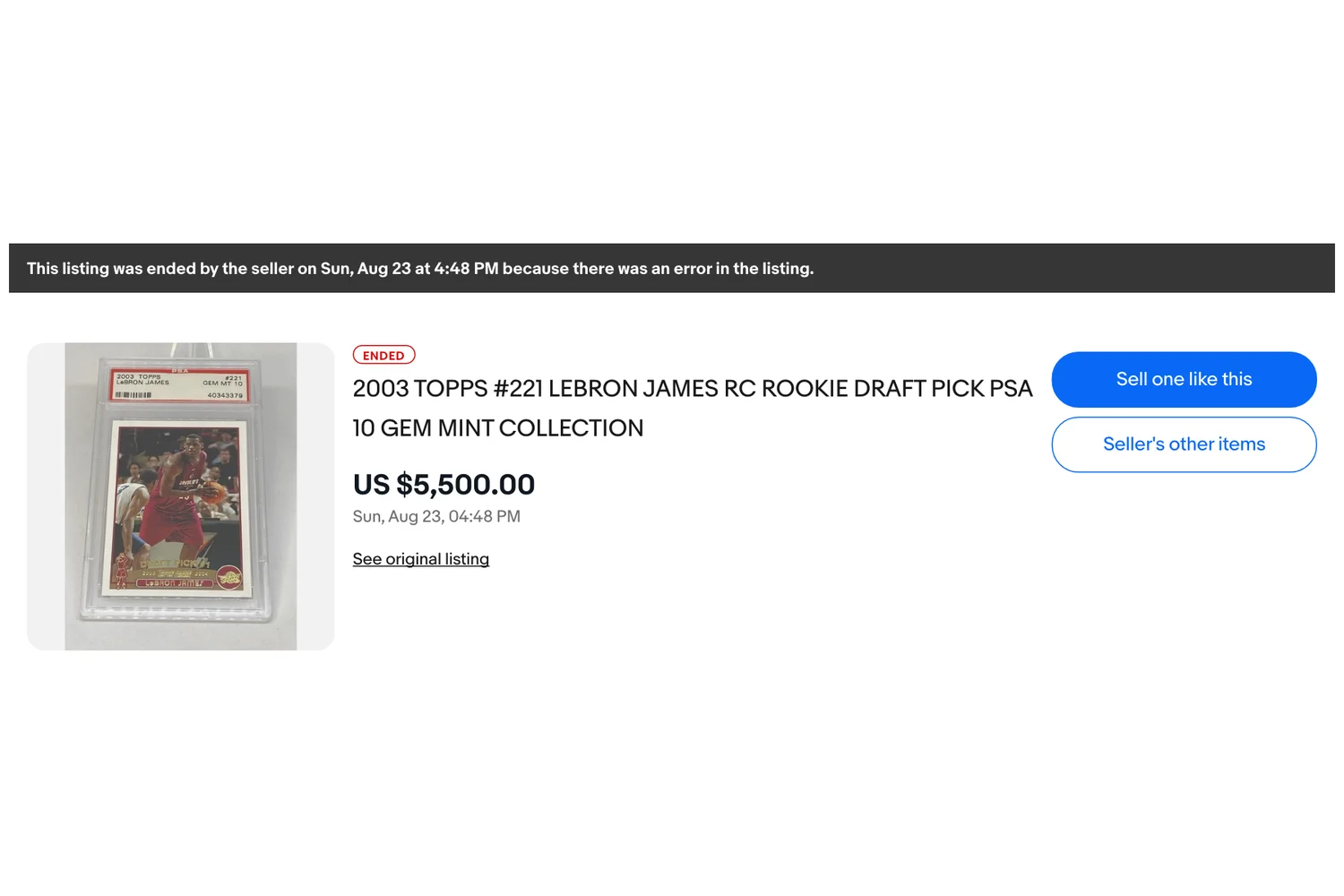
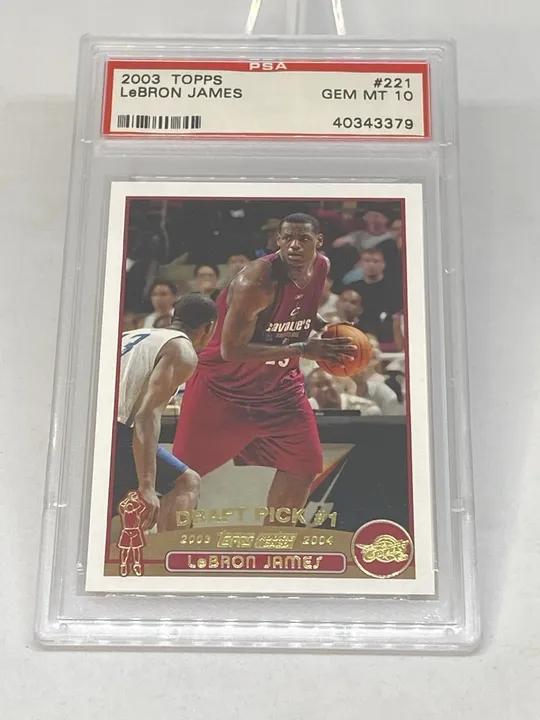
| 2003 Topps LeBron James #221 PSA 10 | Aug 22 | $4,550 | $7,666 | 41% | Seller ended it after 40 hours, citing a listing error |
| 2003 Topps LeBron James #221 PSA 10 | Sep 22 | $5,600 | $7,666 | 27% | Seller ended it after 62 hours, same reason |
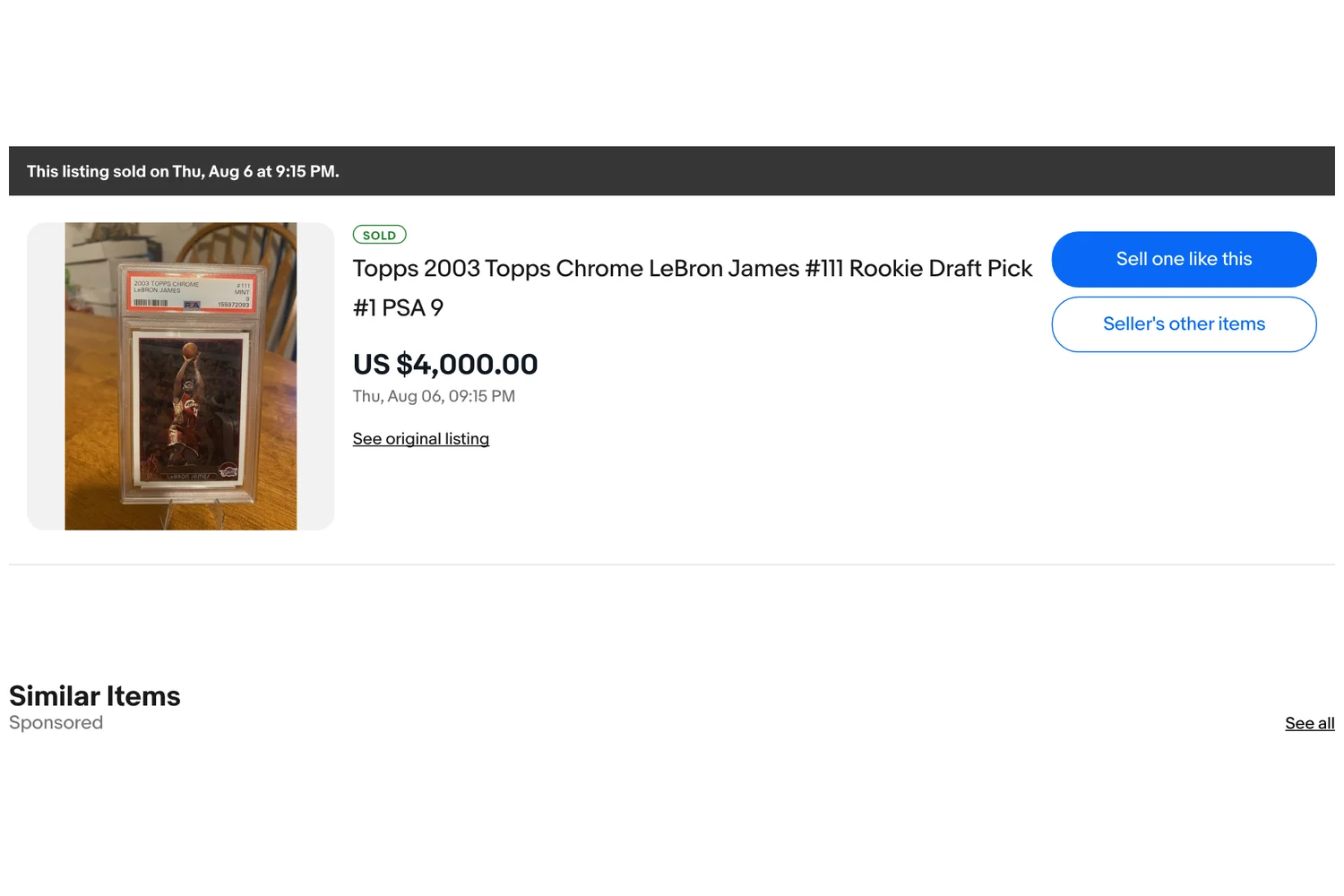
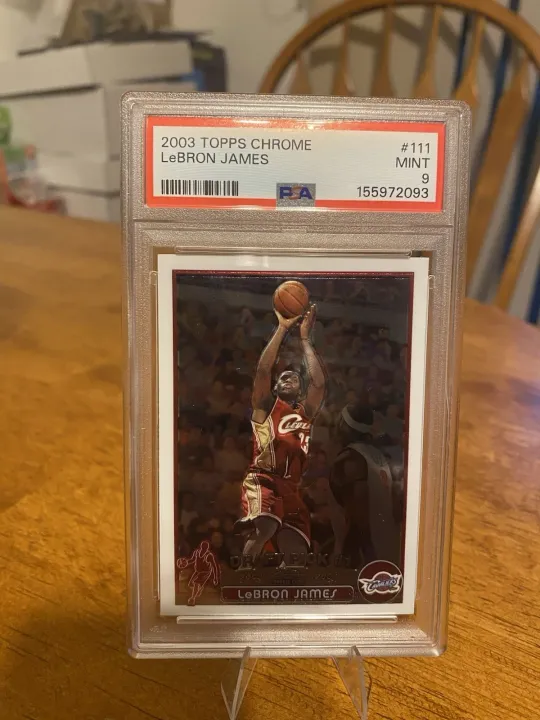
The fastest one is the clearest case. On August 7 at 4:13 UTC a seller with a few thousand feedback listed a 2003 Topps Chrome LeBron James #111 PSA 9 at $4,000. Eight PSA 9 sales were on record from the prior three weeks, from $4,400 to $6,000; the alert priced it at $5,038 and called it 21 percent below. eBay's own page shows the sale time: 9:15 PM Pacific, two minutes after the alert.
A note on the spotlights that follow. Each one charts the recorded sales the pricing engine holds for that exact card and grade, and the footer states the date of the newest sale in the chart. The comp in each alert was computed from those sales on the day the alert fired, so the chart is the evidence behind the number, not today's price. The live card page behind every spotlight link carries the current data.
Real sold comps from CardboardSniper's pricing engine · 30 sales(eBay & Fanatics) · sales through Aug 5, 2026.
View live data on CardboardSniper →The chart in the spotlight is the PSA 9 sales history for this card through August 5, straight from the pricing engine. Trace the summer and the $4,000 listing sits under every sale from late July and early August. Whoever bought it did not need to open a single sold listing, because the comp was already in the alert. That is the entire point of pricing against sold data instead of a number you typed in.
Small Gaps Clear Fast: The 1990 Fleer Jordan Pair
Two 1990 Fleer Michael Jordan #26 PSA 10s listed 8 and 10 percent under the $817 comp in the same week, and both were gone within a day. Fourteen PSA 10 sales were on record for July, from $660 to $825, with most of them between $750 and $810. A $749.99 Buy It Now is not a flip, it is a collector discount, and on a card with this much liquidity a collector discount clears in hours because dozens of people want the card at the comp. The $739 copy on July 25 lasted 19 hours; the $749.99 copy on July 27 lasted 11.
Real sold comps from CardboardSniper's pricing engine · 73 sales(eBay & Fanatics) · sales through Aug 19, 2026.
View live data on CardboardSniper →The PSA 9 of the same card tells the speed story in miniature. Its comp was $92, built from July sales of $60 to $95. A copy listed at $59.99 on July 27 at 18:12 UTC was gone by 18:40. Twenty eight minutes, on a sixty dollar card. The gap was 35 percent and the buyer did not deliberate.
Vintage Pokemon Moves the Same Way
A 1999 Fossil Zapdos Holo 1st Edition PSA 9 listed at $550 against an $897 comp on September 14 and sold inside a day. A 2002 Expedition Kingler Holo PSA 9 at $497.55 against an $893 comp took five days, which is normal for a card that trades a few times a month instead of a few times a week. The pattern is the same as the sports cards: the bigger the gap on a card people actually want, the shorter the window.
One honest caveat for the vintage Pokemon rows. Sports comps rest on dozens of sales a month; WOTC era holos at a specific grade and printing trade less often, so their comps rest on fewer sales and move more between refreshes. The two cards above cleared quickly, which is the market agreeing with the gap, but on a thinner card treat a 40 percent gap as a prompt to check the sales behind it rather than a verdict. The 30 second routine further down is built for exactly that.
The Listing the Seller Pulled
Twice in five weeks a seller listed a 2003 Topps LeBron James #221 PSA 10 more than a quarter below seven recorded July sales, and twice the seller ended the listing within three days citing an error. The July sales ran $6,999 to $7,999 and the comp was $7,666. The August 22 copy listed at $4,550, 41 percent below, and was ended 40 hours later. The September 22 copy listed at $5,600, 27 percent below, and was ended after 62 hours. Translation: the seller noticed the mistake. The window between a listing going up and the seller noticing is the window a sold-price alert is built to hit, and for 40 hours this one was open.
Real sold comps from CardboardSniper's pricing engine · 30 sales(eBay & Fanatics) · sales through Jul 17, 2026.
View live data on CardboardSniper →Worth naming: most of the catches on this page came from sellers with hundreds or thousands of feedback. Mispricing is not a scam signal. It is usually a seller pricing from memory, from a stale guide, or from the wrong grade, and the fix on the seller's side is to end the listing, which is exactly what happened here.
Alert to Gone: How Long the Window Stays Open
Of the eight Buy It Now receipts, five were gone within a day and two within half an hour. The chart puts every receipt on one log scale, from the two minute LeBron to the five day Kingler. Orange bars are under an hour, blue under a day. A saved search digest that arrives at most once per day lands after every orange and blue bar, which is the structural reason a sold-price alert has to check continuously rather than daily.
Orange is under an hour, blue is under a day, grey is longer. The two LeBron #221 bars are listings the seller ended citing an error, so the bar is how long the mistake was buyable. A daily saved-search digest lands after every orange and blue bar on this chart.
Auctions Below Comp Are Not Deals Yet
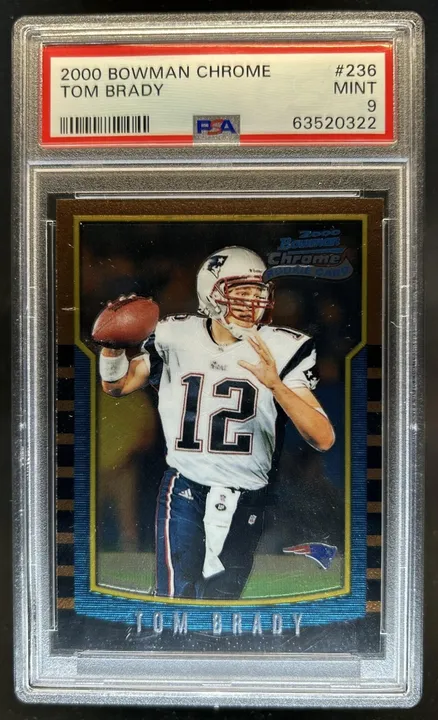
An auction sitting far below comp with days left is a bid, not a price. The scanner flags auctions too, and the honest finding from four August auction alerts is that every one closed at or near the comp. The Brady Bowman Chrome PSA 9 looked 42 percent below when it was flagged with five days left; it closed at $13,401, above the comp, because July sales had run $12,150 to $15,000 and the market found it. The LeBron Chrome PSA 10, the Mantle, and the Trout all closed within four percent of their comps.
| Card | Alert | Bid at alert | Sold comp | Closed at | Close vs comp |
|---|---|---|---|---|---|
| 2000 Bowman Chrome Tom Brady #236 PSA 9 | Aug 2 | $5,986 | $10,317 | $13,401 (Aug 7) | 130% |
| 2003 Topps Chrome LeBron James #111 PSA 10 | Aug 4 | $12,500 | $16,150 | $16,400 (Aug 11) | 102% |
| 1958 Topps Mickey Mantle #150 PSA 4 | Aug 1 | $769 | $1,377 | $1,400 (Aug 8) | 102% |
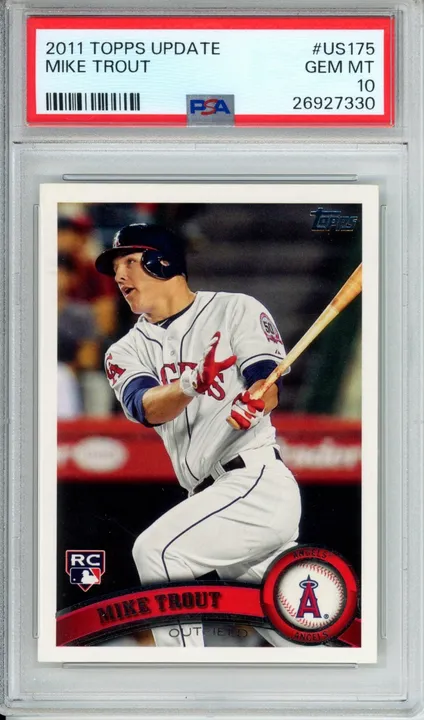
| 2011 Topps Update Mike Trout #US175 PSA 10 | Aug 15 | $615 | $980 | $937 (Aug 17) | 96% |
Every closing price is a recorded sale. The bid at the alert sat 23 to 44 percent under the comp; the closes landed between 96 and 130 percent of it. The scale is per card, so read each trio on its own.
Real sold comps from CardboardSniper's pricing engine · 89 sales(eBay & Fanatics) · sales through Aug 21, 2026.
View live data on CardboardSniper →That is not a failure of the alert. It is what liquid cards do when enough bidders see them. The useful reading of an auction alert is not the gap on the day it fires. It is the reminder to put the card on your list, set a maximum at or under the comp, and bid once in the final minute. Where auction alerts do pay is the quiet close: a bad title, a listing ending at an odd hour, a thin market where the last bidders never show up. Those closes happen every week, and you only catch them if you were already watching with a number in mind.
Real sold comps from CardboardSniper's pricing engine · 12 sales(eBay & Fanatics) · sales through Jul 19, 2026.
View live data on CardboardSniper →The Trout is the cleanest illustration of the close. July PSA 10 sales ran $1,009 to $1,250, the comp was $980, and the scanner flagged the auction on August 15 with bidding at $615. It closed two days later at $937, within five percent of the comp. The Mantle did the same: five PSA 4 sales were on record between July 12 and August 8, from $1,200 to $1,400, the alert fired on August 1 with bidding at $769, and it closed a week later at $1,400. A collector who had set a maximum at the comp and bid in the final minute would have paid market. A collector who chased the gap would have paid more.
Why the Comp Has to Be Grade Matched
The 1990 Fleer Jordan makes the case with one card: the PSA 10 comp was $817 and the PSA 9 comp was $92. A PSA 9 listed at $500 would show as 39 percent below the PSA 10 number and would be more than five times the real price of the card in hand. The LeBron Chrome #111 shows the same thing at the top end, $5,038 for the PSA 9 against $16,150 for the PSA 10. A tool that averages grades together, or pulls a headline price from a guide, cannot tell you anything useful about either listing.
A PSA 9 judged against the PSA 10 number would look 50 to 90 percent below market on every card here. The grade is the market, which is why every alert in this article was priced against sales at its own grade.
Every receipt on this page was judged against sales at its own grade from its own grader, and that is the only reason the gap column means anything. A BGS 9.5 is not PSA 10 money. A CGC 9 is not PSA 9 money. Printing matters the same way: 1st Edition, Shadowless, Unlimited, refractors and numbered parallels are separate markets, and a comp built from the scarcer printing applied to the common one is the most common way a deal alert lies to you.
How to Read a Sold-Price Alert in 30 Seconds
The alert has done the hard work. The last thirty seconds are yours. This is the routine that turns an alert into a good buy and keeps you out of the bad ones.
- Match the grade and the grader. The comp is only valid for the same grader and grade. A PSA 9 judged against a PSA 10 comp will always look like a bargain.
- Match the printing. 1st Edition against 1st Edition, Unlimited against Unlimited, the parallel against the parallel. Check the title and the slab label, not the photo thumbnail.
- Look at the sales behind the number. Three sales from this month beat one sale from last winter. If the comp rests on a single sale, or the sales are months apart, treat the gap as a hint, not a fact. Every card page on this site shows the sales so you can look.
- Read the listing like a buyer. Front and back photos, a visible cert number, a seller with feedback, returns accepted. If the deal only works because the photos are blurry, pass.
- Decide on the gap. Twenty percent or more below a solid comp on a liquid card is a buy now, not a think about it. Eight to fifteen percent is a collector discount. Sixty percent below on a trophy card is a research prompt, because it is usually a reprint, a cracked slab, or a scam.
When the comp is wrong. Every sold-price tool, this one included, is only as good as the sales it matched. The failure to watch for is a comp built from a scarcer printing or a higher grade than the listing in front of you. A listing that sits for weeks at the alert price is telling you the same thing. Verify the printing and the grade before you click buy, every time.
What 77 Days of Sold-Price Alerts Look Like
Between July 21 and October 8, 2026 the scanner flagged 8,783 distinct listings priced 8 to 60 percent below their comp; 2,642 of those were priced against a full grade-matched comp with recorded sales behind it, and every chart below uses only that set. The rest were priced from an estimate, which the alert says plainly, and are excluded here. Two thirds of the full-comp catches were Buy It Now and one third were auctions. The median gap was 34 percent and the median listing price was $499.
Each bar is the number of distinct listings flagged in that band. Auctions skew to the biggest gaps because an early bid is far below where the auction will close; the Buy It Now bars are the ones where the gap is a real price.
Mispricing is not a cheap-card phenomenon. 935 of the 2,642 catches carried a listing price above $1,000, and 310 were above $5,000.
The jump in the week of August 9 is the scanner's watch list growing from a few dozen cards to the full house list. The later weeks are the steady state: roughly 150 to 300 verified below-comp listings a week.
The spread matters more than the count. Catches did not cluster in cheap cards or in one hobby: vintage basketball, modern baseball rookies, WOTC era Pokemon and raw singles all produced below-comp listings in the same weeks. A saved search watches one query. A scanner that prices everything against sold data watches the whole board, which is why the receipts above range from a sixty dollar Jordan to a five figure Brady.
Set Up the Alert That Would Have Caught These
Each catch above came from an alert that named a specific card and grade. Not a player, not a set, the card. The tighter the alert, the cleaner the comp, and the faster you can act when it fires.
- Name the exact card, grader and grade: 2003 Topps Chrome LeBron James #111 PSA 9, not LeBron rookie.
- Set the deal threshold at 20 percent below comp for cards you want to flip, 10 percent for cards you want to own.
- Turn on instant email. A daily digest would have missed every Buy It Now catch on this page.
- Add auctions only for cards you are prepared to watch to the close, with a maximum bid already decided.
- When the alert fires, run the 30 second check and buy or pass. Do not reopen the research.
CardboardSniper watches eBay and Fanatics Collect around the clock, prices every new listing against grade-matched sold comps, and emails you within minutes when a card lists below market. Start a free 7 day trial and put the card you are hunting on the scanner tonight. The sports card alerts and Pokemon card alerts pages walk through the setup for each hobby.
Sold-Price Deal Alert FAQ
What is a trading card deal alert based on sold prices?
An alert that compares a new listing to recorded sales of the same card at the same grade, instead of to a price you typed in or to a keyword match. The alert shows the listing price, the sold comp and the gap, so you can judge the deal without opening the sold listings yourself.
How is the sold comp calculated?
CardboardSniper averages the last three sane recorded sales of the exact card, grader and grade, after trimming obvious outliers. A PSA 9 is never priced against PSA 10 sales. If a grade has no recent sales, the alert shows no verdict rather than borrowing a number from another grade.
Are the snipes on this page real?
Yes. Every row is a real listing the scanner flagged, shown with the price it listed at and the comp it was judged against. Each one was re-checked on eBay in October 2026 and against the recorded sales behind the comp; the eBay banners in the screenshots are the proof. Closing prices for the auctions are recorded sales.
How fast do underpriced Buy It Now listings sell?
Fast. In this set a LeBron Chrome PSA 9 listed 21 percent below comp sold in two minutes, a 1990 Fleer Jordan PSA 9 was gone in 28 minutes, and two Jordan PSA 10s listed under 10 percent below comp were gone within a day. eBay saved search emails arrive at most once per day, which is after the window closes.
Do sold-price deal alerts work for auctions?
They flag auctions, but an auction below comp with days left is a bid, not a price. The four auction alerts on this page closed at 96 to 130 percent of the comp. Use the alert to put the card on your list and set a maximum bid, and treat quiet closes on thin markets or bad titles as the real opportunity.
What if the comp is wrong?
It happens, usually when sales from a scarcer printing or a higher grade get matched to the listing. Check that the grader, grade and printing match before you buy, and look at how many sales sit behind the number. A listing that stays unsold for weeks at the alert price is a sign the comp is stale.
Is buying an underpriced listing fast considered sniping, and is it allowed?
Buying a mispriced Buy It Now listing quickly is simply buying, and last second auction bidding is allowed on eBay, including software that places bids for you. Neither is a loophole. The only edge is seeing the listing first and knowing the comp cold. The full policy question is covered in is eBay sniping allowed.
Put the receipts to work: the comp method explains the number inside every alert, the free card value checker shows the grade-matched comp for any slab, and the live alert feed is where the next one of these surfaces.